Live data from Hacker News

The Elusive Peril of Space Junk

newyorker.com

31–40 of 42 posts

Re: The Elusive Peril of Space Junk

#31

In the discussion of space junk, and kessler syndrome, there is a large bias that needs to be addressed. Most commentators operate under the impression that most of the stuff up there is "junk" from human activities, that space was essentially clean until we got there. It wasn't. It isn't. There are literally tons of natural rock falling onto earth every day. By some measurements over 100 metric tons per day. That is…

True, but generally most the "natural" debris are much smaller objects (micro-meteoroids). These are on the order of micrometers in size. Smaller micro-meteoroids are much more prevalent [0]. These do still cause damage to spacecraft but it is on a much smaller scale. The effects are typically things like cracked solar arrays, tears in multi-layer thermal insulation. This is still a a concern and when things like meteor showers occur some spacecraft will try and optimize the orientation of their solar arrays so that they are not normal to the ram direction (i.e. the solar arrays are facing in the direction of travel which gives a greater chance of hitting something at high velocity)

Larger debris does tend to come from satellites. And things such as satellite collisions cause a noticeable effect on the number of objects (of a size that we can track) [1].

[0] https://www.nap.edu/openbook/0309051258/xhtml/images/img0001...
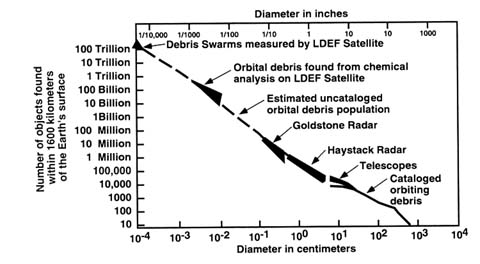
[1] https://en.wikipedia.org/wiki/Space_debris#/media/File:Space...

Re: The Elusive Peril of Space Junk

#32

The show The Expanse has some interesting scenes involving loose items inside ships as well as junk/ballistics ripping through ships that this reminded me of. Interesting to see that fiction was inspired by the reality.

It's a shame that only plotty debris is addressed in The Expanse. What about the front of the ship colliding with uncharted rocks at 1800km/s?

Makes me wonder if sane interstellar travel requires a warp drive in order to bend debris around the vehicle. See the speculated UFO propulsion observed in the USS Nimitz incident.

Re: The Elusive Peril of Space Junk

#33

I approach these articles from a point of skepticism (but still open minded). It seems to me to any venture mankind takes on has to fit into this narrative of man sinning against nature. It’s kind of like original sin for non religious folks. Kessler syndrome is the example of this for space. It’s hard to find arguments against man expanding into space but oh wait you could pollute low earth orbit so better stay on e…

It's a popular narrative amongst the 'intellectual' class in the US, which traces its roots back to the initial wave of Puritanism in New England. It's easy to trace the path from Mather to Emerson/Thoreau to Silent Spring. This is also why American Liberalism is different from anything a European would call Liberalism- hard to get too worked up about the plight of the proletariat when deep down you secretly believe the dirty sinners must deserve it.

Re: The Elusive Peril of Space Junk

#34

In the discussion of space junk, and kessler syndrome, there is a large bias that needs to be addressed. Most commentators operate under the impression that most of the stuff up there is "junk" from human activities, that space was essentially clean until we got there. It wasn't. It isn't. There are literally tons of natural rock falling onto earth every day. By some measurements over 100 metric tons per day. That is…

>Why has the ISS not been sandblasted after 20+ years in orbit?

While "sandblasted" might be hyperbolic, micrometeoroid and orbital debris (MMOD) is a known risk to the ISS and they have a variety of shields to try on protect it.[1]

[1]https://www.nasa.gov/sites/default/files/files/E_Christianse...

Re: The Elusive Peril of Space Junk

#35
post #20

Earlier quoted context omitted.

Yes but it's so slow on Firefox for Android that it constantly overs rolls. Very hard to read because it keeps jumping to the wrong place.

Disable javascript, and it stops being a vanity art project, and magically turns into a web article. Some people should not be allowed near web publishing.

I used to make sites like this as a full time job; yeah until technology advances enough to make the jank disappear completely it's just a vanity project, it actually detracts from the substance of the article

Re: The Elusive Peril of Space Junk

#36

I approach these articles from a point of skepticism (but still open minded). It seems to me to any venture mankind takes on has to fit into this narrative of man sinning against nature. It’s kind of like original sin for non religious folks. Kessler syndrome is the example of this for space. It’s hard to find arguments against man expanding into space but oh wait you could pollute low earth orbit so better stay on e…

But we have been "sinning" against nature, eh? I mean, the record of human history is the record of the destruction of the bounty of nature.

In the USA we had herds of bison that took days to pass by, clouds of birds that blocked out the sun, rivers so thick with fish you could walk across them, trees so huge they break the mind, and all of it was destroyed with hardly a thought. We took the Great Plains and made the Dust Bowl.

Today our industrial agriculture creates dead zones in the oceans, our energy system is toxic, oil spills regularly destroy life over vast areas, we are fishing the oceans to death, and about to start mining the sea floors, our topsoil is blowing and washing away, I could go on and on.

Re: The Elusive Peril of Space Junk

#37

> “People are not really worrying about this, because it is inconvenient to act responsibly,” Darren McKnight, who works as a technical director at the aerospace-services company Centauri, told me. Reading this article about space garbage just after reading the article about plastic garbage also currently on the HN front page was interesting and the quote could have fit well into the other article, too. Our species s…

Yes, space debris is a problem and we are likely not doing enough to keep up with the growth of the space industry. But I dislike the rhetoric of "People are not really worrying about this..."

This was really true in the early arenas of space and we can still see the effects of that today. But every person that launches a satellite now in order to get a communications license for their satellite from the FCC or the ITU has to prove that their satellite will de-orbit within 25 years. With the start of the mega-constellations there have been discussions about tightening this rule [0]. Chief among the people who want to tighten the rule is the US DoD. When you invest a whole lot of money in putting something up in to space you want to make sure it is going to survive. So there are significant number of people working on tighter restrictions for future satellites launched in to space.

From the side of removing debris from space, there are multiple people working on technologies to remove debris from space [1]. Part of the problem here is the economics of it do not currently add up. However, considering the investment in the prevention of creating more debris the economics of this might come around soon. The other problem is the actual technology of removing debris without creating more debris. To catch a piece of debris you essentially have to maneuver a satellite "rendezvous" with the debris. Otherwise the relative velocities might turn an instance of "catching debris" in to "debris collision". Maneuvering between objects takes fuel which means more mass launched and more money to remove something smaller.

[0] https://breakingdefense.com/2020/04/fcc-reconsiders-tighteni...

[1] https://www.nanalyze.com/2019/06/space-debris-removal/

Re: The Elusive Peril of Space Junk

#38

> “People are not really worrying about this, because it is inconvenient to act responsibly,” Darren McKnight, who works as a technical director at the aerospace-services company Centauri, told me. Reading this article about space garbage just after reading the article about plastic garbage also currently on the HN front page was interesting and the quote could have fit well into the other article, too. Our species s…

> Our species seems incredibly good at making things and incredibly bad at cleaning up.

I think it's fundamentally an entropic phenomenon. You mine rocks (easy rel.), then you refine them into minerals (less easy) and materials, then you arrange those into complex objects with perhaps thousands of materials (difficult).

Obs: difficulties vary with material, product, etc.

Finally, reverting this complex arrangement back into materials (very difficult) generally has at least as much energy cost as manufacturing did. If you were religious about it, it would probably take orders of magnitude more energy (trace materials add the difficulty); the cost would probably scale as a function of purity (99% purity easy, 99.999% purity hard), diverging to infinity as you approach 100% purity.

We have a discount because the purity of rocks we can easily find is generally greater than the purity left by our complex products. So we can just discard everything. Eventually, this will catch up to us. Eventually productive mineral deposits (for some select elements first) will get increasingly hard to access, and we'll be forced into processing our own waste to obtain it. It seems our energy costs will grow and grow.

What is truly incredible is that organic life has managed to largely enter a steady state into this process. Every substance used by life has a cycle (usually some lifeform plays a role in that cycle), from water to carbon, to sulfur, nitrogen, and so on. Organic life has entered a steady state of recycling its own waste, assembling itself from ashes of its ancestors. Life tolerates impurity very well. This is all driven by sunlight.

Maybe technological civilization can approach it as well. In time, we'll certainly have to (or face perish).

Re: The Elusive Peril of Space Junk

#39
post #20

Earlier quoted context omitted.

Yes but it's so slow on Firefox for Android that it constantly overs rolls. Very hard to read because it keeps jumping to the wrong place.

Disable javascript, and it stops being a vanity art project, and magically turns into a web article. Some people should not be allowed near web publishing.

I strongly disagree with this view -- the art is precisely what drew me into this article. Of course the content is the center here, but it adds so much. I wouldn't remember a generic article on Space Junk, but I'll sure remember this for a long time.

It's really important that it adds to the experience. It should have been tested on low performance devices, and so on. (I'm designing a few websites with those concerns in mind right now)

I think one approach is benchmarking and adjusting features based on that. Don't let the perfect be the enemy of good!

Please expand your horizons on the utility of art (integrated into our daily lives). It can be far from vain.

Re: The Elusive Peril of Space Junk

#40

I approach these articles from a point of skepticism (but still open minded). It seems to me to any venture mankind takes on has to fit into this narrative of man sinning against nature. It’s kind of like original sin for non religious folks. Kessler syndrome is the example of this for space. It’s hard to find arguments against man expanding into space but oh wait you could pollute low earth orbit so better stay on e…

But we have been "sinning" against nature, eh? I mean, the record of human history is the record of the destruction of the bounty of nature. In the USA we had herds of bison that took days to pass by, clouds of birds that blocked out the sun, rivers so thick with fish you could walk across them, trees so huge they break the mind, and all of it was destroyed with hardly a thought. We took the Great Plains and made the…

That’s my point though. That narrative is already in your head because it’s the prevailing belief system. Any criticism of humanity fits neatly into it.

Here are a few things we’ve done really well on IMO that don’t fit with the narrative:

All the nations got together and fixed the ozone layer.

We created the national park system and NWR’s with surprisingly large tracts of land.

Whaling is banned in the USA and many other countries AFAIK.

No more orca shows at sea world after black fish and it seems like we’re moving in the right direction with captive whales and dolphins?

Acid rain is way better. (That was a huge deal in the 80s)

We’re getting close to completely getting off coal as a power source (in the US)

A large portion of new power capacity is renewable.

Recycling looks like it doesn’t actually work well but it’s amazing that almost every household does it in an effort to help.

Post reply on HN