Live data from Hacker News

Nuclear power: Are we too anxious about the risks of radiation?

bbc.com

571–580 of 619 posts

Re: Nuclear power: Are we too anxious about the risks of radiation?

#571

Earlier quoted context omitted.

The buried lede from that article: > But Japan relies on coal for more than a third of its power generation needs. And while older coal plants will start retiring, eventually reducing overall coal dependency, the country still expects to meet more than a quarter of its electricity needs from coal in 2030. So this decade Japan's reliance on coal power will roughly drop from 33% to 25%. To provide even more context, Ja…

> Japan's energy consumption has been falling since before the 2011 disaster That is really surprising. Can this be traced back to a cause. Some industry that closed down or did appliances and lighting got that more efficient?

It's worth pointing out that the trend is seen not just in Japan but in other major developed economies too:

https://d33wubrfki0l68.cloudfront.net/0784d9d63336606d4ca025...
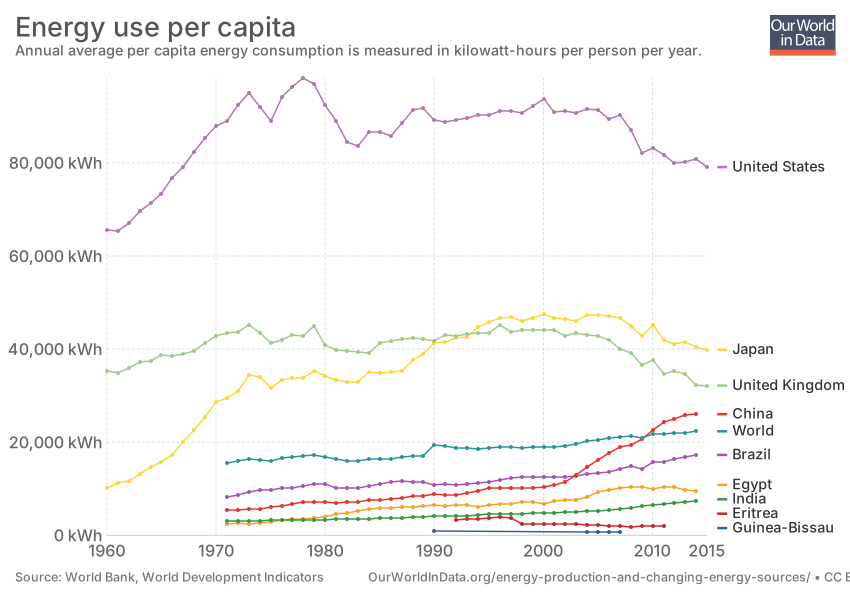
The usual explanation given is that these countries have outsourced their energy-intensive industries to other countries that have a corresponding increase in energy use, but there is reason to be optimistic even when factoring in "imported emissions" of CO2, in the UK, for example:

"While UK carbon dioxide (CO2) emissions peaked in 1972, once we consider imported emissions – such as when the UK imports products that are manufactured abroad – UK emissions peaked in 2007."[0]

Of course, peaking emissions isn't the same as peaking energy usage, but it does assuage some of the concerns about outsourcing our manufacturing to countries with "dirtier" energy like China.

[0] https://www.ons.gov.uk/economy/nationalaccounts/uksectoracco...

Re: Nuclear power: Are we too anxious about the risks of radiation?

#572

Earlier quoted context omitted.

If you're using caverns to reduce the capital cost of storing hydrogen, then you're ignoring a substantial amount of the real cost. Caverns are a geographically dependent feature, you might as well just say that we should use hydroelectricity as our main source of power.

Geological formations suitable for storage of hydrogen are quite widespread. They're basically identical to the formations that are already used to store natural gas.

Storing hydrogen is much more complicated than storing methane. Not to mention the challenge of moving hydrogen from the production location (probably close to a river), to the storage site. Hydrogen rapidly corrodes metals, turning them into metal hydrides. Hydrogen molecules are small, and they permeate through metals effectively increasing surface area. Even if storage is widespread, transport is challenging.

Hydrogen gas would be useful for things like shipping. Such gas would likely be produced close to the port through thermochemical means, powered by a nuclear plant. This would minimize the amount of pipeline that needs to be built to transfer the gas to ships.

Re: Nuclear power: Are we too anxious about the risks of radiation?

#573

Earlier quoted context omitted.

The price increased. And this increase occurred over the span of a century, not a decade.

https://jancovici.com/wp-content/uploads/2016/04/prix_petrol...

Yup, the price of oil was a steady $20/barrel from 1880 through the 1960s. Now it's $100/barrel.

Now imagine what is going to happen if the demand for batteries increases one thousand fold (which is what is necessary to make grid storage possible) over the course of a decade or two.

Re: Nuclear power: Are we too anxious about the risks of radiation?

#574

Earlier quoted context omitted.

https://jancovici.com/wp-content/uploads/2016/04/prix_petrol...

Yup, the price of oil was a steady $20/barrel from 1880 through the 1960s. Now it's $100/barrel. Now imagine what is going to happen if the demand for batteries increases one thousand fold (which is what is necessary to make grid storage possible) over the course of a decade or two.

But you said it increased! It did not.

So why will scaling up battery demand a thousand fold over the course of a decade or two make it explode in price, but scaling up nuclear plant construction five hundred fold (from two to a thousand) not do the same?

You are putting your thumb on the scales. I think we're done here.

Re: Nuclear power: Are we too anxious about the risks of radiation?

#575

Earlier quoted context omitted.

In general, due to their more recent construction, suburban homes tend to be better than average at insulation when compared to other single family dwellings. That said, given the levels of snark I'm reading I would guess things like "single family dwelling", "family", or even property ownership itself would probably be pretty hot topics for you.

I was actually very ignorant to the not very new ideas that Leftists hold about "abolishing the family", even as far back as Marx (maybe even further). Very disturbing

So is it true that Leftists want to abolish the family, or do users here simply think I'm exaggerating?

Re: Nuclear power: Are we too anxious about the risks of radiation?

#577

Earlier quoted context omitted.

I'm apparently not making myself very clear: A proposed way of shifting power demand is giving the power company some measure of control over the temperature in your house, or your hot water boiler, your freezer, the steam in your district heating's pipes, or your aluminium smelter. You define an acceptable band of temperature and the power company can choose to turn heating or cooling on or off, as long as the tempe…

You're making yourself perfectly clear, you're just wrong about the claim that smart grids will improve heating: * With my normal thermostat I set my home to be heated to 68 degrees Fahrenheit. When it falls below 68 degrees it gets heated. * With a smart thermostat I set my home to be heated to 68 degrees. When it falls below that, it gets heated. There is zero difference between the behavior of a "smart" thermostat…

No you don't understand. The power company can heat your home warmer than 68°F when the electricity is plentiful so that it can wait longer with heating when the electricity is scare.

Re: Nuclear power: Are we too anxious about the risks of radiation?

#578

With advances in long distance power transmission, I don't know why theyre not being build on desert coasts. Does anyone know? The Singapore-Australia line is about the se distance as a Western Sahara-UK line would be... https://en.m.wikipedia.org/wiki/Australia%E2%80%93ASEAN_Powe...

Probably for the reason renewable energy plants are not built there [1]: Problems of politics and stability.

[1] https://en.wikipedia.org/wiki/Desertec

Re: Nuclear power: Are we too anxious about the risks of radiation?

#579
post #245

Earlier quoted context omitted.

There will be no useful fusion power produced on Earth in this century, at least in a Tokamak. Tokamak fusion is a jobs program for high neutron flux physicists, to maintain a population to draw on for weapons work. It does not need to produce other results.

The first part is very likely wrong. Fusion won’t be a major grid player in this century and by extension may be “too late” for meaningful climate change. However, we may be more fucked than people think. Seasonal energy storage (10^14 Wh scale) has no solutions. Where are the low carbon alternatives to base load power production? The second part is entirely wrong. That only applies to IEF programs in the US. NIF is…

You seem to be saying that all that is needed to conceal weapons-targeted budgeting from you is to label it "EIF"?

Re: Nuclear power: Are we too anxious about the risks of radiation?

#580
post #28

Earlier quoted context omitted.

> For example, it's easy to find people who get anxious about xrays but not about flying even though it gives you roughly the same amount of exposure. A 7 hour flight gives you 1/5th (.02 mSv- 2000x daily background exposure) as much as a chest xray and 1/350th as much as a chest CT. They're only similar if you fly relatively often, and if you get any kind of CT you need to fly a LOT to make them comparable. Your exa…

https://agupubs.onlinelibrary.wiley.com/doi/full/10.1002/201... says: During times of calm space weather, travelers on flights from say, Chicago to Beijing, over the north pole get the equivalent radiation dose of a chest X‐ray (~0.1 mSv) [e.g., Meier et al., 2009; Bennett et al., 2012, 2013; Joyce et al., 2016; Tobiska et al., 2016].

I guess 'Chicago to Beijing over the north pole' can hardly be considered as standard for 'flying' ...
Post reply on HN