Ok, this is a crazy comment, but I have been playing Microsoft Flight Simulator 2020 a lot and almost every piece of land has something, somewhere built on it. Farm, suburb, etc It's depressing but maybe it helps me understand that we are using too much of earth. Do we really need endless farms?
Wildlife in ‘catastrophic decline’ due to human destruction, scientists warn
51–60 of 277 posts
Re: Wildlife in ‘catastrophic decline’ due to human destruction, scientists warn
#52Earlier quoted context omitted.
I believe in the contiguous USA the furthest you can get from a road is only 20 miles. There are no undisturbed places left, really. Unfortunately preserving roadless areas is politically contentious here. Clinton enacted a roadless area rule at the end of his administration and Bush tried to reverse it a week later.
Not sure I believe the 20 miles thing unless you could count an old road that hasn't been used in 100 years as "developed". There are massive swaths of land in the lower 48 that are pretty much untouched beyond a few footpaths that are rarely used.
Re: Wildlife in ‘catastrophic decline’ due to human destruction, scientists warn
#53I think the future is very grim for biodiversity. Even if we stopped destroying habitats tomorrow, many larger animals are already living in small, isolated pockets surrounded by roads, farms, and industry. Meanwhile, plants and smaller animals face intense competition from invasive species - often brought in by accident thanks to the constant flow of goods around the globe. We're probably headed for a pretty homogen…
That might be over pessimistic as "95% Of The World's Population Lives On 10% Of The Land" https://www.sciencedaily.com/releases/2008/12/081217192745.h...
According to the IPCC, humans have transformed _more than 70%_ of all ice-free land if you take stuff like agriculture into account.
Edit: It'd seem that I've had remembered outdated figures.
Re: Wildlife in ‘catastrophic decline’ due to human destruction, scientists warn
#54I think the future is very grim for biodiversity. Even if we stopped destroying habitats tomorrow, many larger animals are already living in small, isolated pockets surrounded by roads, farms, and industry. Meanwhile, plants and smaller animals face intense competition from invasive species - often brought in by accident thanks to the constant flow of goods around the globe. We're probably headed for a pretty homogen…
That might be over pessimistic as "95% Of The World's Population Lives On 10% Of The Land" https://www.sciencedaily.com/releases/2008/12/081217192745.h...
Re: Wildlife in ‘catastrophic decline’ due to human destruction, scientists warn
#55I think the future is very grim for biodiversity. Even if we stopped destroying habitats tomorrow, many larger animals are already living in small, isolated pockets surrounded by roads, farms, and industry. Meanwhile, plants and smaller animals face intense competition from invasive species - often brought in by accident thanks to the constant flow of goods around the globe. We're probably headed for a pretty homogen…
That might be over pessimistic as "95% Of The World's Population Lives On 10% Of The Land" https://www.sciencedaily.com/releases/2008/12/081217192745.h...
The amount of land we live on is tiny compared to the amount of land we use.
Re: Wildlife in ‘catastrophic decline’ due to human destruction, scientists warn
#56I think the future is very grim for biodiversity. Even if we stopped destroying habitats tomorrow, many larger animals are already living in small, isolated pockets surrounded by roads, farms, and industry. Meanwhile, plants and smaller animals face intense competition from invasive species - often brought in by accident thanks to the constant flow of goods around the globe. We're probably headed for a pretty homogen…
Our living environments create opportunities for well-adapted species to flourish. This will certainly shift the makeup of our planet's biodiversity.
You mention all of this in passing, but I think these effects make the prognosis on biodiversity somewhat less than "very grim".
Re: Wildlife in ‘catastrophic decline’ due to human destruction, scientists warn
#57Earlier quoted context omitted.
Not sure I believe the 20 miles thing unless you could count an old road that hasn't been used in 100 years as "developed". There are massive swaths of land in the lower 48 that are pretty much untouched beyond a few footpaths that are rarely used.
Yeah, I'm pretty sure that statistic includes every Forest Service road on the books.
https://www.google.com/maps/@39.7775746,-122.9327754,2401a,3...
Re: Wildlife in ‘catastrophic decline’ due to human destruction, scientists warn
#58Earlier quoted context omitted.
We got a lot of people to feed. The only right way to stop/reverse climate change is to control population growth. Others ways, like reducing each individual’s carbon footprint or clean energy just gives us excuse to breed more and overwhelm the planet, but later.
Completely disagree. Tje richest 10% of the world is responsible for 50% of CO2 output. I don't know about other metrics, but that I'm sure that pattern isn't just limiter to carbon footprint. We don't have a population problem. We have a problem with Greer and resource use that slashing ourr population - even drastically - will not in any way solve.
The poorest 50% of the world would absolutely love to emit more CO2, and will do so just as fast as they can acquire the resources.
I don't think any steps to limit population growth really need to be taken, however, other than two things which are good in and of themselves: women's education, and improving access to birth control.
But concerns about Earth's carrying capacity need to be taken seriously. Malthus is wrong right up until he isn't, and we should strive to avoid hitting that limit.
Re: Wildlife in ‘catastrophic decline’ due to human destruction, scientists warn
#59Earlier quoted context omitted.
Second reply: Impact = Population * Affluence * Technology. The problem is not rising population, it's rising affluence and inert technology. As people earn more, they consume more in general, and more of environmentally harmful products like meat, cars, and plane trips in particular. Meanwhile we're not improving core technologies quickly enough. We make buildings using Portland cement. Cement making is responsible…
> Cities are badly designed for pedestrians. Eh every large city I've been to that isn't in US or Canada is extremely pedestrian friendly. To the point of being actively nicer and easier to navigate by foot than by car. Even NYC and SF are way faster to navigate by foot/bike than by car. I've stopped using Uber in SF because it's faster (and cheaper) to get places with a rented bike.
Re: Wildlife in ‘catastrophic decline’ due to human destruction, scientists warn
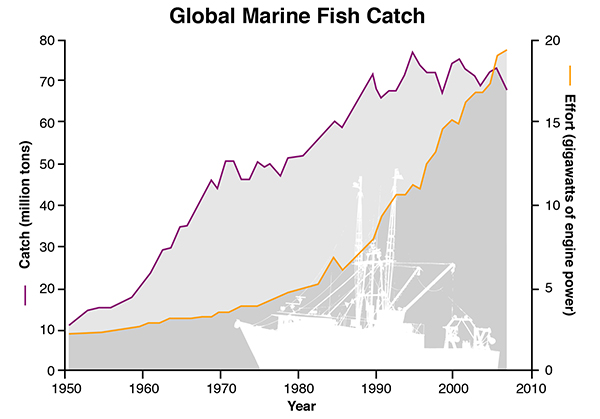
#60https://reefresilience.org/wp-content/uploads/graph02.jpg
It shows rate of fishing has plateaued or declined but importantly, "effort" continues to climb so I imagine cost should provide a natural limit.