Live data from Hacker News

Why is there a normal galaxy sitting at the edge of the Universe?

syfy.com

151–160 of 252 posts

Re: Why is there a normal galaxy sitting at the edge of the Universe?

#151

Earlier quoted context omitted.

Sorry for also asking a space 101 question, but since the fabric of space is expanding, does that mean that things are getting bigger as well? Naively, it would seem that way. In your balloon example, the dots would get bigger.

Not in practice. In practice, this provides a very tiny force pulling subatomic particles apart in an atom's nucleus, or pulling atoms away from each other in a molecule, or pulling a celestial body's molecules away from each other. It makes no difference at all, because that force is absolutely dwarfed by the strong nuclear force, electromagnetism, or gravity, respectively. Systems that are coupled together by those…

Does that expansion provide potential energy by creating space between attractive bodies? If so how do you account for conservation of energy?
Re: Why is there a normal galaxy sitting at the edge of the Universe?

#152

Earlier quoted context omitted.

>"space itself is expanding (into what? nobody knows)" I have a terrifying theory on this (granted, the Earth will be long gone). What if the universe is not actually expanding in the sense that it is being propelled by an initial explosion, but instead falling towards a much greater mass - the end of time so to speak, where all mass ends. Considering that gravity is a "weak force", the scale of such a mass makes me…

From my layman's perspective, I think this is plausible, and many physicists seem to agree it's plausible. Maybe another plausible explanation could be the reverse: maybe before the Big Bang, our/the universe was in the state you describe, and the Big Bang is our perception of it "snapping back" and exploding violently outward (aka a white hole). Carlo Rovelli and others propose that black holes actually only appear…

> Carlo Rovelli and others propose that black holes actually only appear as they do to us due to the extreme time dilation, and similar to how a photon's "perspective" is that it's experiencing all of time at once, a black hole's perspective is that it's basically a massive explosion that occurs at essentially the same moment it forms. So under this hypothesis, a black hole never reaches a true singularity, but as close to a singularity as physically possible, and then it almost instantaneously bounces back like a taut rubber band that's stretched back as far as it'll go. From our perspective on the outside, it's an intense explosion occurring in very slow motion, and from the perspective on the inside, it's an intense explosion happening all at once.

I’ve been yelling like a crank for a while that a black hole is actually a massive explosion we see in (ultra) slow motion, so it’s really cool to hear I’m not alone, and that other people call it a “planck star”. I haven’t heard anyone connect that to the big bang being a white hole, but it does make a lot of sense, even if we currently have no direct observable evidence or even any theoretical predictions.

Thanks for sharing, now I can follow along the research.

Re: Why is there a normal galaxy sitting at the edge of the Universe?

#153

Earlier quoted context omitted.

The problem with that model is that as was previously said, the electromagnetic, nuclear, and gravitational forces easily countermand the expansion on non-inter-galactic scales, to the point of not being measurable on the scale of a meter. Ultimately the molecular structure of your meter-stick is determined by various structure constants that aren’t changing, so the expansion can’t affect it unless it starts ripping…

> Ultimately the molecular structure of your meter-stick is determined by various structure constants that aren’t changing Really? These structure constants never involve any units of distance? Isn't distance changing at all levels? If I have a meter stick, and then space expands by 10%, you're saying that my meter stick will end up being 0.91 new-meters long, yes? Wouldn't that require the structure constants to cha…

It's not the idea of a meter that's expanding. It's the physical space that starts out a meter long/deep/wide that's expanding.

The meter-long stick you put into that space to measure it is still one meter long at some time in the future because the force that pulls the space apart (dark energy) doesn't pull on the matter that makes up the meter stick strong enough to overcome the forces that hold the stick together. But even if it did, the idea of one meter hasn't changed its definition. It's just the tool you used to measure one meter has broken.

Re: Why is there a normal galaxy sitting at the edge of the Universe?

#154
post #59

All right hackernews. Genuine question, not sure where else to ask. If galaxies and stars at the other “end” formed out of matter resulting from the big bang, just as the matter we are made of, how did we get here at the same time that that matter got there? Is it because speeds faster than light are possible, and around the big bang all matter was spread near instantly at that speed? I don't understand how matter of…

this is because things aren’t ‘moving apart’— space itself is expanding (into what? nobody knows). it’s not that the galaxies are being propelled apart from a force in a particular place either; everything is expanding away from everything else . On the traditional balloon model, the surface of the balloon represents space itself. Those dots on the surface of an expanding balloon are not moving relative to space (the…

[deleted]

Re: Why is there a normal galaxy sitting at the edge of the Universe?

#155

Earlier quoted context omitted.

Interesting analogy. So in effect to someone “watching” from outside our universe anything moving at the speed of light in our context, is moving either faster or slower than the speed of light in their context. Since the ballon and everything inside is expanding it means that either things are moving at the speed of light + speed of expansion, or speed of light - speed of expansion, when watched from outside. Assumi…

Since there's no frame of reference outside the universe, you can't make that analogy. I think you're getting tripped up on a variation of this idea, e.g. moving a laser pointer across the moon's surface faster than light. https://www.universetoday.com/109147/how-a-laser-appears-to-...

> Since there's no frame of reference outside the universe

That's unknown. The observable universe is all we know for sure and there's evidence that there is both something beyond what we can observe, which conforms to what we know as space and matter, and something beyond that (whatever existed around the big bang locality).

Re: Why is there a normal galaxy sitting at the edge of the Universe?

#156

Earlier quoted context omitted.

Since there's no frame of reference outside the universe, you can't make that analogy. I think you're getting tripped up on a variation of this idea, e.g. moving a laser pointer across the moon's surface faster than light. https://www.universetoday.com/109147/how-a-laser-appears-to-...

> Since there's no frame of reference outside the universe That's unknown. The observable universe is all we know for sure and there's evidence that there is both something beyond what we can observe, which conforms to what we know as space and matter, and something beyond that (whatever existed around the big bang locality).

>there's evidence that there is something beyond what we can observe

By definition, there can't be. Evidence implies something we can observe, which would mean it isn't beyond the observable universe.

Re: Why is there a normal galaxy sitting at the edge of the Universe?

#157

Earlier quoted context omitted.

It would be interesting to hear your answer to mekkkkkk‘s question

I didn't really understand mekkkkkk's question, but I wrote up a longer reply here at your prompting: https://news.ycombinator.com/item?id=24424626

Thank you.

If I understand what you’ve written already, the essence of the answer in terms of mekkkkkk’s question (for reference: “ Sorry for also asking a space 101 question, but since the fabric of space is expanding, does that mean that things are getting bigger as well? Naively, it would seem that way. In your balloon example, the dots would get bigger.”), I think the answer would be:

Anything held together (for example by gravity, or the force that keeps out atoms together) is not growing along with the universe simply because those forces are (for now) stronger than the expansion.

This does produce an interesting side question though: aren’t we (humans) shrinking in relation to the universe? Or, without the click-baity phrasing: isn’t the universe growing without us?

Re: Why is there a normal galaxy sitting at the edge of the Universe?

#158
post #2

Nice gravitational lens observation! We're hoping to use the same technique with the Sun to observe exoplanets by launching a fleet of small satellites to 547 AU (80 billion km / ~3 light days). The craft would sample the distorted Einstein ring around our Sun from that vantage point, then combine and reconstruct an image of the disk of an Earth-like exoplanet up to 100 light-years beyond, at a resolution of 25 kilom…

25 kilometers per pixel is incredible resolution for something that far away!

That would be tremendous.

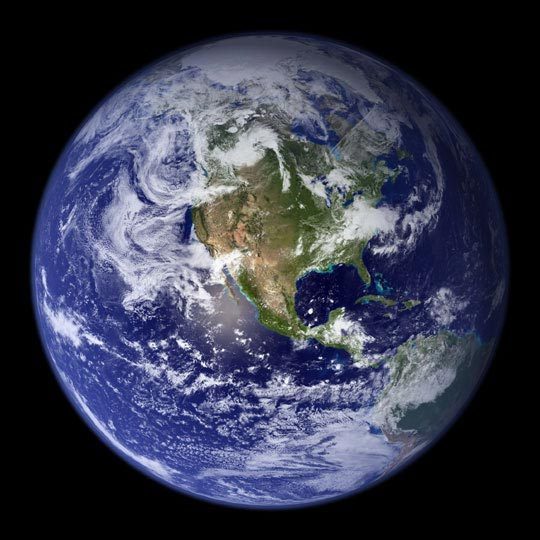
Earth is 12700 km in diameter, so such an image would be a bit more than 500px across.

Here is a picture of the Earth that is about 500px in diameter: https://cdn.mos.cms.futurecdn.net/3upZx2gxxLpW7MBbnKYQLH.jpg

Re: Why is there a normal galaxy sitting at the edge of the Universe?

#159

Earlier quoted context omitted.

>"space itself is expanding (into what? nobody knows)" I have a terrifying theory on this (granted, the Earth will be long gone). What if the universe is not actually expanding in the sense that it is being propelled by an initial explosion, but instead falling towards a much greater mass - the end of time so to speak, where all mass ends. Considering that gravity is a "weak force", the scale of such a mass makes me…

From my layman's perspective, I think this is plausible, and many physicists seem to agree it's plausible. Maybe another plausible explanation could be the reverse: maybe before the Big Bang, our/the universe was in the state you describe, and the Big Bang is our perception of it "snapping back" and exploding violently outward (aka a white hole). Carlo Rovelli and others propose that black holes actually only appear…

>So under this hypothesis, a black hole never reaches a true singularity, but as close to a singularity as physically possible, and then it almost instantaneously bounces back like a taut rubber band that's stretched back as far as it'll go.

Kind of like a graph of 1/x, where everything behaves predictably, but there's that one point that doesn't fit?

Re: Why is there a normal galaxy sitting at the edge of the Universe?

#160
post #2

Nice gravitational lens observation! We're hoping to use the same technique with the Sun to observe exoplanets by launching a fleet of small satellites to 547 AU (80 billion km / ~3 light days). The craft would sample the distorted Einstein ring around our Sun from that vantage point, then combine and reconstruct an image of the disk of an Earth-like exoplanet up to 100 light-years beyond, at a resolution of 25 kilom…

Your link suggests the satellites word need to be around 2000 AU to avoid the corona, though I suppose the delta v requirements would be pretty small for such a large change so far from the sun (but my only source for the intuition is kerbal so take it with a grain of salt).
Post reply on HN