> But it wasn’t strictly an “everything is bigger in Texas” ethos that caused Houston to sprawl the way that it does. Rather, Cold War–era urban design philosophy in the U.S. prioritized sprawl because older cities that had urbanized pre–World War II—New York, Chicago, Philadelphia, and Detroit—were seen as being susceptible to nuclear strikes. Less-dense cities such as Los Angeles and Houston were less likely to be…
Interchange in Houston is the same size as an entire city center in Italy
171–180 of 570 posts
Re: Interchange in Houston is the same size as an entire city center in Italy
#172The elephant in the room is the assumption that _everyone wants to be stacked on top of each other_. I do agree that designing cities around cars has ruined a lot of nice places though.
> assumption that _everyone wants to be stacked on top of each other_ It's also an assumption that everyone wants to begin and end every trip, no matter how trivial, with a parking spot. It's an assumption that people will want to drive in traffic for 20 minutes minimum to get to a supermarket, do anything with their kids, or anything outside their property line. The notion of "stacked on top of each other" has unple…
I wouldn't be surprised to find some suburbs with some of the traits you mention, but it hasn't been my experience with them. I've lived in about 5 different suburbs in my life and a supermarket has never been more than 2 miles away - certainly not a 20 minute drive and it's even within biking distance. Parks are by schools and there's usually an elementary school fairly close if you're looking to do something with your kid. Depending upon the suburb you can also play in the street, which I regularly did growing up.
The traits you are talking about sounds more like a rural area than a suburban one.
Re: Interchange in Houston is the same size as an entire city center in Italy
#173Earlier quoted context omitted.
This sounds fairly dubious. There was a period between sub-megatonne pure fission warheads being standard and multi-megatonne 'hydrogen' ones, but it was under a decade. That seems like a very narrow window to change how cities were planned.
Urban sprawl happened because people were tired of living on top of each other, and cities that had the room to expand used it. There was also another name used for that sprawl, white flight. I think we're seeing some of the results of that today.
Re: Interchange in Houston is the same size as an entire city center in Italy
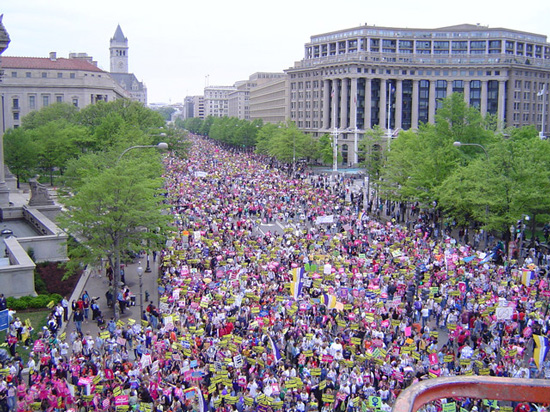
#174It's interesting that protests generally happen in dense parts of cities. Now imagine a city without a dense part - protesting becomes more difficult. Myanmar's non-democratic military government actually moved their capital from a dense city to a new city so spread out and with no downtown area - potentially to prevent the ability to protest the government. https://www.independent.co.uk/travel/inside-burma-s-ghost-t…
People can drive to the location of the protest. Less dense means more transportation, protests could also mean blocking off major freeways.
https://upload.wikimedia.org/wikipedia/commons/8/87/March_fo...
Re: Interchange in Houston is the same size as an entire city center in Italy
#175Earlier quoted context omitted.
> assumption that _everyone wants to be stacked on top of each other_ It's also an assumption that everyone wants to begin and end every trip, no matter how trivial, with a parking spot. It's an assumption that people will want to drive in traffic for 20 minutes minimum to get to a supermarket, do anything with their kids, or anything outside their property line. The notion of "stacked on top of each other" has unple…
> It's also an assumption that everyone wants to begin and end every trip, no matter how trivial, with a parking spot. It's an assumption that people will want to drive in traffic for 20 minutes minimum to get to a supermarket, do anything with their kids, or anything outside their property line. I wouldn't be surprised to find some suburbs with some of the traits you mention, but it hasn't been my experience with th…
I'd consider that far, far away.
My walk to the nearest train station is about one mile, takes about 15 minutes to get there on foot, and that's irritatingly far, too, considering the trip is two way and repeats every day. Something like a grocery shop should be accessible within decent walking distance, a five-minute walk or so.
A rule of thumb is that if something is far enough that I have to take the car in the first place I'll be incentivised to drive further away to a big supermarket/other big stores while I'm at it.
Re: Interchange in Houston is the same size as an entire city center in Italy
#176Earlier quoted context omitted.
Sparing Tokyo worked because Japan didn’t have the capability to retaliate. Any launching during the mid-to-late Cold War would have been a massive first strike and possibly a retaliation at the same scale. In the early Cold War it may have been a reasonable strategy, but as another poster notes that’s a very narrow window for changing how a city grows. Even if there was an effect, I’d be very surprised if the signal…
Also Japan was hit by bombs in the low tens of kilotons. Modern bombs are in the megaton range.
Re: Interchange in Houston is the same size as an entire city center in Italy
#177Earlier quoted context omitted.
> assumption that _everyone wants to be stacked on top of each other_ It's also an assumption that everyone wants to begin and end every trip, no matter how trivial, with a parking spot. It's an assumption that people will want to drive in traffic for 20 minutes minimum to get to a supermarket, do anything with their kids, or anything outside their property line. The notion of "stacked on top of each other" has unple…
> Would you feel "stacked on top of each other" in a Parisian townhouse with a magnificent shared courtyard, 12 foot ceilings, and everything you could possibly want a short walk or subway ride away? No, I wouldn't feel "stacked on top of each other" if I were a multi-millionaire in Paris. But, in the real world, your talking about putting families into 600sqft (at very best) boxes, with audible neighbors on every si…
- Warsaw
- Glasgow
- Porto
- Lisbon
- Athens (Greece)
- Berlin
- Budapest
- Barcelona (OK, this one gets pricey but is superbly laid out)
Re: Interchange in Houston is the same size as an entire city center in Italy
#178> But it wasn’t strictly an “everything is bigger in Texas” ethos that caused Houston to sprawl the way that it does. Rather, Cold War–era urban design philosophy in the U.S. prioritized sprawl because older cities that had urbanized pre–World War II—New York, Chicago, Philadelphia, and Detroit—were seen as being susceptible to nuclear strikes. Less-dense cities such as Los Angeles and Houston were less likely to be…
That would be a lot of ICBMs. The city center is not residential. Most people that work in the city center for city's like houston or LA commute from one of many different cities. Just to wipe out half of houston you would need to simultaneously strike at least a dozen different locations. The idea was, if there is a missile on the way or if other cities are being attacked, the sprawl would allow evacuating a lot of…
Re: Interchange in Houston is the same size as an entire city center in Italy
#179> But it wasn’t strictly an “everything is bigger in Texas” ethos that caused Houston to sprawl the way that it does. Rather, Cold War–era urban design philosophy in the U.S. prioritized sprawl because older cities that had urbanized pre–World War II—New York, Chicago, Philadelphia, and Detroit—were seen as being susceptible to nuclear strikes. Less-dense cities such as Los Angeles and Houston were less likely to be…
Re: Interchange in Houston is the same size as an entire city center in Italy
#180Earlier quoted context omitted.
Urban sprawl happened because people were tired of living on top of each other, and cities that had the room to expand used it. There was also another name used for that sprawl, white flight. I think we're seeing some of the results of that today.
I've always thought it was funny how whites moving from the city to the suburbs is bad (white flight) and whites moving from the suburbs to the city is also bad (gentrification).