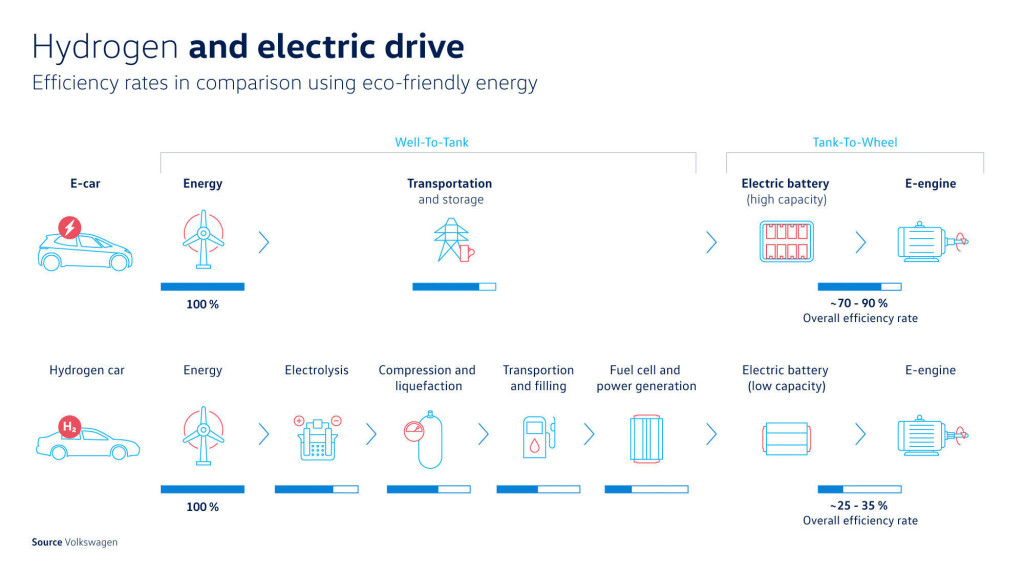
Hydrogen has an efficiency problem. You need to convert other forms of energy to hydrogen at a loss. Then you need to store it and transport it, which is costly and may impose quite some energy cost for cooling or compression. Then you need to convert it back to electricity, also at a loss. If you start at electricity, the electrical grid and batteries would be much more efficient. If you start at oil or gas, you cou…
Many of the things you're saying aren't correct, see my other comment (sibling to yours) for references. Nuclear is not cheap compared to photovoltaics, wind and hydro. Since the former two are bursty, overcapacity in them leads to cheap excess energy at times, which needs to be stored. Which storage method is the best depends on multiple factors, particularly on the duration of storage, capacity required and frequen…
I really wish that I was wrong instead of just semi-accurate and sloppy.
> Nuclear is not cheap compared to photovoltaics, wind and hydro.
The price of nuclear power is dominated by regulation. Running the power plant is quite cheap. The real cost is satisfying regulation and getting rid of the nuclear waste. If you use new reactor designs it promises to be really cheap. But currently regulation cost is so high that it's not happening any time soon. Similarly, nuclear fusion promises a lot. Maybe one day it will deliver.
My point is that IFF you have dirt cheap nuclear energy, it would be quite appealing to convert it to hydrogen (or Methane/Methanol) and to replace natural gas and oil with it. But since that is not happening, renewables will NOT deliver enough energy to replace gas and oil completely any time soon. We have a factor of 10-100 to scale up for that to happen.
> Since the former two are bursty, overcapacity in them leads to cheap excess energy at times, which needs to be stored.
Wind and solar currently rarely have overcapacity because in many nations mandated by regulations the other sources will have to go offline instead. The problem is that if you really manage to build up wind and hydro to satisfy electricity demand on average the Hydrogen generators will only utilize somewhat in the region of 10% of their design capacity in average. They need to be very cheap to run at a profit for that.
Also, if electricity is really cheap, we have a lot of uses for it. For example heating is ideally done using clean electricity. This substitution frees up a lot oil and gas that you can use instead of Hydrogen.
> Which storage method is the best depends on multiple factors, particularly on the duration of storage, capacity required and frequency of charging/discharging.
> Batteries are great for relatively short term storage, but for long term, seasonal storage, hydrogen and pumped hydro are the options we have. Pumped hydro capacity is limited, and the cost of hydrogen production and storage is coming down. So that's where hydrogen makes sense: Long term, high capacity storage.
True. But if you have enough production capacity, you don't really need storage. You only store it if it is cheaper than simply generating more power when you need it. Instead of generating Hydrogen and storing it you could use a natural gas peaker plant. You have natural gas and storage solutions already available and installed. Hydrogen has to be cheaper than natural gas.
You have some nice academic references while I only have anecdata that may be partially outdated by now. In my past experience Hydrogen and fuel cells have failed to deliver time after time, year after year while Lithium batteries have really taken off.
Look at that figure: https://ars.els-cdn.com/content/image/1-s2.0-S25424351183058...

Currently, Hydrogen is off the charts because it is too expensive but it is projected to come down and dominate the upper end in 30 years while Lithium batteries dominate all the rest. Lithium batteries are here today and the focus is on batteries. Natrium and other battery technologies may be ready by then and drop prices a further factor of 10.
I do not deny that some Hydrogen from electricity makes sense. Especially if you need Hydrogen for your chemical processes. Maybe even for storage of excess electricity (or just adding it to the natural gas instead of storing it). But I don't see Hydrogen for small vehicles anytime soon.