Live data from Hacker News

After many false starts, hydrogen power might now bear fruit

economist.com

121–130 of 343 posts

Re: After many false starts, hydrogen power might now bear fruit

#121
post #75

Hydrogen has an efficiency problem. You need to convert other forms of energy to hydrogen at a loss. Then you need to store it and transport it, which is costly and may impose quite some energy cost for cooling or compression. Then you need to convert it back to electricity, also at a loss. If you start at electricity, the electrical grid and batteries would be much more efficient. If you start at oil or gas, you cou…

Many of the things you're saying aren't correct, see my other comment (sibling to yours) for references. Nuclear is not cheap compared to photovoltaics, wind and hydro. Since the former two are bursty, overcapacity in them leads to cheap excess energy at times, which needs to be stored. Which storage method is the best depends on multiple factors, particularly on the duration of storage, capacity required and frequen…

> Many of the things you're saying aren't correct, see my other comment (sibling to yours) for references.

I really wish that I was wrong instead of just semi-accurate and sloppy.

> Nuclear is not cheap compared to photovoltaics, wind and hydro.

The price of nuclear power is dominated by regulation. Running the power plant is quite cheap. The real cost is satisfying regulation and getting rid of the nuclear waste. If you use new reactor designs it promises to be really cheap. But currently regulation cost is so high that it's not happening any time soon. Similarly, nuclear fusion promises a lot. Maybe one day it will deliver.

My point is that IFF you have dirt cheap nuclear energy, it would be quite appealing to convert it to hydrogen (or Methane/Methanol) and to replace natural gas and oil with it. But since that is not happening, renewables will NOT deliver enough energy to replace gas and oil completely any time soon. We have a factor of 10-100 to scale up for that to happen.

> Since the former two are bursty, overcapacity in them leads to cheap excess energy at times, which needs to be stored.

Wind and solar currently rarely have overcapacity because in many nations mandated by regulations the other sources will have to go offline instead. The problem is that if you really manage to build up wind and hydro to satisfy electricity demand on average the Hydrogen generators will only utilize somewhat in the region of 10% of their design capacity in average. They need to be very cheap to run at a profit for that.

Also, if electricity is really cheap, we have a lot of uses for it. For example heating is ideally done using clean electricity. This substitution frees up a lot oil and gas that you can use instead of Hydrogen.

> Which storage method is the best depends on multiple factors, particularly on the duration of storage, capacity required and frequency of charging/discharging.

> Batteries are great for relatively short term storage, but for long term, seasonal storage, hydrogen and pumped hydro are the options we have. Pumped hydro capacity is limited, and the cost of hydrogen production and storage is coming down. So that's where hydrogen makes sense: Long term, high capacity storage.

True. But if you have enough production capacity, you don't really need storage. You only store it if it is cheaper than simply generating more power when you need it. Instead of generating Hydrogen and storing it you could use a natural gas peaker plant. You have natural gas and storage solutions already available and installed. Hydrogen has to be cheaper than natural gas.

You have some nice academic references while I only have anecdata that may be partially outdated by now. In my past experience Hydrogen and fuel cells have failed to deliver time after time, year after year while Lithium batteries have really taken off.

Look at that figure: https://ars.els-cdn.com/content/image/1-s2.0-S25424351183058...

Currently, Hydrogen is off the charts because it is too expensive but it is projected to come down and dominate the upper end in 30 years while Lithium batteries dominate all the rest. Lithium batteries are here today and the focus is on batteries. Natrium and other battery technologies may be ready by then and drop prices a further factor of 10.

I do not deny that some Hydrogen from electricity makes sense. Especially if you need Hydrogen for your chemical processes. Maybe even for storage of excess electricity (or just adding it to the natural gas instead of storing it). But I don't see Hydrogen for small vehicles anytime soon.
Re: After many false starts, hydrogen power might now bear fruit

#122

Hydrogen has an efficiency problem. You need to convert other forms of energy to hydrogen at a loss. Then you need to store it and transport it, which is costly and may impose quite some energy cost for cooling or compression. Then you need to convert it back to electricity, also at a loss. If you start at electricity, the electrical grid and batteries would be much more efficient. If you start at oil or gas, you cou…

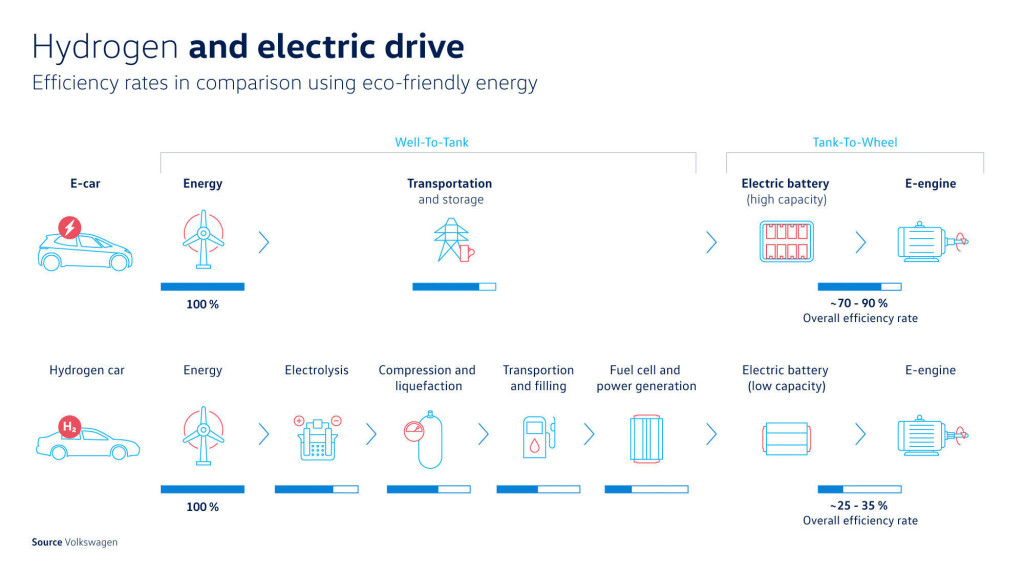
I like this diagram from Volkswagen visualizing the energy loss at every step for hydrogen versus BEV:

https://images.hgmsites.net/lrg/hydrogen-vs-electric--volksw...

This image (don't know the source), which includes oil and coal, is also a good visualization:

https://i.imgur.com/Wuhnlvu.png

Even simpler:

https://pbs.twimg.com/media/DPkaz0nX4AAcr_v.jpg

Re: After many false starts, hydrogen power might now bear fruit

#124
post #99

Earlier quoted context omitted.

There are other ways of generating electricity apart from electrolysis. For example, from food waste through yeast and other methods. Yes, there is some energy being used but you are talking about material which would go waste anyway: https://fuelcellsworks.com/news/a-simplified-way-to-turn-foo... First: Energy density The primary advantage of hydrogen is energy density. Though Li Ion and other technologies have impr…

Hydrogen's high density of available energy per unit mass is the key to identifying where it is most potentially useful. Simply, it is by far the best of all possible aircraft fuels. Its one major disadvantage for this, as for most uses, is its low mass density: it needs more room than diesel to store enough to be useful. The tanks need to be bigger, and either strong enough to contain high pressure, or well-enough i…

Pure oxygen can also be used in the pyrolysis phase of gasification, turning waste organic matter into syngas (Carbon monoxide and Hydrogen gas), as it produces a more pure fuel then using air alone (which is 60% inert nitrogen).

Re: After many false starts, hydrogen power might now bear fruit

#126

Hydrogen has an efficiency problem. You need to convert other forms of energy to hydrogen at a loss. Then you need to store it and transport it, which is costly and may impose quite some energy cost for cooling or compression. Then you need to convert it back to electricity, also at a loss. If you start at electricity, the electrical grid and batteries would be much more efficient. If you start at oil or gas, you cou…

I like this diagram from Volkswagen visualizing the energy loss at every step for hydrogen versus BEV: https://images.hgmsites.net/lrg/hydrogen-vs-electric--volksw... This image (don't know the source), which includes oil and coal, is also a good visualization: https://i.imgur.com/Wuhnlvu.png Even simpler: https://pbs.twimg.com/media/DPkaz0nX4AAcr_v.jpg

How efficient is electrolysis compared to making hydrocarbons?

Re: After many false starts, hydrogen power might now bear fruit

#127
post #75

Hydrogen has an efficiency problem. You need to convert other forms of energy to hydrogen at a loss. Then you need to store it and transport it, which is costly and may impose quite some energy cost for cooling or compression. Then you need to convert it back to electricity, also at a loss. If you start at electricity, the electrical grid and batteries would be much more efficient. If you start at oil or gas, you cou…

Many of the things you're saying aren't correct, see my other comment (sibling to yours) for references. Nuclear is not cheap compared to photovoltaics, wind and hydro. Since the former two are bursty, overcapacity in them leads to cheap excess energy at times, which needs to be stored. Which storage method is the best depends on multiple factors, particularly on the duration of storage, capacity required and frequen…

Do we really need long-term storage? Wouldn't it be cheaper just to overprovision production?

Re: After many false starts, hydrogen power might now bear fruit

#128
post #75

Earlier quoted context omitted.

Many of the things you're saying aren't correct, see my other comment (sibling to yours) for references. Nuclear is not cheap compared to photovoltaics, wind and hydro. Since the former two are bursty, overcapacity in them leads to cheap excess energy at times, which needs to be stored. Which storage method is the best depends on multiple factors, particularly on the duration of storage, capacity required and frequen…

> Many of the things you're saying aren't correct, see my other comment (sibling to yours) for references. I really wish that I was wrong instead of just semi-accurate and sloppy. > Nuclear is not cheap compared to photovoltaics, wind and hydro. The price of nuclear power is dominated by regulation. Running the power plant is quite cheap. The real cost is satisfying regulation and getting rid of the nuclear waste. If…

Nuclear power is only dirt cheap if the government/society picks up all the externalised costs for the storage and recycling of waste.

Can you tell me which nuclear stations cover all their own costs?

As far as I am aware, all nuclear power stations in the world do not bear that cost - it is always picked up by the government.

They often figure that the long term cost is worth it for energy stability - not because nuclear is cheap - but because it is more stable than relying on energy imports from another country.

Re: After many false starts, hydrogen power might now bear fruit

#129
post #84
post #24

I've been diving into this literature a bit recently, and it's been mostly encouraging. Affordable clean energy is realistic. Clean energy sources are typically the cheapest sources of energy [0]. The intermittent production issue is solvable: At ~150 $/kWh storage, a combination of storage and renewables is the cheapest energy source 95% of the time [1]. The cost of different energy storage methods is coming down ex…

Regarding [1], the article quotes production costs of USD 50/MWh for renewables, and USD 100/MWh for coal (graph 3). You/[1] is saying that with storage costs of USD 150,000 per MWh, renewables can be competitive? It doesn't compute, unless I misunderstand something.

Batteries last longer than one cycle...

Re: After many false starts, hydrogen power might now bear fruit

#130

Hydrogen has an efficiency problem. You need to convert other forms of energy to hydrogen at a loss. Then you need to store it and transport it, which is costly and may impose quite some energy cost for cooling or compression. Then you need to convert it back to electricity, also at a loss. If you start at electricity, the electrical grid and batteries would be much more efficient. If you start at oil or gas, you cou…

sounds like Iceland would do well to export hydrogen from electrolysis

They might be just connected to the Euro-Powergrid in the future: https://www.landsvirkjun.com/researchdevelopment/submarineca...
Post reply on HN