Live data from Hacker News

Have you ever asked yourself “how did research get done before LateX?”

twitter.com

171–180 of 204 posts

Re: Have you ever asked yourself “how did research get done before LateX?”

#171
post #62

Earlier quoted context omitted.

If you're an actual mathematician writing pages and pages of equations, LaTeX is not complicated, unintuitive, ugly, or slow. It's actually extremely well designed for addressing what is a very difficult problem, the problem of translating mathematics into ASCII. For how difficult that problem is, LaTeX is quite genius. I think a lot of the would-be LaTeX-disruptors lack enough experience actually writing mathematics…

But what if you a computer scientists or an economist that needs to write graphs, charts, tables, code, etc? Last time I tried to strikeout a column it required some weird TikZ shenanigans.

Agree LaTeX is painful here. For tables and inline code snippets, it is indeed a genuine shortcoming of LaTeX.

On the other hand:

* For graphs and charts, I'm not sure how it could be done much better in a text-based programming language.

* Even for tables you have to have some sympathy because remember, the cells in the table can (and occasionally do) contain very complicated mathematical contents. Tables are hard, as many a frontend dev will assure you.
Re: Have you ever asked yourself “how did research get done before LateX?”

#172

Hey everyone! Thread author here. Happy to see so many people taking an interest in beautiful scientific communication! If anyone has other examples of beautiful typography or graphing/figures throughout history, I'd love to see them! I've been replying to the original thread on twitter with some favorites: https://twitter.com/iraphas13/status/1262489387767480322?s=2...

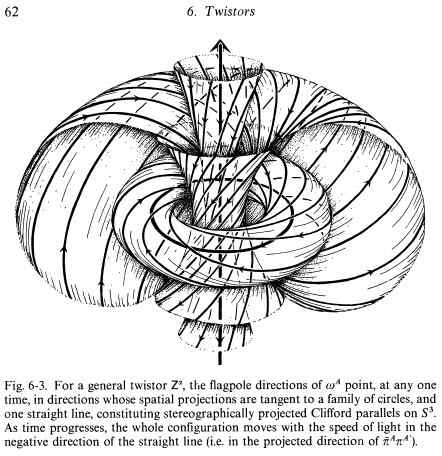
I believe Roger Penrose draws all his own illustrations. For copius excellent examples, see his book Road to Reality. Here is one example:

https://phys.org/news/2018-03-math-bridges-holography-twisto...

https://theportal.wiki/images/1/11/Penrose-Rindler-Clifford-...

He also comes from the pre-ppt age of presenting with handwritten acetate transparencies - and still does afaik. Many of his slides have been captured for the infowebs.

http://cgpg.gravity.psu.edu/online/Html/Seminars/Fall1998/Pe...

http://cgpg.gravity.psu.edu/online/Html/Seminars/Fall1998/Pe...

Some of his original papers from the 1960s were not published at the time, but circulated as samizdat facsimiles of his handwritten notes, until later transcribed by professors or their students, then published in book collections:

http://math.ucr.edu/home/baez/penrose/Penrose-TheoryOfQuanti...

Penrose is famous for his visual imagination, which seems to ground many of his insights. Here is a paper where he invents a visual notation for tensors and operators:

https://en.wikipedia.org/wiki/Penrose_graphical_notation

http://homepages.math.uic.edu/~kauffman/Penrose.pdf

This has inspired recent work by Bob Coecke, as captured in his beautiful book Picturing Quantum Processes.

(arXiv example: https://arxiv.org/pdf/0908.1787.pdf)

Re: Have you ever asked yourself “how did research get done before LateX?”

#173

Earlier quoted context omitted.

Noob question: No one makes LaTeX "distros"? Failing that, what about sharing a Docker image?

There are LaTeX distros, but just a few of them. Most people on linux use the TeXLive distro. I recently downloaded the latest version from its home ( https://www.tug.org/texlive/ ), and I think it took something like 6GB on my disk. Probably half of that is font files. TeXLive is in (for example) the Ubuntu repositories, but they are usually way behind the release version. I’ve heard there is a distribution for Wind…

The most common windows version is probably miktex which comes with its own package manager which by default downloads packages on use, while texlive often is most easily used in the full scheme installing every package, but there exists a separate package manager as well, which is often not included as distros want you to use the OS package manager.

Re: Have you ever asked yourself “how did research get done before LateX?”

#174

Earlier quoted context omitted.

And it's already slow and needs to run multiple times to generate a table of contents and bibtex Edit: phone autocomplete typo

Generally I use a Makefile that looks like this ``` SRC :=$(wildcard .tex .bib) Paper.pdf: $(SRC) pdflatex Paper bibtex Paper.aux pdflatex Paper pdflatex Paper short: $(SRC) pdflatex Paper clean: rm -f .glo .log .dvi .gls .toc .aux .ist .out .glg .pdf .bbl .blg .lof .brf *.sta .PHONY: clean ``` I hate that you have to run things multiple times to get references right. Really it should just be `pdflatex Paper` and you…

Isn't this what latexmk does for you?

I don't use things like bibtext so I don't know how it handles that, but latexmk works perfectly for normal use cases, and ensures that you never have to run it more times than you need to.

Re: Have you ever asked yourself “how did research get done before LateX?”

#175
post #148
post #77

Earlier quoted context omitted.

Almost no documents properly support ctrl-F. You'll get at best single word search, but you won't find coherent sentences. There are arbitrary line-breaks caused by various styling and layout packages (most columns are broken). There are even publishers that purposefully put garbage into the PDF's text layer as a braindead form of "piracy protection". PDF and TeX are broken beyond repair in terms of accessibility. Th…

Let's take an example: https://arxiv.org/pdf/1606.06389.pdf A cursory inspection seems to indicate ctrl-F is fine here? Or am I missing something?

Try copying across a line break. You'll notice that the spaces between the words are missing when you paste it.

Re: Have you ever asked yourself “how did research get done before LateX?”

#176
post #62

Earlier quoted context omitted.

If you're an actual mathematician writing pages and pages of equations, LaTeX is not complicated, unintuitive, ugly, or slow. It's actually extremely well designed for addressing what is a very difficult problem, the problem of translating mathematics into ASCII. For how difficult that problem is, LaTeX is quite genius. I think a lot of the would-be LaTeX-disruptors lack enough experience actually writing mathematics…

But what if you a computer scientists or an economist that needs to write graphs, charts, tables, code, etc? Last time I tried to strikeout a column it required some weird TikZ shenanigans.

Do you mean strike out each entry in the column separately? Or a single line that extends from the top left of the column to the bottom right?

The first can be done in a straightforward manner. Can Word do the second easier than Latex?

Re: Have you ever asked yourself “how did research get done before LateX?”

#177
post #88

Earlier quoted context omitted.

Are you specifically talking about the math syntax within latex, or actual latex commands in general? Because I would disagree on the latter one. (But I'm a computer scientist not a mathematician.) uglyness is porbably hard to discuss as it's just a matter of taste. I personally consider compile times that are measured in seconds for "simple" tasks slow (here's the question of it being an inherent problem of the spac…

As someone who did both math courses and programming courses, I found LaTeX to be awesome for writing equations. It felt so natural I would more often then not solve equations in LaTeX directly. However when writing stuff for my comp-sci courses, man what a chore. Pseudo-code was a PITA, as was getting decent tables of results where I wanted. So for a lot of those I threw my hands in the air and finished the paper us…

Markdown (via Pandoc) with the tex_math_dollars extension for math is the bees knees.

Re: Have you ever asked yourself “how did research get done before LateX?”

#178

Reminded me of the recent piece: Crafting Crafting Interpreters, in which Nystrom describes his process for creating hand-drawn diagrams. http://journal.stuffwithstuff.com/2020/04/05/crafting-crafti...

This beautiful booklet my Tai-Danae Bradley also contains hand-drawn diagrams:

https://arxiv.org/pdf/1809.05923.pdf

It is set using the Tufte LaTeX template:

https://twitter.com/math3ma/status/1042569522056716289

https://www.overleaf.com/gallery/tagged/tufte

Re: Have you ever asked yourself “how did research get done before LateX?”

#179
post #161

Earlier quoted context omitted.

This is going to be really unpopular but you could allow people to write their papers in Microsoft word . Either that or the other answer would be to say that’s why you have grad students .

I work in a lab which publishes in both CS and biology journals. Biologists require Word. Most our people hate it more than LaTeX, since in LaTeX it is at least difficult to break the template accidentally. Often the writing starts in GDocs, then gets moved to LaTeX, then converted to Word and cleaned up manually. I'd love Word if it had that one feature, disable direct formatting , to enable changing formatting only…

Word has that feature. Type "Protect Document" into the search bar, then select "limit formatting to a selection of styles" in the options toolbar that shows up on the right hand.

Re: Have you ever asked yourself “how did research get done before LateX?”

#180
post #6

Earlier quoted context omitted.

LaTeX is a bit like democracy. It is horrible, but all the alternatives I have tried a worse.

Gosh yeah. Imagine writing a 150+ pages thesis in Word. Would give me nightmares. EDIT: To complement: I think it's obviously possible, lots of people do it. But I feel I would spend a lot of time on "keeping the structure right" as I edit it. Feels more straightforward with Latex. And then Math is kind of hard to write efficiently, but that's field specific.

Start by splitting it up into parts, each document not to contain more than 5-10 pages, then enable "limit formatting to a selection of styles" (anyone who disables this is to suffer the ordeal of the boats). Once everything is the way you want it, copy everything to a new place, add a master document and set the styles as you want. The export to PDF, publish or whatever you want.

If you want it truly beautiful, use a DTP and don't format the word documents at all.

Post reply on HN