I hate to rain on your parade, because I'm deeply interested in alternatives for established models, and as a rule I strongly prefer intuitive visualisations over mathematical wankery, but this is just... nonsense. It has nothing to do with electricity in any sense. There's no matching theory that this is visualising. To begin with: 1) This doesn't explain why in general only metals conduct electricity. You used the…
Hydrogen is a great place to start with electricity since there is only one orbital surface/ electron-shell. The principles are easily generalized to the multipolar surfaces of metals. Metals are conductive because of these unique d orbitals. In general they have unpaired electrons, which means charge on balance. "To begin with"... 1) these are ionized hydrogens with delocalized electrons. 2) Capacitors build up volt…
> Hydrogen is a great place to start
It is an insulator, so a terrible place to start. Simplicity doesn't help if it's oversimplified to the point of being totally wrong.
> In the vacuum, there is such low pressure on the atoms that their surfaces expand to fill the void.
I don't think you realise just how absurdly distorted the orbitals would have to be for this to make sense. The gap in a classic Leidenjar capacitor is about 1mm, or something like 4 million times the inter-atomic spacing. You seriously want me to believe that the surface atoms have electrons whizzing out to orbits shaped like a 4,000,000-to-1 ratio ellipse and then coming back to whip around a specific nucleus? You're... kidding, right?
> All those cyclotron measurements are electric at the end of the day
What I mean is that cyclotrons have individual, loose particles circling around. Like isolated electrons, muons, protons, or whatever. They're not atoms, but there's a definite current that you can measure in Amperes. The beam makes a magnetic field and everything. How does your "atomic orbitals meshing together" explain currents that don't involve atoms!?
> Batteries charge the terminals electro-chemically... Basically, it is the same concept.
The same concept as what? You haven't explained how chemicals can produce the electron shell rotations.
> What dynamos
It's another word for generators. How does an AC generator generate your current? Use equations please that predict the output current using numbers based on the geometry of the coils and the rotation.
> All materials resist current to certain extent
That's just plain false, superconductors exist.
> All these details deserve a follow-up blog at some point for sure.
They deserve treatment in the first post, the first paper, the first video. It's like saying "I've got this wonderful idea for fusion power! The actual fusion and power bit I might cover later, I'm going to start by waffling on about how the vacuum chamber has no air in it."
> Hydrogens that are ionized are not empty protons, they simply have delocalized shells
In no way is this true. You can separate protons from electrons and move them meters apart and they'll just sit there. This happens all the time in interstellar space where plasmas can have mean inter-particle distances measured in meters. There is no meaningful way in which you can point at a particle in one room and say that it "belongs" to a particle in another room and that this makes up a hydrogen atom.
> We don't think the limitless extension of the electron is mathematical gibberish
Mathematically it's perfectly fine. You can define fields however you like. Infinite extent, infinite precision, infinite whatever you like. The physical universe just doesn't work that way, there are no known physical infinites.
> We think that those structures are essential to other atomic phenomenon, including light and gravity.
If you can solve the problem of gravity, you can collect your Nobel prize. Unfortunately you have to start with baby steps, such as explaining how capacitors work without hand-waving. Use numbers. Run a simulation or two.
> the locked up gear thing isn't a problem for the multi-polar orbitals of actual metals. It would be a problem for a hydrogen lattice, unless it had a hexagonal crystal, with bent geometry...hm.
Hmm indeed. Look at the crystal structures of common metals: https://www.ggspdt.com/uploads/8/1/0/4/81043910/8970374_orig...
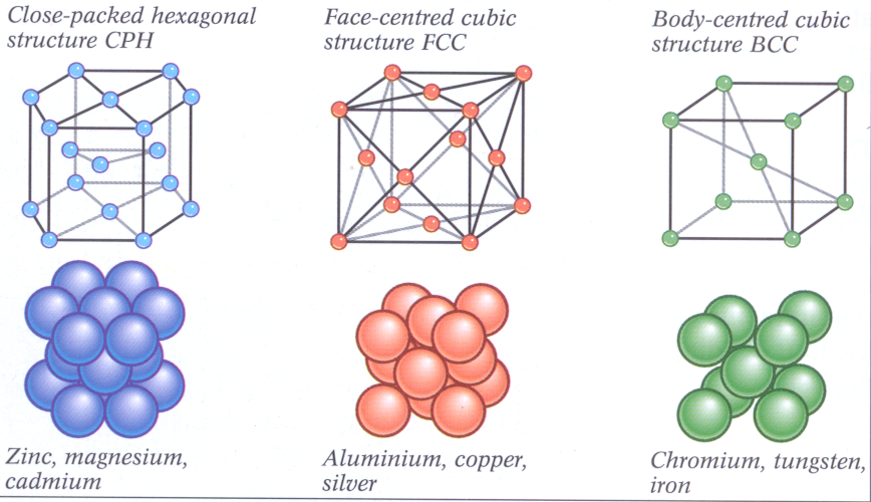
The close-packed hexagonal structure cannot transmit rotations in the sense of enmeshed gears, because it's made up of a bunch of triangles! Last time I checked, zinc, magnesium, and cadmium are all conductors.
Again, with actual metals, the "polar" orbits don't participate in conduction. Loose electrons do, and they don't mesh like gears. They can't possibly, because hexagonal lattices still conduct electricity.