Live data from Hacker News

Our Bookless Future

claremontreviewofbooks.com

11–20 of 108 posts

Re: Our Bookless Future

#11
post #8

The following assertion interests me greatly: > She points out how the “physical and temporal thereness of books” provides a tactile support for the reading circuit’s development that e-books do not, while noting e-books nonetheless continue to spread to classrooms and children’s bedrooms. Why would this be the case? Is there a measurable difference between dedicated "paper-like" e-book readers like the Kindle vs. e-…

I imagine it could have something to do with the physical fixedness of a book. I can remember the positions of the line breaks in some of my favourite books as a child and it wouldn't surprise me if the physical layout of the words on the page (and how far through the book you are) somehow factored into the way the brain stores the memories of reading the book. With an ebook you have the same little device with exact…

I think all these points are valid. As someone who spent the first 30 years of my life reading physical books, the transition to e-books has been difficult for a lot of the reasons you mention.

I wish the author was more specific on what "reading circuit development" means.

The frustrating thing about e-book reading devices is how slow they are. Flipping to the table of contents or flipping around the book just doesn't work. Mobile devices, tablets and computers are faster, but the experience still isn't as good a physical book. And then there are distractions.
Re: Our Bookless Future

#12
post #6
post #2

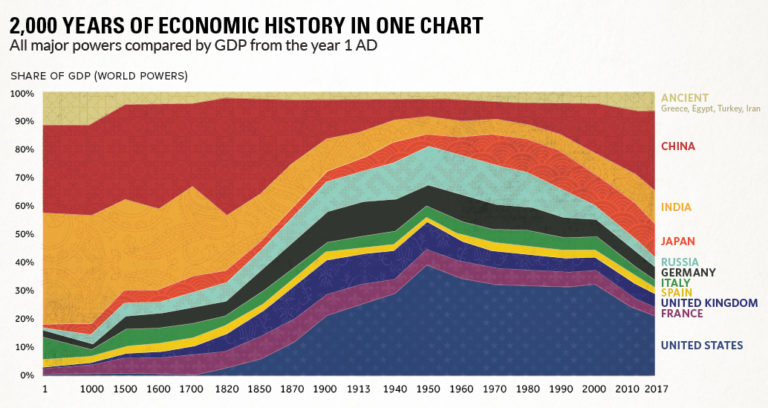
The effect of a bookless society can already be seen for centuries: suffice to compare development of societies that use them vs those that don’t. There is a clear correlation between GDP and the number of centuries (millennia in Chinese’s case) written medium has been in use.

Explain China's complete lack of development until very recently, then.

Google China's "century of humiliation". China was the world's biggest economy until the 1870s. Here's just one chart showing it. This is well known to everyone who has studied economic history.

http://urbanlogics.eu/wp-content/uploads/2019/02/share-of-gd...

You could have asked your question with more humility and less abrasion. Just because you don't know about a topic doesn't mean there isn't reams of research about it.

Re: Our Bookless Future

#14
post #10

The following assertion interests me greatly: > She points out how the “physical and temporal thereness of books” provides a tactile support for the reading circuit’s development that e-books do not, while noting e-books nonetheless continue to spread to classrooms and children’s bedrooms. Why would this be the case? Is there a measurable difference between dedicated "paper-like" e-book readers like the Kindle vs. e-…

I think where you are in the book as you read along is another sensory impression that can form stronger memories about the book's contents. I always have a sense of where to go back to to refresh some old ideas if my memory gets blurry. Knowing how far into the book it was already aids my recollection.

Yes, this 100% resonates with me.

Re: Our Bookless Future

#15
post #8

The following assertion interests me greatly: > She points out how the “physical and temporal thereness of books” provides a tactile support for the reading circuit’s development that e-books do not, while noting e-books nonetheless continue to spread to classrooms and children’s bedrooms. Why would this be the case? Is there a measurable difference between dedicated "paper-like" e-book readers like the Kindle vs. e-…

I imagine it could have something to do with the physical fixedness of a book. I can remember the positions of the line breaks in some of my favourite books as a child and it wouldn't surprise me if the physical layout of the words on the page (and how far through the book you are) somehow factored into the way the brain stores the memories of reading the book. With an ebook you have the same little device with exact…

That's a fair assessment. The brain doesn't store information so much as reproduce your experiences while reading during recall. It lets you relive, in part, the lighting, the angle, how heavy the book was, whether your edition had a defect on a particular page, the feel of the paper, the smell...

All of that comes in to play.

For my last read-through of Children of Dune (roughly a year ago now), I read it on the Kindle app on my phone. I remember the hotel room in Mumbai, the look of the text (white on a black background), the sun going down, and the characters moving through my mind. Would I have developed these recall skills if I hadn't spent my life reading paper books? I'm not so sure.

Re: Our Bookless Future

#18
post #4

>In these later letters, Wolf sounds like the kind of alarmist digital enthusiasts often deride. After all, they say, reading is not dying; it’s thriving. Wolf herself quotes a study from the University of California, San Diego, showing that an average user consumes 34 gigabytes of data per day—the equivalent of nearly 100,000 words. How is that the equivalent of nearly 100,000 words? I appreciate people read a lot o…

> How is that the equivalent of nearly 100,000 words?

It was probably meant to say 100,000 books. That would be 0.34 MB per book which is reasonable. For comparison, the first Harry Potter book as a text file is 0.4 MB.

Re: Our Bookless Future

#19
post #9

This line from the article really caught my attention: > In sum, Wolf says, the paper reading brain has better memory, more imagination, immersion, and patience, and more knowledge than the screen reading brain. I've been torn for years about how to feel about my reading and writing habits. I love reading physical books, especially when I'm trying to develop a deep understanding of some topic, and I have, at times, m…

That’s mostly because you’ve become conditioned to experience screen reading as mindless content consumption and dumps.

Re: Our Bookless Future

#20

The following assertion interests me greatly: > She points out how the “physical and temporal thereness of books” provides a tactile support for the reading circuit’s development that e-books do not, while noting e-books nonetheless continue to spread to classrooms and children’s bedrooms. Why would this be the case? Is there a measurable difference between dedicated "paper-like" e-book readers like the Kindle vs. e-…

Just found this presentation online by Maryanne Wolf:

https://www.stjornarradid.is/media/menntamalaraduneyti-media...

See page 30 for the "reading circuit" diagram.

Post reply on HN