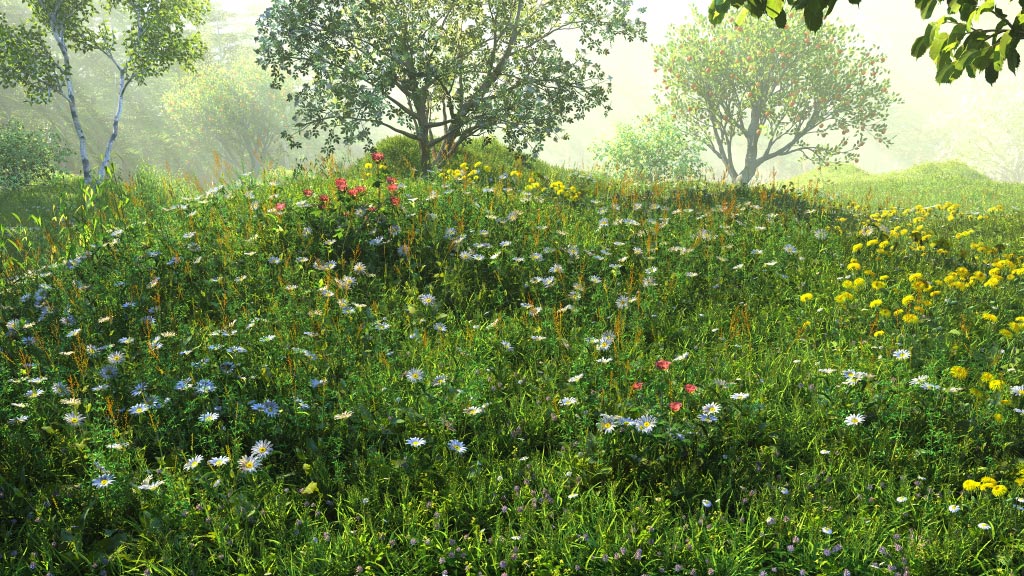
Earlier quoted context omitted.
It isn't just tooling. > At render time, though, you need to use a bunch of extra tricks to get the right smoothing Nurbs or any smooth geometry needs to be subdivided too. You can set levels, max size of polygons, smoothness constraints subdivide based on the pixel size from the camera projection or any combination. In practice this is not a problem for polygons or nurbs. > - bump/texture mapping, This is orthogonal…
3delight also traces SDS and nurbs analitycally. In offline renderers geometry data constitutes to most of memory usage. Texture RAM usage is kept under a few GB by use of page-based cache.
Ray Tracing with POV-Ray: 25 scenes in 25 days (2013)
51–60 of 112 posts
Re: Ray Tracing with POV-Ray: 25 scenes in 25 days (2013)
#52There is a special place in my heart for POVray. After BBC Basic, it was the first coding I ever did all the way back in ‘94.
The thrill of changing an object from opaque to glass, and the anticipation of watching the ray scan grind to a treacle-like pace as it passed over any glass objects. Happier times, simpler times!
May it live forever.
Re: Ray Tracing with POV-Ray: 25 scenes in 25 days (2013)
#53I loved POV-Ray in the 1990s and early 2000s. The thing is—it’s ridiculous to try and make something remotely complicated or organic with POV-Ray, unless you are using some modeling program that can export to POV-Ray format. POV-Ray scenes were dominated by procedural textures and geometric primitives, for the most part. The rendering engine was very strong, and supported all sorts of features like area lighting, dep…
POV-Ray was my introduction to programming, before actual programming. Graph paper and a lot of trial and error. My longest render was 50 hours for a single 640x480 image, with caustics and area lighting. 50 hours of a Pentium 100 MHz buzzing near my bed.
Re: Ray Tracing with POV-Ray: 25 scenes in 25 days (2013)
#54Wow, the state of the art in 3D rendering has changed dramatically. The state of the art in open source 3D rendering has changed even more dramatically. Compare these screenshots from 2013 (although I think POV-Ray was looking pretty dated by then) to renders that come out of Blender's Cycle renderer now. The big change is that everyone has moved to "physically based rendering" that do path-tracing for propagating li…
That's rather unfair to POV-Ray. These are hardly representative of what it's capable of. Look through the old IRTC archives, for instance: http://ftp.irtc.org/stills/index.html People were doing stuff like this ( http://oz.irtc.org/ftp/pub/stills/1999-04-30/13hystri.jpg ) in 1999.
I remember looking at this entry in particular: http://www.irtc.org/ftp/pub/stills/2006-06-30/hideaway.jpg and thinking "how the hell is that possible?"
Re: Ray Tracing with POV-Ray: 25 scenes in 25 days (2013)
#55Ah, the nostalgia. Thanks, David, and the entire POVRay team.
Re: Ray Tracing with POV-Ray: 25 scenes in 25 days (2013)
#56Earlier quoted context omitted.
Yep, I'm tired of these kids saying PovRay coudn't do shit as if PovRay had in 1997 the same capabilities of an Irix machine from 1987. They couldn't even be more wrong with that. I remember seeing photoreallistic images made with PovRay in 1997 you coudn't even do with a GPU today in real time. Kids today have a lot of ignorance on the 90's technologies, guess why they confuse the 80's and the 90's a lot thanks to t…
The explosion of JS and web development created a culture of people totally ignorant of the hard-learned lessons since the 1960s. That is why you see constant reinventions of the wheel, a shitty wheel at that.
That and their selfish issue being unable to acknowledge the 90's legacy and we could achieve in early 00's. For example their previous comment stating as if everything was invented in late 00's/early 10's and we were badly surviving with DOS and Amigas in late 90's, when, FFS, people began to emulate Amigas in '99 with UAE.
Man, we have Voodoo's and Geforce's exploded in late 90's, raytracing was done in software but we didn't do the crippled examples people is trying to show off to the rest as if it was what we truly do in the 90's. Not even close. Even a 286 could do these under half and hour or a full one, but that was the 3D lore from several years ago.
Re: Ray Tracing with POV-Ray: 25 scenes in 25 days (2013)
#57Earlier quoted context omitted.
Right, but the rest of the questions remain, along with the usefulness of CSG in real scenarios. CSG can be interesting, but it does end up being very impractical for anything except for some specific effects that are then turned into polygons. It is technically possible to create sdfs and trace against those I'm sure, but csg is rarely used and baking it to sdf instead of polygons even more so.
POV-Ray disagrees. It renders CSG . It never converts to polygons. So stop saying what a 30 year old program does is "impossible".
I asked 'how do you trace rays against it' because to do it directly is not fast, yet you are left with all the problems I stated that you skipped over. Think about what it would take to directly trace lots of overlapping primitives. What you gain from tracing it directly is minimal and what you give up is substantial.
Re: Ray Tracing with POV-Ray: 25 scenes in 25 days (2013)
#58Earlier quoted context omitted.
Polygons can be smoother and subdivided efficiently at render time without artifacts, which is how they are used now. Nurbs and other curved surface representations end up with huge problems pragmatically when it comes to tools, workflow, visualization, texture coordinates, keeping the surfaces together etc. The list is long. Polygons are very simple in all these areas and can be made smooth at render time so you get…
That’s the beauty of CSG though... it’s volumetric, not surface based
Re: Ray Tracing with POV-Ray: 25 scenes in 25 days (2013)
#59POV-Ray was the reason that I wanted a 486 DX back in the mid-90's, and not a puny FPU-less 486 SX like my friends had. I didn't do much with it, ultimately, but I really enjoyed noodling around w/ POV-Ray. Rendering a bunch of TGA files and then stringing them together into an animated GIF (or was it an FLC?) was a major exercise. I recall 15 y/o me trying to explain it to the "oldster" who my father purchased the P…