Live data from Hacker News

Learning to See in the Dark (2018)

github.com

51–60 of 179 posts

Re: Learning to See in the Dark (2018)

#51

The problem with techniques like this is that they fundamentally amount to ‘making a plausible guess as to what the image would look like’, since essentially they can’t extract information that is simply not there. There is a Shannon entropy limit here. Machine learning is really machine-enhanced educated-guesswork, which has its place but also has its limits.

Counterpoint: The human brain converting a 2D image to a 3D model is educated-guesswork too :)

This hits on an interesting point.

There is an entropy limit to the message, but the message isn't actually the only data.

One thing humans are great at is integrating existing knowledge into a messy situation and intuiting more than is available just from the raw message.

I.e. The message has an entropy limit, but the message isn't the whole dataset.
Re: Learning to See in the Dark (2018)

#52
post #4

I was just wondering a couple days ago why the image from my phone is so grainy, while my eyes+brain can see everything clear in the dark (it wasn't completely dark, of course). This seems to replicate the post-processing we do in our brain (which is also a giant neural network). I wonder if the process is similar?

Your brain doesn’t make a 2 dimensional image based entirely on photons entering your eye. You generate a complex physical model of your surroundings based only partially on visual input and rely substantially on memory.

Also other senses, including proprioception. In a completely dark environment, you could swear that you see your hand waving in front of your face. That's because your brain actually does know it's there, and it's trying to create a unified model.

Re: Learning to See in the Dark (2018)

#54
post #3

Impressive of the American news channel, CNN, to convert images in minus one second.

I understand that the title may have brought confusion, and I think your comment calls attention to this whilst also being somewhat funny.

But still, could we make an effort not to devolve into what has happened on Reddit, i.e. comment sections which mainly consist of puns and other low effort jokes?

Re: Learning to See in the Dark (2018)

#55
post #50

Earlier quoted context omitted.

Your brain doesn’t make a 2 dimensional image based entirely on photons entering your eye. You generate a complex physical model of your surroundings based only partially on visual input and rely substantially on memory.

Kind of like this well trained CNN is no longer relying entirely on the raw pixel values, but is statistically inferring a brighter image from the baseline.

There's a difference between applying known priors, and making things up based on statistics. Conflating the two isn't helping anyone.

Re: Learning to See in the Dark (2018)

#57

Earlier quoted context omitted.

I think OP was being sarcastic

Me too, but lots of people may not know so I answered it as if it were sincere.

raises hand I interpreted it as the news company, looked at Github and came back going "what does CNN have to do with this, it looks like they're uni students." Thank you for the actual acronym expansion, it's obtuse if you don't know anything about this stuff. Terrible title.

Re: Learning to See in the Dark (2018)

#59
post #3

Impressive of the American news channel, CNN, to convert images in minus one second.

I understand that the title may have brought confusion, and I think your comment calls attention to this whilst also being somewhat funny. But still, could we make an effort not to devolve into what has happened on Reddit, i.e. comment sections which mainly consist of puns and other low effort jokes?

Title is confusing (?intentionally).

Would make sense to add Tensorflow to make it more specific.

Re: Learning to See in the Dark (2018)

#60
post #18

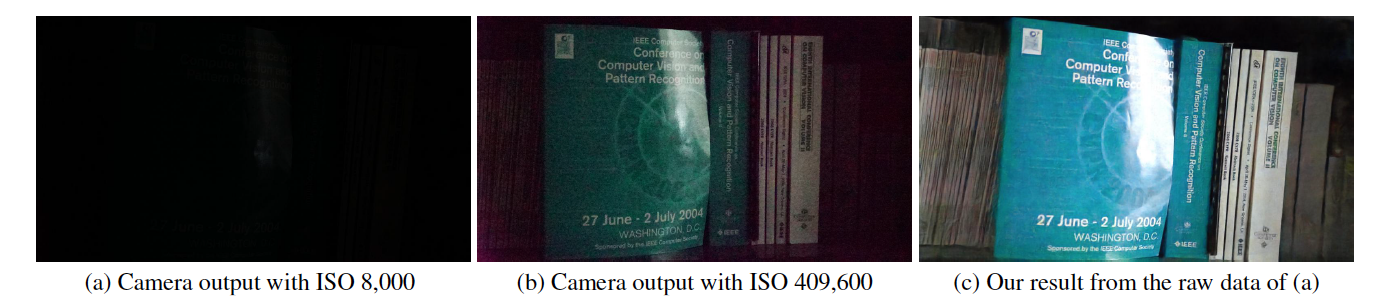
As a photographer, the comparison to "raw" results without color balance or noise removal seems somewhat deceptive. The effects visible in the video seem easy to quickly replicate with existing techniques, such as the "surface blur" filter that averages out pixel values in areas with similar color. This happens at the expense of detail in low-contrast areas, producing a plastic-like appearance of human skin and hair,…

Interestingly, this effect is notably visible in their example image [0]. Notice the distinctly "plasticized" appearance of the book cover, and how the text is not intelligible in the low-contrast areas of the reflection.

[0]: https://raw.githubusercontent.com/cchen156/Learning-to-See-i...

Post reply on HN