Live data from Hacker News

Climate models are running red hot, and scientists don’t know why

bloomberg.com

161–170 of 332 posts

Re: Climate models are running red hot, and scientists don’t know why

#161
post #88
post #19

Earlier quoted context omitted.

Can you even imagine how a Total War economy/society based on transitioning to greener energies, cutting emissions and pollutants, and working on improvements to housing and urban planning would end up looking? Like ignoring the whole climate change thing for a moment (though we absolutely should not do that), just the quality of life improvements to our health and well being this kind of mobilization would bring wou…

Total wars are not known to increase the quality of life. If a transition to a green economy guaranteed such massive economic gains (and no pains) don't you think that politicians of all colours would scramble to implement it? The first step to solving issues is to acknowledge all the difficulties that lie ahead: otherwise you end up in a delusional state in which solutions are obvious and easy and the only reason th…

...don't you think that politicians of all colours would scramble to implement it?

You would hope, but sadly it depends on what lobbying group they're listening to and what industries are employing their constituents.
Re: Climate models are running red hot, and scientists don’t know why

#162
Does anyone know if these models use floating point? If the do, are they properly handling the many subtleties[1] of IEEE 754 (and other floating point implementations)? Many years ago I read something about a model that produced very different results depending on the hardware architecture. If a model is sometimes chaotically sensitive to initial conditions, improper handling of rounding could be catastrophic.

[1] https://docs.oracle.com/cd/E19957-01/806-3568/ncg_goldberg.h...

Re: Climate models are running red hot, and scientists don’t know why

#163

Earlier quoted context omitted.

That's not what climate is about. Also, it depends on location, in many places it was colder in 2019 than in 2018. If you're talking about some calculated "global" temperature, it doesn't exist in a valid form.

Are you claiming that it is not possible to find a trend in a mean temperature of a great many points across the globe, over a long period of time? What makes such a measurement an "invalid form"?

It is not possible if there aren't valid temperature measurements available for all points throughout the measured period of time, so that many temperatures are "interpolated", estimated etc.

Re: Climate models are running red hot, and scientists don’t know why

#164
post #19

Earlier quoted context omitted.

Can you even imagine how a Total War economy/society based on transitioning to greener energies, cutting emissions and pollutants, and working on improvements to housing and urban planning would end up looking? Like ignoring the whole climate change thing for a moment (though we absolutely should not do that), just the quality of life improvements to our health and well being this kind of mobilization would bring wou…

> Total War economy/society > quality of life improvements to our health and well being this kind of mobilization would bring would be astonishing. The impact on quality of life and society would be "astonishing," but they won't be improvements. The Soviets and Chinese tried similar "mobilization[s]" for food production. The idea was to direct society's efforts to producing enough food for everybody. Tens of millions…

> It turns out that governments are bad at running economies.

Extrapolating a general theory from just two examples seems like a mistake.

Re: Climate models are running red hot, and scientists don’t know why

#165

I am not a climate change denier by a long shot, but stories like these give a ding to the credibility of climate scientists. > "So we can't throw them out yet." This might be an elementary view of science, but I think there is a danger here that while everyone is making their models, if anyone is an outlier they go and tweak their model to match the patterns of others: 'Klaus Wyser’s group "switched off" some of the…

Typically it's not obvious what to switch on and off for "accuracy". If your model produces wildly different results from previous models, either you hit on some really big discovery or you made a mistake. An ethical scientist will try to rule out the latter possibility before accepting the former.

It goes deeper than that. If you can tweak your new model to correspond to an older one for which you have results available, you must run tests in which you apply these tweaks and verify that you get the same results. If you get different results, one of the models simply isn't doing what you think it's doing and you need to understand that. And in the vast majority of cases, it's likely a mistake in a model, not any kind of new science.

One pretty general debugging/analysis strategy for a complex model is to deactivate it piece by piece until you get it to a point where it should reproduce a result that you can verify by other, independent means. E.g. tweak the parameters of the model so that reproduces a result that is known analytically. For instance, whenever it is possible in a model, a good sanity check is to set parameters that must lead to e.g. a perfect conservation of certain quantities.

Re: Climate models are running red hot, and scientists don’t know why

#166
post #28

Does anyone know if this is actually true? I was under the impression that climate models have been mostly overshooting reality over the past 40 years > One question modeling can help answer is called “climate sensitivity,” an estimate of how much warmer the planet will be once it has adjusted to atmospheric CO₂ at double the pre-industrial level. (At current rates, CO₂ could reach a doubling point in the last decade…

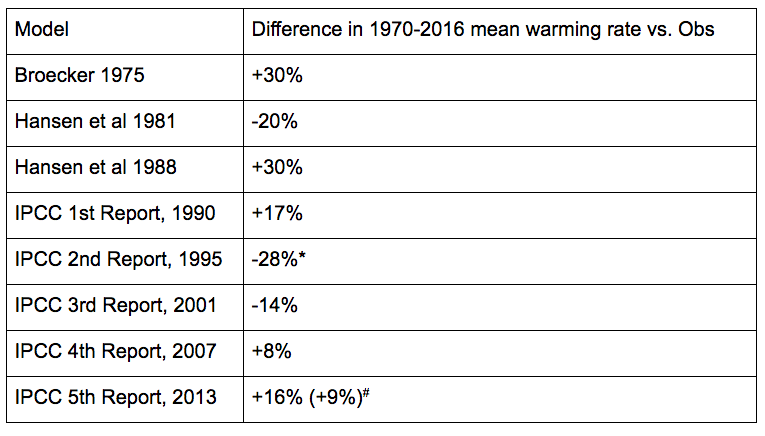
Here's a systematic comparison of climate model predictions vs reality, since the 1970s. It turns out that the models have done a great job of predicting reality. https://www.carbonbrief.org/analysis-how-well-have-climate-m... I'd be curious where your impression comes from, in terms of what sources of information you're receiving.

I was thinking of the same data, I guess it's not quite as clear as I thought, but the majority are overestimating the warming: https://www.carbonbrief.org/wp-content/uploads/2017/10/Scree...

Re: Climate models are running red hot, and scientists don’t know why

#167

There is a big observational campaign happening right now that is trying to get to the heart of this called EUREC4A (main website: http://eurec4a.eu and information sheet: http://eurec4a.eu/fileadmin/user_upload/eurec4a/2019/Press/E... ). The key uncertainty between different climate models is whether shallow clouds in the tropics (which in general cool the Earth through radiation) will disappear or not and make our…

I suppose my immediate question is - is there any way for an non-professional with a pair of eyes and a smartphone to contribute in a crowd-sourcy way?

Why do you want to a horde of “non-professional[s] with a pair of eyes and a smartphone” to contribute if literally hundreds of professionals with high-end equipment, meteorological observation satellites, and oodles of computational firepower are already on the task?

The main problem has never been a lack of science, the problem has always been (and alas, continues to be) a lack of political wherewithal to actually rapidly implement the drastic steps necessary to avoid the worst outcomes.

Maybe we’re finally getting what we collectively deserve?

Re: Climate models are running red hot, and scientists don’t know why

#168

Earlier quoted context omitted.

You're right that individual action isn't enough. But individual action does also have an impact. Commuter cars and SUVs (not airplanes, not shipping trucks) are the largest single source of carbon emissions in the US[1], accounting for about 15% of all US carbon emissions[2]. If just 1 in 10 commuters switched to taking public transit instead of driving, that alone would drop US emissions by 1.5%. If public transit…

> If public transit became the default method for most transportation, we could realistically lop off 7-10% of US emissions. I honestly struggle to understand this statement in the context of discussing individual action. Making public transit a reasonable option for most personal transportation in the US would be a public works project on the scale of the New Deal. Perhaps more importantly, cutting US emissions by 1…

> Making public transit a reasonable option for most personal transportation in the US would be a public works project on the scale of the New Deal.

I don't agree. Most large-ish cities already have quite good public transportation networks, but outside of a couple special places like NYC, Chicago, and maybe SF, they're not the default option. If the demand is there, adding more bus routes and increasing frequency is trivial. Adding more rail and subway lines is definitely a major task, but we spend more on garbage like the TSA and the F-35 than we do on increasing public transit options; it's hardly a task on the order of the New Deal.

My overall point is individual action is a major factor in transit emissions, which is a major source of carbon, and thus individual action does have an impact on our climate change future. The fact that individual action alone isn't enough to fix the problem isn't an excuse for individuals to avoid making choices to lower their emissions.

> Perhaps more importantly, cutting US emissions by 10% is very nearly inconsequential unless it is part of a coordinated effort that is driving global emissions down by significantly more than 10%.

I don't agree at all that decreasing US emissions by 10% is inconsequential[1], but yes, of course, it is not enough. I already agreed with you that individual action is not enough. But it is significant. I'm trying to back up that assertion with numbers.

[1] Ten percent of US emissions is about 1.37% of global emissions, https://en.wikipedia.org/wiki/List_of_countries_by_carbon_di...

Re: Climate models are running red hot, and scientists don’t know why

#169
post #91

Earlier quoted context omitted.

Not a catastrophe for whom is the obvious question here.

Pretty much everybody: https://www.cnbc.com/2019/08/20/climate-change-to-slow-globa... > In other words, if global GDP doubles or halves by 2100, the results suggest real GDP per capita would still be 7.22% below where it would be otherwise. For most of the world, an RCP8.5 scenario is equivalent to knocking out 3-4 years of GDP growth. Bad, but not catastrophic, and probably less bad than the impact of "WWII-style m…

Pointing at GDP over and over again is at a best a fuzzy indicator of overall well-being, especially in the developed world where inequality has unmoored it from improvement in material standards for many people. Amazon stock prices skyrocketing tells you little about the health or well-being of their workforce.

Re: Climate models are running red hot, and scientists don’t know why

#170

I’m a climate change skeptic almost entirely because I don’t trust models. I believe there are too many dynamic things happening in the world for anyone to be able to predict accurately say the next 100 years (solar, earthquakes, volcanoes etc). One way to make me a believer though is an experiment: if I were to give you a 100 year stretch of history and you were able to accurately predict with the models what exactl…

So if I asked you to bet at 50/50 odds that next year would be colder on average than this year, you'd take the bet?

It seems people do take a variation of this bet quite often; they keep moving to and investing in coastal cities and regions.
Post reply on HN