Hm, the experiment took place before 1973 and involved 8 pseudo-patients, all anonymous. This person was able to deanonymize and locate 3 of the pseudo-patients. Because they didn't find all 8 they then claim the study was fraudulent and never involved 8 people. That seems an absurd conclusion. It's not reasonable to think one could find all the anonymous/identity cloaked participants in a nearly 50 year old study.
David Rosenhan’s fraudulent Thud experiment set back psychiatry for decades
91–100 of 127 posts
Re: David Rosenhan’s fraudulent Thud experiment set back psychiatry for decades
#92Earlier quoted context omitted.
[EDIT: do the people downvoting this care to explain why they disagree with it? Just because one person was involved is not evidence other people weren't scared off because of harassment. Nor is it evidence that there was no harassment. If you disagree, why?] His role and behavior is independent of whether there was harassment of academics from people. He may have had that role and either one of these three options c…
> not evidence other people weren't scared off because of harassment If that abomination of a researcher wasn't scared off, it's pretty strong evidence that there wasn't any significant harassment that had a chilling effect on discussion. (You can apply all the "autogynephilia" testing and logic to most cis women and they'll come out with a strong diagnosis. Whatever you think about the nature of transgenderism, appl…
> You can apply all the "autogynephilia" testing and logic to most cis women and they'll come out with a strong diagnosis.
That is not true. Trans women score much higher on tests of autogynephilia.[1] This is even found to be true in amateur surveys.[2] Trans females score the highest, then cis males, then cis females. Trans males have the lowest scores for autogynephilia.
1. https://sci-hub.tw/10.1007/s10508-007-9306-9 From the abstract:
> The results showed that, overall, transsexuals tended to place more importance on partner’s physical attractiveness and reported higher scores on Blanchard’s Core Autogynephilia Scale than biological females.
2. https://www.reddit.com/r/TheMotte/comments/et039t/independen...
Re: David Rosenhan’s fraudulent Thud experiment set back psychiatry for decades
#93Earlier quoted context omitted.
Forced incarceration is pretty rare, and doesn't seem likely to become common or misused in severe ways. I'm more worried about a diagnosis -- even a correct one -- that marks you forever and limits your freedom in overt and subtle ways. I'm sure that prevents a lot of people from seeking treatment, unfortunately.
I agree that forced incarceration is pretty rare now, but it was much more common at the time of the Rosenhan study. Electroshock therapy was also in vogue, and psychiatric lobotomy was still practiced in some countries
Electroshock therapy now called Electroconvulsive therapy (ECT) is still pretty much in vogue and is gaining momentum.
Re: David Rosenhan’s fraudulent Thud experiment set back psychiatry for decades
#94Earlier quoted context omitted.
There are, in cases, effective drugs. There's also a long history of failed or discredited treatments (chemical and otherwise), as well as theoretical models. Mind: I'm not arguing that science doesn't make mistakes. Science is a mistake-making-and-correcting process. But there are certain fields of science, somewhat more so in the social than physical and biological sciences, in which a widely-adopted plausible theo…
Since you used the word resisted, it sounds like you're suggesting that there is an existing demonstrable and falsifiable underpinning for one or more of the social sciences which has not been adopted. What would that be?
Soddy himself is a partial answer, in the case of economics, though I find Georgescu-Roegen generally a more complete treatment. The fact that Nobel-prize-winning economists are on record stating that economics still has no coherent theory of growth (the subject of its most notable foundational text) is ... significant. Steve Keen has been addressing that and strikes me as solidly convincing:
https://invidio.us/watch?v=BAjN6bG7XzM
(There's a paper, I'm not sure if it's published, I received it directly from Keen, will research.)
There's Thorstein Veblen's provocative question as to why economics is not an evolutionary science: https://archive.org/details/jstor-1882952
There's the difficulty economics has, generally, in even settling on basic questions: what is wealth (is it a stock or a flow? how is it measured?)? What is money? What is value?
W. Brian Arthur notes in one of his books that virtually all economics is aimed at policy, and that as a consequence there's very little purely theoretical foundation. (His own contribution has been on complexity economics, with several interesting contributions and two notable seminars.)
Of the set of sciences here, political science is the one I can comment the least on, though if it should also happen to revolve and evolve largely around policy rather than theoretic discussion, it may be afflicted by similar dynamics as economics, and a casual observation suggests it is.
My reading is that the social sciences generally should probably be formulated as systems sciences, and there've been some attempts, mostly solidly rejected, at doing so. Norbert Weiner's exceedingly cringily-named On the Humane Use of Human Beings (the book is vastly better than its title suggests) was an attempt at this. There's another by Alfred Kuhn (no relation to Thomas), of the University of Cincinnati, The study of society : a unified approach (https://www.worldcat.org/title/study-of-society-a-unified-ap...)
The systems dynamics approach of Jay Forrester and others would be another.
The organisation of M.I.T.'s study of psychology, "Brain and Cognitive Sciences" (formed through departmental mergers in 1986) reflects one approach.
My view of pscyhology and sociology is that they are studies of behaviour, of individuals and groups, on the basis of perceptions, information processing, and interactions, subject to evolutionary and other influences, as well as various pathologies.
Many psychological disorders seem to me more akin to cancer in physical medicine, as opposed to infectious diseases: they concern symptom clusters which may have multiple and diverse underlying etiologies, rather than of specific cause-centered disorders.
The distinction is that if you can identify a specific underlying causal agent (say: bacterium or virus, or some environmental insult), you can focus treatment on eliminating or attacking that specific cause.
If you have a symptom cluster with multiple possible etiologies, you risk falling into the One True Way trap, thinking that one identified cause is all causes.
Robert Sapolsky's lecture on depression and the various ways in which various types of behaviour-regulating neurotransmitters can malfunction is an example of the underlying messaging complexity within psychology:
https://invidio.us/watch?v=NOAgplgTxfc
I'm less versed again on sociology, and would speak less to its specific failures and more what I've noted looking through survey texts: that there doesn't seem to be any single underlying organisational premise. Again I'd suggest that this be as a systems science, here looking at groups of people (from couples/teams to all of humanity), and various behaviours. "Evolution" here would include both biological and cultural transmission of information.
Re: David Rosenhan’s fraudulent Thud experiment set back psychiatry for decades
#95Earlier quoted context omitted.
Since you used the word resisted, it sounds like you're suggesting that there is an existing demonstrable and falsifiable underpinning for one or more of the social sciences which has not been adopted. What would that be?
It would be more accurate so say that they've resisted looking for one. And even that's a bit unfair, since doing proper experiments (with basic features like a control group, never mind replication or blinding) in sociology, economics, or political 'science' is somewhere between crushingly expensive and outright impossible.
A bit of both.
The increasing specialisation both between and within academic domains, grants-making processes, various forms of gatekeeping and academic jealousies, all contribute to this.
The capitalist-communist antipathy throughout much of the 20th century also created major impediments, on both sides. Each camp was highly ideologically motivated, each used a consolidation of political power to drive academic policy and practice, and each side tended to both cultivate groupthink around certain concepts and mark others as taboo.
The Soviet Bloc notably preempted explorations in biology. The Western states greatly suppressed anything remotely touching on Marxist concepts (of which there is both bad and good). There were some shared areas of neglect (notably environmental concerns) and of focus (nuclear energy, weapons, jet propulsion, and space flight).
The interactions of power, ideology, and academic interests is ... pretty fascinating of itself.
Re: David Rosenhan’s fraudulent Thud experiment set back psychiatry for decades
#96Earlier quoted context omitted.
> not evidence other people weren't scared off because of harassment If that abomination of a researcher wasn't scared off, it's pretty strong evidence that there wasn't any significant harassment that had a chilling effect on discussion. (You can apply all the "autogynephilia" testing and logic to most cis women and they'll come out with a strong diagnosis. Whatever you think about the nature of transgenderism, appl…
> You can apply all the "autogynephilia" testing and logic to most cis women and they'll come out with a strong diagnosis. That is not true. Trans women score much higher on tests of autogynephilia.[1] This is even found to be true in amateur surveys.[2] Trans females score the highest, then cis males, then cis females. Trans males have the lowest scores for autogynephilia. 1. https://sci-hub.tw/10.1007/s10508-007-93…
This study isn't super helpful because it doesn't give a number for cis men to compare to. But being able to statistically distinguish between 41 and 35, standard deviation 10, or between 3.08 and 2.93, standard deviation 1.4, doesn't exactly give a ton of evidence to the idea that your test groups have fundamentally different underlying reasons for feeling female.
And I wouldn't be surprised if the huge difference on "Attraction to Transgender Fiction" or "Interest in Uncommitted Sex" are begging the question. If you filter biological women on the same criteria you'd probably have similar answer patterns there.
Also the "autogynephilic transsexual" group is the one closer to the "biological female" group on a bunch of these metrics.
Re: David Rosenhan’s fraudulent Thud experiment set back psychiatry for decades
#97While this is fascinating and I'm glad to have read it, it doesn't substantiate that this experiment set back psychiatry. The fact that the DSM-IV was prompted or encouraged by the experiment is suggested, but there's no argument for it. Even beyond that, the article doesn't even hint at an argument that the DSM-IV set back psychiatry (except offering the bare assertion that reductionism is false). Of course, the DSM…
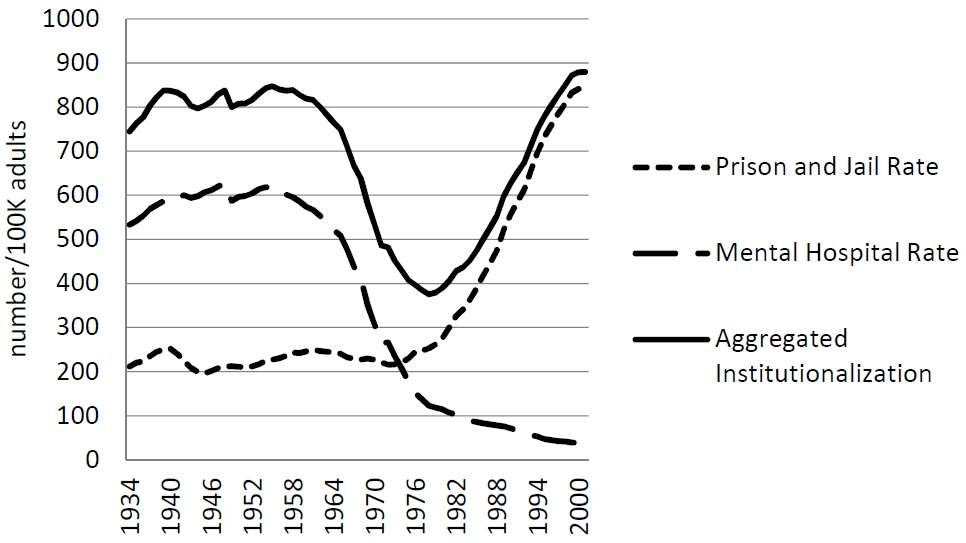
It no doubt aided the movement to deinstitutionalize patients with mental illness. Between 1955 and 1994, most state hospitals for the mentally ill were closed. This was done with the best of intentions, but the implementation led to the current mess where many severely mentally ill people are without adequate treatment and are homeless or imprisoned.
There's a great graph[1] showing per capita US institutionalization rates from 1934-2000, differentiating between prison, mental institutions and the combined total. The aggregate rate of US institutionalization is about the same as it was in 1954ish, the holding pen has just changed.
The graph is from a blog post on Volokh Conspiracy[2] about a paper from American Criminal Law Review [3] entitled "Is Mass Incarceration Inevitable"
[1]https://d2eehagpk5cl65.cloudfront.net/img/q60/uploads/2019/1...
[2] https://reason.com/2019/10/08/in-mass-incarceration-inevitab...
[3] https://papers.ssrn.com/sol3/papers.cfm?abstract_id=3436933
Re: David Rosenhan’s fraudulent Thud experiment set back psychiatry for decades
#98Earlier quoted context omitted.
How many mental hospitals were closed in the 80s due to this?
Not enough. This article is nothing but propaganda. These experts never explained why homosexuality was considered a mental illness and later that decision was reverted. Neither of those changes was ever justified. It's almost like those decisions are made with no objective criteria.
[deleted]
Re: David Rosenhan’s fraudulent Thud experiment set back psychiatry for decades
#99Earlier quoted context omitted.
> You can apply all the "autogynephilia" testing and logic to most cis women and they'll come out with a strong diagnosis. That is not true. Trans women score much higher on tests of autogynephilia.[1] This is even found to be true in amateur surveys.[2] Trans females score the highest, then cis males, then cis females. Trans males have the lowest scores for autogynephilia. 1. https://sci-hub.tw/10.1007/s10508-007-93…
This study isn't super helpful because it doesn't give a number for cis men to compare to. But being able to statistically distinguish between 41 and 35, standard deviation 10, or between 3.08 and 2.93, standard deviation 1.4, doesn't exactly give a ton of evidence to the idea that your test groups have fundamentally different underlying reasons for feeling female. And I wouldn't be surprised if the huge difference o…
It really seems like you're asking, "Must I believe this?" instead of "What is true?" You picked a couple of questions on the survey to try to dismiss the study. Someone believing the opposite of you could have picked "attraction to male physique" (where trans women score lower) combined with "attraction to feminine males" (where they score higher) to bolster the autogynephilia theory. There's also the complication that trans women seem to be closer to men in other psychological measures (less masochism, less jealousy, preference for younger partners).
Pretty much all studies are complex enough that one can poke a couple holes in them this way. If that's enough to dismiss a study, then it's hard for us to believe anything in soft sciences.
And yes, the first study only looked at trans and cis women. But did you look at the amateur survey? It also surveyed trans and cis men. It reproduced the results of the academic study despite the creator of the amateur survey having no knowledge of it. That's some pretty convincing evidence in my book.
Also, do you have any studies that show that the majority of cis women would be considered autogynephilic? Because the only study I've found that asserts this is Autogynephilia in Women[1], which counted women as autogynephilic if they answered anything other than "never" to 9 questions about potentially arousing experiences. If someone answered "on occasion" to any question in that list, they were considered autogynephilic. When one of the questions is, "I have been erotically aroused by imagining that others find me particularly sexy, attractive, or irresistible.", it's easy to see what the authors of the study were trying to do. Nobody who is testing for autogynephilia uses such a low threshold.
Re: David Rosenhan’s fraudulent Thud experiment set back psychiatry for decades
#100Earlier quoted context omitted.
This study isn't super helpful because it doesn't give a number for cis men to compare to. But being able to statistically distinguish between 41 and 35, standard deviation 10, or between 3.08 and 2.93, standard deviation 1.4, doesn't exactly give a ton of evidence to the idea that your test groups have fundamentally different underlying reasons for feeling female. And I wouldn't be surprised if the huge difference o…
It really seems like you're asking, "Must I believe this?" instead of "What is true?" You picked a couple of questions on the survey to try to dismiss the study. Someone believing the opposite of you could have picked "attraction to male physique" (where trans women score lower) combined with "attraction to feminine males" (where they score higher) to bolster the autogynephilia theory. There's also the complication t…
Let me put it this way: Being able to distinguish groups is not enough. The core of the theory is that these people have a fundamentally different underlying reason for feeling female.
I'll keep this study in mind, but without more context it doesn't seem to show a difference like that on 90% of the parameters. With more numbers maybe it would... but I don't have them.
I picked those questions because they showed some of the strongest statistical results. But they also have a very obvious alternate explanation that needs to be tested.
Especially because:
"Transsexual participants were categorized as autogynephilic or non-autogynephilic based on their scores on the Core Autogynephilia, Autogynephilic Interpersonal Fantasy, Attraction to Feminine Males, and Attraction to Transgender Fiction scales."
This desperately needs a comparison where they apply the same technique to the biological female data.
(Though that the last one is really tricky, because maybe a better analogy is "waking up as a woman, as usual, hooray" fiction and that's far too bland and common to be a genre.)
> It reproduced the results of the academic study despite the creator of the amateur survey having no knowledge of it. That's some pretty convincing evidence in my book.
Convincing of some overall trends. But the theory is much more than that.
> Also, do you have any studies that show that the majority of cis women would be considered autogynephilic?
No, I haven't spent that much time on this subject before to the point of digging up studies.