Live data from Hacker News

Germany is moving beyond nuclear power, but at what cost?

nytimes.com

151–160 of 239 posts

Re: Germany is moving beyond nuclear power, but at what cost?

#151
post #135

Here is a by the minute diagram of the german energy consumption. Germany would be fine with all the nuclear power plants switched off. They invest heavily in renewable energy which shows off. https://energy-charts.de/power_de.htm?source=all-sources&yea...

Their "heavy investment" in renewables doesn't do much for Germany. It's really coal and gas "saving" them from nuclear, and that's problematic.

https://www.electricitymap.org/?page=country&solar=false&rem...

#1: coal, 34% #2: wind, 18% #3: gas, 13% #4: nuclear, 12% (Solar is zero of course, it's night right now : inconveniently, this tends to happen rather regularly)

for a whopping average of 400gCO2/kW, compared to France 68, Sweden's 42, or Iceland's 28.

"It shows" indeed, but nothing to be proud of.

Re: Germany is moving beyond nuclear power, but at what cost?

#152
people are using the words 'nuclear power' like the word 'disease'. There multiple different kinds of nuc power. I disagree with our use of fast breeders and other reactions that also keep our supply of weapons grade fissile material 'fresh'. However there are other much safer reactions that are much safer and aimed more at energy generation like molten salt reactors - thorium, fluoride?

Just like there are diseases with which we can cope(chickenpox) and others which are horrible(smallpox), we should not use the words 'nuclear power' in planning or discussion among educated people. 'Nuclear power' is only useful in third grade science class.

Re: Germany is moving beyond nuclear power, but at what cost?

#153
post #122

Earlier quoted context omitted.

Well, Germany expanded the share of renewable for electricity production from 6% in 2000 to 46% in 2019. I think that's quite remarkable. https://www.strom-report.de/strom

But it doesn't matter, because their CO2 emissions are still catastrophically worse than they could have been with nuclear (compare and contrast with neighbouring France). It just demonstrates that even a strong and "remarkable" drive towards renewables alone such as what Germany did, just isn't enough to sustain a developed economy, unless you're lucky like Sweden and have a geography that allows a lot of hydro.

we would sit on a bunch of nuclear waste we would not know what to do with. France does not scale with nuclear to the rest of Europe. Basically France is bound to nuclear because it needs the technology for their nuclear weapons and nuclear powered submarines ... otherwise it would phase out this costly technology.

Germany helps the world more, since renewable energy scales much easier and is cost effective, low-danger, ... that's why exporting energy efficient systems and renewable energy production technology is the way to go. Whether we use coal for a decade longer or not does not matter much in the larger picture. We need to develop scalable renewable technology and deploy it, for billions of people. Nuclear is too slow and too risky. If we look at the world-wide numbers for electricity production from nuclear, its mostly stagnating and it will be tough in the coming years when aging reactors will be taken off grid to sustain the level of production, enhance the life of existing reactors by upgrading them, build storage, have money for both decommision of old reactors and money to build new ones. France will need to invest upwards 100 billion Euro just for their aging fleet ... good luck with that. There is a single new EPR in the works and its expensive and late. With an old design from decades ago. The real battle for emission reductions will not be with 80 mill Germans, but with billions of people in Africa and Asia - where the growth is. We need to develop together with them fast scalable electricity production.

Let me quote the World Nuclear Report (!) from 2019:

* Non-Nuclear Options Save More Carbon Per Dollar. In many nuclear countries, new renewables can now compete economically with existing nuclear power plants. The closure of uneconomic reactors will not directly save CO2 emissions but can indirectly save more CO2 than closing a coal-fired plant, if the nuclear plant’s larger saved operating costs are rein- vested in efficiency or cheap modern renewables that in turn displace more fossil-fueled generation.

* Non-Nuclear Options Save More Carbon Per Year. While current nuclear programs are particularly slow, current renewables programs are particularly fast. New nuclear plants take 5–17 years longer to build than utility-scale solar or onshore wind power, so existing fossil-fueled plants emit far more CO2 while awaiting substitution by the nuclear option. Stabilizing the climate is urgent, nuclear power is slow.
Re: Germany is moving beyond nuclear power, but at what cost?

#154

Earlier quoted context omitted.

Actually there have been numerous studies how wind and solar could provide 100% power for a country like the US. The thing is you need significant upgrades to your power grid, this will become easier and easier with improving battery and storage tech. The myth of base load is essentially nuclear propaganda that keeps getting debunked. Power plants that can't easily be adjusted are pretty much the worst for operators.

Citation much needed, because that sounds like unsubstantiated wind/solar kool aid that's not worth much more than "nuclear propaganda". My impression is that battery storage tech and infrastructure is nowhere near able to provide 100% of US power when it's night and the wind doesn't blow (which is surprisingly often)

It's absolutely not. These calls for relying on renewables are pure fantasy; the storage technology doesn't exist yet, so you can't build a reliable power grid based on something that isn't in existence.

It's just like the calls to rely on fusion power instead of building fission plants. Fusion doesn't exist (as a usable power generation method), so calling for it to be planned for now is ridiculous. It's the same with storage systems; we don't have any that can supply the entire grid yet. We're having a hard enough time just getting enough lithium to make batteries for the relatively small number of electric vehicles on the road now. There are things like pumped-hydro, but those only work in some places, and we already have them (i.e., we can't make more of them, because we've already exhausted all the available hydropower sites), and they're not enough.

Don't get me wrong: renewables are great for what they're good at: supplying variable power, especially on sunny days, and the US in particular could definitely stand to deploy much more, particularly in the sunny states where a lot of power is used for A/C. But it's not a solution yet for baseload power.

Re: Germany is moving beyond nuclear power, but at what cost?

#155

Earlier quoted context omitted.

If by "handling well" you mean examples like buying the Belgian energy sector and then buying the Belgian politicians with generous revolving doors to keep open extremely dated and deteriorating reactors in Wallonia (Thiange) and Flanders (Doel) and playing deaf to the objections of neighboring states scared shitless of having these things operating in a dilapidated state so close to their borders, then yes, I guess…

Part of the German public and political class can be "scared shitless" until they're blue in the face, they have no leg to stand on. If I were Belgian, I sure would remain deaf to a lecture about energy and the environment, by one of the worst European contributors to CO2 emissions and emitter of deadly fine coal particles causing dozens of thousands of deaths now Germany, this is so out of character for you. You hav…

Have you ever considered that maybe it is because they have the smarts that they are getting out of both nuclear and coal?

And you might want to read up on Thiange before you tell Belgians to ignore and carry on.

Re: Germany is moving beyond nuclear power, but at what cost?

#157

Earlier quoted context omitted.

I rather have 10 Fukushima nuclear accidents than one big dam break: > https://www.ozy.com/flashback/230000-died-in-a-dam-collapse-... Fukushima is mostly restored already: > https://www.japantimes.co.jp/news/2019/04/05/national/evacue... > https://www.japantimes.co.jp/news/2019/07/20/national/beach-... > https://www.pref.fukushima.lg.jp/site/portal-english/en02-01... You can even read current restaurant reviews on G…

> I rather have 10 Fukushima nuclear accidents than one big dam break You say that, but Fukushima didn't even come close to reaching it's catastrophic potential. Japan was facing the possibility of having to immediately evacuate 50 million people[0], or roughly 15% of the US population. An evacuation on that scale would almost certainly top any other emergency evacuation in human history. Japan got pretty lucky with…

I got curious about the largest evacuations in history and a cursory google search says that the largest sea evacuation took place in NYC during 9/11, when 500,000 were ferried out of the city, beating Dunkirk in WWII (319k).

So the prime minister of Japan was facing the possibility of an evacuation 100x this size. That is truly insane.

Re: Germany is moving beyond nuclear power, but at what cost?

#159
post #67

Earlier quoted context omitted.

It's just that Germany did not switch to coal.

That is simply not true. Right this moment, coal is the single largest source of electricity production in Germany (33.66% of the total) They're emitting nearly 400gCO2eq/kWh, compared to nuclear-first France's 70. That is an abysmal result. https://www.electricitymap.org/

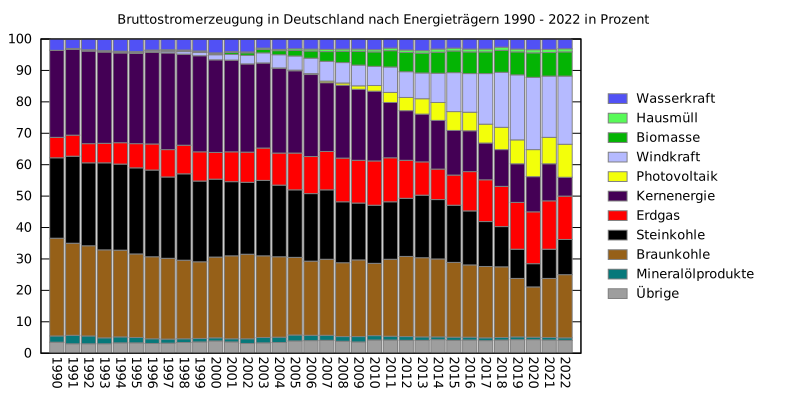
That's simply wrong. Renewable energy for electricity is at 46% last year. Up from 6% in 2000. Coal has been declining a lot from 2000 (when the Energiewende startet) to today.

https://upload.wikimedia.org/wikipedia/commons/c/c9/Energiem...

Re: Germany is moving beyond nuclear power, but at what cost?

#160
post #132
post #100

Earlier quoted context omitted.

Removing the radioactive material from Fukushima is going to take forty years. Parts of the area around Chernobyl will be unsafe for the next 20,000. It doesn't matter how frequently something succeeds if failure is too costly to bear.

That isn't too costly to bear. There are already huge swathes of earth that are uninhabitable wastelands. The change in evacuating a region is painful, but the length of time it stays evacuated isn't important. In the long term it is like the existence of the Sahara - just a fact.

Why nuclear industry cannot bear this burden then instead of tax payers?
Post reply on HN