Earlier quoted context omitted.
We did! That’s what caused me to inquire when the opportunity presented itself.
Right! I found it: https://news.ycombinator.com/item?id=19188205 . Thanks for remembering!
No need to thank me, was your idea!
271–276 of 276 posts
Earlier quoted context omitted.
There are a tiny handful of space based satellites, its far more than only a "bit" of inconvenience.
I mean it is a small inconvenience for telescopes on earth, and not that "it is a small inconvenience in general because there are space telescopes". Genuine question: is your opinion about these satellites based on working in some related field, or simply on dislike of greedy capitalists? I have a phd in physics and have friends who work as astronomers, with whom i've talked about this. Of course there is always a c…
For some types of astronomy --- especially larger fields -- heavily increased use of LEO may reduce the effective hours of observation by 4 hours a night by spoiling most exposures, while creating some impact at other hours. This is more than a 33% reduction in throughput.
Even with a smaller satellite population, there's been losses of valuable data. Two images in an early sequence of SN1987A had a (amazing improbable) perfect satellite streak right down the middle.
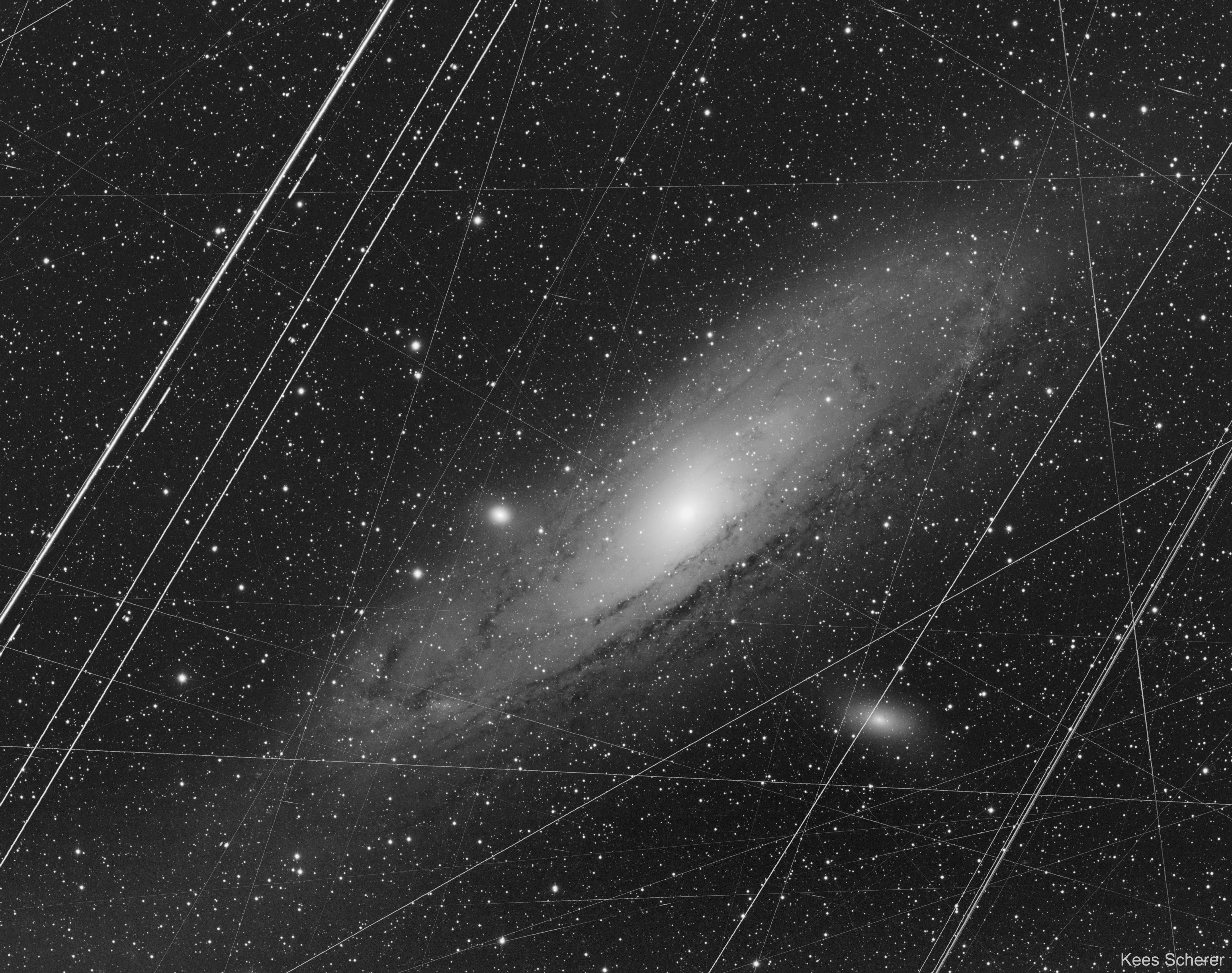
Or there's this past APOD https://apod.nasa.gov/apod/image/1910/M31Before_Scherer_4298... where we see the effect of the current satellite population (and a few planes with the ~10 parallel lines from upper right to lower left) on a big stack of images of Andromeda. Zooming in makes it obvious there are many more trails than leap out -- including a few neat tumbling objects's with periodic brightness changes (not the plane strobes).
What's tripling the number of satellites going to do?
I am concerned about increasing satellite counts for a few reasons (including the potential debris problems) I don't think it should preclude progress, but existing and future stakeholders (astronomers, people who enjoy dark skies, current/future users of LEO) should be considered.
Earlier quoted context omitted.
Professional astronomers would rather use a swarm of large and better working telescopes in space instead of dealing with clouds, city lights, and the Sun not allowing to work at normal hours. > Not the greedy entrepreneurs littering the sky with Internet access satellites. The "littering" will be done not just by "greedy entrepreneurs" but by millions of people who will pay for faster internet, and by astronomers wh…
I'd be very interested to know if any of the people who strongly disagree with the above comment are professional astronomers, or physicists.
Also, space telescopes are very expensive, so we have a very small number-- we're not going to ever have enough to look at as much of the sky as we'd like to look at. We've got hundreds of thousands of 0.3 meter scopes out there, employed by everything from outright amateurs to citizen-scientists to auxiliary observing and discovery for research astronomers. We can't give all these people time on orbiting telescopes.
Earlier quoted context omitted.
Can you point to some of those cost estimates? Latency absolutely matters for "high speed internet". Once you have reasonable bandwidth, that's the dominant factor in the user experience.
NSR has some public estimates here: https://www.nsr.com/leo-survival-of-the-fittestor-the-smarte... NSR estimates for SpaceX are higher than what SpaceX claims (Gwynne Shotwell just claimed some Morgan Stanley estimates of $1M launch + $1M to be way off [1]), but still, I wouldn't expect them to be able to launch the 4,409 satellites of their intial design for less than $10B. And it's not clear that they will be able…
Earlier quoted context omitted.
So while it sounds good that we've fixed the launch industry and can launch everything cheaper, that we should only have space based telescopes, space telescopes are a very different game from ground based telescopes. First, as others have pointed out, is size. Ground based mirrors are very large, in the 10s of meters, and those mirrors are extremely heavy, like tons. You can't lift one of those mirrors up on one roc…
> Ground based mirrors are very large, in the 10s of meters, and those mirrors are extremely heavy, like tons. Seemingly fantastically - SpaceX is currently constructing a system designed to launch 100 tons to LEO, for as low as $35/kg [1]. Musk says this capability is what the Starlink business is to pay for. It appears lately, more realistic than it has sounded. [1] https://caseyhandmer.wordpress.com/2019/10/29/the…
Earlier quoted context omitted.
I'm well aware of the scale of starlink, but the speeds delivered by starlink won't be any faster than the existing GEO satellites at the time, not will it be cheaper. The OP talked about high speed internet, which, in most cases, the latency doesn't matter. Every cost estimate made by people in this industry say it will be much higher than geo to deliver a bit. If you have a source that says otherwise, please post i…
Can you point to some of those cost estimates? Latency absolutely matters for "high speed internet". Once you have reasonable bandwidth, that's the dominant factor in the user experience.
http://tmfassociates.com/blog/2019/12/12/reality-and-hype-in...