Live data from Hacker News

Electric motor design claims remarkable improvements

newatlas.com

51–60 of 144 posts

Re: Electric motor design claims remarkable improvements

#51

Earlier quoted context omitted.

There are electrostatic motors, it's just that they aren't particularly interesting (low power density, very high drive voltages, poor efficiency). They do have one interesting property, which is that at zero speed they can develop nominal torque without using any power (unlike say a synchronous servo).

How much of that is just a matter of more R&D though? I don’t see why any of that is inherent to electrostatic?

It's mostly Coulomb's law; electrostatic force is proportional to the involved charges divided by their separation. You don't have that problem in electromagnetic motors because strong magnetic fields don't break down the rotor/stator air gap. You might turn the air gap into a dielectric oil gap, but now you have fluid friction losses which again limit how narrow that gap can be.

You'll note that this is a recurring pattern with electromagnetic vs. electrostatic implementations of roughly the same idea.

Re: Electric motor design claims remarkable improvements

#52
post #32

Earlier quoted context omitted.

> I just want to mention that improving motor efficiency would also help with some of the other losses you mention. It's not that simple. Increases in torque are strongly associated with increases in current- torque is directly proportional to total magnetic flux, so more torque in a smaller package generally means more current in your wires. The alternative is to add more turns of thinner wire, but thinner wire has…

But the missing torque necessitates a transmission as the article mentions that will also have a limited degree of efficiency.

Or another motor. Or a motor optimized for high torque (lots of pole pairs) and another one for high speed (two pole pairs as you can hardly do 360° with a single pair). The issue is usually operating at high speeds, as electrical motors do develop high torque. Even a bus needs to operate with flux weakening.

The motor in the article seems to combine a classical cylindrical design with a planar design (poles places on a disc).

Re: Electric motor design claims remarkable improvements

#53
Don't get me wrong, I saw the title and was excited. I want this to be real.

I want to believe.

But way too many keyword drops. Disruptive is what red flagged me the most.

Way too many promises.

Only lab results and "experts" commenting that it should work in theory.

But no prototype?

Even though it's a different motor they don't "believe" it's going to cost more to make than traditional motors?

Only 3d renders?

I think there was a medical company that did something similar with blood testing. Didn't really work out for them.

Re: Electric motor design claims remarkable improvements

#54
post #41

Earlier quoted context omitted.

I think they must be claiming a 20% improvement on the 90% baseline, otherwise it doesn't make any sense.

That's still impossible. 20% of 90% is 18%.

A 20% improvent would be a 20% closer to 100% specifically 20% out of the remaining 10% so 2% overall improvement.

From 90% to 92%

Re: Electric motor design claims remarkable improvements

#55
post #34

Earlier quoted context omitted.

> Surely the advantage would be the same as for an IC engine. No. The two types of motor are fundamentally different. Combustion engines need transmissions because they produce relatively constant torque (within 50% of max torque). Electric motors on the other hand produce relatively constant power . This makes total sense when you think about it. An IC engine is powered by explosions; every explosion produces roughl…

> Electric motors on the other hand produce relatively constant power. Generally speaking, no. P = 2 pi M*n, while the common types of motor used in electric drives (synchronous and asynchronous three phase machines) will produce nominal torque at (almost) any speed from 0 (not for asynchronous machines) to nominal speed; therefore output power is pretty much proportional to speed. The only type of motor that comes t…

What you're describing[1] is only true for fixed-voltage controllers. With a real driver, all motors will behave as I described, even induction motors[2]. The only caveat is that due to saturation and hysteresis there are obvious nonlinear regions where speed or torque can't be increased. Between those two regions, all motors are capable of constant power output. Air-core motors are in theory more ideal, but good luck getting them to behave.

In fact, it's a fundamental property of motors- the power constant. There is a torque constant (rpm/volt), a torque constant (torque/amp) and a motor constant that describes the efficiency of transformation from electrical to mechanical power.

[1]: http://raise.spd.louisville.edu/ECE252/images/L19-18.gif

[2]: http://www.eeeguide.com/speed-control-of-variable-frequency-...

[3]: http://www.motioncomp.com/pdfs/Motor_Constant_Great_Equalize...

Re: Electric motor design claims remarkable improvements

#56
post #53

Don't get me wrong, I saw the title and was excited. I want this to be real. I want to believe. But way too many keyword drops. Disruptive is what red flagged me the most. Way too many promises. Only lab results and "experts" commenting that it should work in theory. But no prototype? Even though it's a different motor they don't "believe" it's going to cost more to make than traditional motors? Only 3d renders? I th…

Electric motors are remarkably good already. Even if it doubled the power for half the weight you still need lug along all those batteries.

Re: Electric motor design claims remarkable improvements

#57
post #53

Don't get me wrong, I saw the title and was excited. I want this to be real. I want to believe. But way too many keyword drops. Disruptive is what red flagged me the most. Way too many promises. Only lab results and "experts" commenting that it should work in theory. But no prototype? Even though it's a different motor they don't "believe" it's going to cost more to make than traditional motors? Only 3d renders? I th…

I had the same reaction. Reminds me of old claims for a 50 mpg carburtor (on cars circa 1970). There's definitely a fishy smell about it.

Re: Electric motor design claims remarkable improvements

#58
post #33

Earlier quoted context omitted.

I'm a lay person somewhat familiar with the terminology. I am going to be wrong on several details. What they were talking about is phase weakening. Think of voltage as 'electrical pressure'. Like PSI or Bar. Think of amperage as 'volume per second' or 'amount of electrons (equivalent charge) per second'... like liters per minute. Combine the volume per second by pressure and you get total energy per second; watts. H…

Very interesting, thank you! Do you have more information I can read about phase weakening and BLDC control algorithms? I ask because I happen to be designing a BLDC motor controller, I am aware of using the back EMF to measure the motor phase, but never considered it as a force slowing the motor down. As a software engineer by trade I was hoping I could perhaps dynamically switch between the two control techniques t…

[deleted]

Re: Electric motor design claims remarkable improvements

#59

Earlier quoted context omitted.

Electric motors full torque regardless of RPM, unlike an ICE which has the usable torque in a limited RPM range.

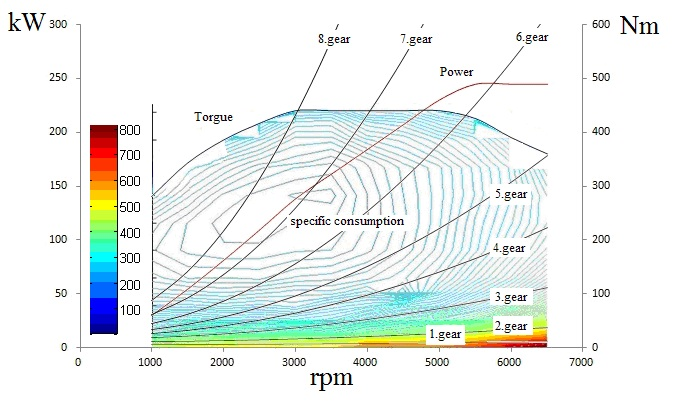
We have many gears for better efficiency with ICE, because every ICE has very narrow areas of RPM×torque that give you acceptable efficiency (typically those with high mean effective pressure). You could totally get away with three gears and still get to 150 km/h, it's just that it will be a lot less efficient. Electric motors don't have this particular problem, and they don't need a start gear that is a lot shorter…

> every ICE has very narrow areas of RPM×torque that give you acceptable efficiency (typically those with high mean effective pressure). You could totally get away with three gears and still get to 150 km/h, it's just that it will be a lot less efficient.

It isn't that narrow[2]. Engines with fewer gears aren't particularly less efficient, they're just MUCH slower. Look at a map of gears[2]: the top gears are in the efficient range, but the lower gears are only there to allow you to rev the engine high while accelerating. In the ratios you gave, you could cut out 1, 3, 4 and only use gears 2, 5 and 6 and be able to get around fine- you start in second and then shift up as soon as you're rolling. You'd have a much more efficient car but you'd be incredibly slow.

[1]: https://qph.fs.quoracdn.net/main-qimg-0c6c45106b28601fc1aef4...

[2]: http://www.posterus.sk/wp-content/uploads/p12975_02_obr02.pn...

Re: Electric motor design claims remarkable improvements

#60

I’ve always wondered why no one is researching motors that use electric fields instead of magnetic?

Relative permeability is the characteristic of electrical steels that lets them carry magnetic fields. M19 steel has a permeablity ~8500x higher than vacuum[1].

Permittivity is the characteristic that allows dielectrics to transmit electrical fields. The vast majority of dielectrics are humans have very low breakdown voltages; high voltage motors are often dangerous to be around.

Fundamentally it's because materials lend themselves much better to magnetics.

[1]: https://pdfs.semanticscholar.org/9303/19ba00b3c7329308df2479...

Post reply on HN