Live data from Hacker News

“Origins of the Apple human interface” lecture – an annotated transcription

morrick.me

31–40 of 40 posts

Re: “Origins of the Apple human interface” lecture – an annotated transcription

#31
post #22

There’s a story (Prometheus myth) that Steve Jobs and the Mac team copied the human graphical interface idea from Xerox. A fascinating read about it here: https://web.stanford.edu/dept/SUL/sites/mac/parc.html

Not a story it's a fact of history. Xerox PARC is the lab where Xerox invented several parts of what defined computers up to today (the window oriented gui with mouse, the laser printer, ethernet,...They're even credited for invented the wysiwyg text editor, so basically Word), inventions that were then completely ignored by Xerox while the other companies around jumped on them. Bill Gates is much more open about how the Microsoft and Apple gui was copied / stolen from Xerox, but then again he and Microsoft never had the "we are the first / we invented it" thing that is so important to Apple mythos.

Reading about Xerox parc is super weird though because it feels like the place was handled the way you expect a publicly funded place to be, being so open to share their finding with competitors and all. Truly a golden era, today those are much more closed, even places like MS Research.
Re: “Origins of the Apple human interface” lecture – an annotated transcription

#32
post #24

Earlier quoted context omitted.

This is kind of how I feel about Windows 95. I remember when there was only DOS, and then Windows 3 came out, and then Windows 95 which seemed like the very perfection of UI. Since then it seems to have gone downhill. Not very many true innovations, which is partly why I started experimenting with desktop Linux and finally switched to Mac OS X 10.4, because it felt like the final evolution of the desktop. Nowadays, n…

I think it’s not just nostalgia. Windows 95 was a huge step for MS and introduced most of the UI elements that we are still using now. Since then I have trouble seeing any fundamental improvements in newer Windows versions. I’d be happy to go back to the UI of 95 or XP compared to the latest Windows 10 stuff. I just don’t it really got any better. Just slower.

Windows 95 was a major step into OSes too. I remember how well done the UI was. It became silly in 98 and then on XP with crazy design styles that. I don't know if the original design team left Middle Earth, but in two years they've experimented too much and Windows became normless while Apple maintained guidelines with better hand.

Re: “Origins of the Apple human interface” lecture – an annotated transcription

#33

Earlier quoted context omitted.

Dock does a lot more than just the part you can see at the bottom of the screen, so you're not going to be able to truly get rid of it without breaking pretty much everything to do with Spaces and Launchpad along with it. Perhaps you could set it to auto-hide and only show after an extremely long delay?

That's exactly my point. Apple wove so much functionality into the Dock that it's now effectively impossible to remove it. And I may be weird, but Spaces and Launchpad are two of the things I immediately turn off, along with Mission Control, Dashboard, Expose, etc. because all of the above consume needless RAM or just get in my way.

If you don’t like those things, then I don’t see why you can’t just prevent it from launching?

Re: “Origins of the Apple human interface” lecture – an annotated transcription

#34
post #19

Thank you: to the person who posted the link to my blog; and to all the people who came and checked it out. I'm glad that my transcription efforts have been of use! Cheers, Riccardo Mori

Hi, thanks for your work. Regarding: "I’ve listened to this bit many times and I’m pretty sure Tesler says ‘foils’, and I guess he’s using the term in its architecture‐related meaning of “a leaf‐shaped curve formed by the cusping of an arch or circle” — But I welcome any correction from native English speakers."

He surely talks about preparing the "transparency" foils for presenting them using the overhead projectors:

https://en.wikipedia.org/wiki/Transparency_(projection)

"A transparency, also known variously as a viewfoil, foil, or viewgraph"

That's how the presentations were done at that time, using the:

https://en.wikipedia.org/wiki/Overhead_projector

The good side was that you were able to prepare the foils before but then annotate any (i.e. write or draw on it) during the presentation, which had its own dynamic -- it could have been a result of the interaction with your viewers -- like while you were answering some question.

The foils were even used in the very talk you transcribed: https://youtu.be/OW-atKrg0T4?t=1295

Re: “Origins of the Apple human interface” lecture – an annotated transcription

#35
post #19

Thank you: to the person who posted the link to my blog; and to all the people who came and checked it out. I'm glad that my transcription efforts have been of use! Cheers, Riccardo Mori

Regarding the foil reference, it’s actually a reference to something that technology has made obsolete. Back then people used to use overhead projectors for presentations, and the sheets of transparent film were called foils. There were sometimes hand drawn with markers, people could have used LisaDraw to print foils. Later on programs like Aldus Persuasion and Microsoft PowerPoint were used, but for a long time their output was printed rather than used directly like most people know today.

Re: “Origins of the Apple human interface” lecture – an annotated transcription

#36
post #23
post #22

There’s a story (Prometheus myth) that Steve Jobs and the Mac team copied the human graphical interface idea from Xerox. A fascinating read about it here: https://web.stanford.edu/dept/SUL/sites/mac/parc.html

Well, there's always that quote from Bill Gates when Jobs accused MS of stealing Apple's GUI design: “Well, Steve [Jobs]… I think it’s more like we both had this rich neighbour named Xerox and I broke into his house to steal the TV set and found out that you had already stolen it.” - Bill Gates Source: https://www.goodreads.com/quotes/824084-well-steve-jobs-i-th...

I always found it weird that Gates characterized it as Apple "stealing" the TV set. Xerox gave the TV set away! They had made a pre-IPO investment in Apple and in exchange the executives were happy to show Apple what they were working on (to the dismay of the actual researchers)

Re: “Origins of the Apple human interface” lecture – an annotated transcription

#37
post #35
post #19

Thank you: to the person who posted the link to my blog; and to all the people who came and checked it out. I'm glad that my transcription efforts have been of use! Cheers, Riccardo Mori

Regarding the foil reference, it’s actually a reference to something that technology has made obsolete. Back then people used to use overhead projectors for presentations, and the sheets of transparent film were called foils. There were sometimes hand drawn with markers, people could have used LisaDraw to print foils. Later on programs like Aldus Persuasion and Microsoft PowerPoint were used, but for a long time thei…

Thank you. I'll make the necessary changes to my commentary in the transcription. Cheers!

Re: “Origins of the Apple human interface” lecture – an annotated transcription

#38
post #34
post #19

Thank you: to the person who posted the link to my blog; and to all the people who came and checked it out. I'm glad that my transcription efforts have been of use! Cheers, Riccardo Mori

Hi, thanks for your work. Regarding: "I’ve listened to this bit many times and I’m pretty sure Tesler says ‘foils’, and I guess he’s using the term in its architecture‐related meaning of “a leaf‐shaped curve formed by the cusping of an arch or circle” — But I welcome any correction from native English speakers." He surely talks about preparing the "transparency" foils for presenting them using the overhead projectors…

Thanks! Maybe it's because I was overwhelmed by the transcription work itself, but while I know this meaning of 'foils', I was totally misled. Tesler was talking about this drawing program and all I did was fixating on geometric shapes, haha. Cheers!

Re: “Origins of the Apple human interface” lecture – an annotated transcription

#39
post #11

As a Macintosh user since System 7, I cannot be more in love with the old UIs and UX. I really enjoy the pixel era. Certainly, the introduction to OS X took Apple to a different level, but the OS 9 UI for me will be one of the best examples of the epitome of OS. Good in interactions, colors, details, sound feedback. I will always thanks Apple for such work poured on an OS.

Yes, when it comes to icons, pictures, non-trivial logos etc. the "pixel" style has always been the most effective way of coming up with something that will look appealing even with minimal effort. Even on modern screens, a properly-upscaled, pixel-based icon usually looks a lot better than the symbolic, vector-based look you most often see today, while taking a lot less time and effort to create. You can see this ve…

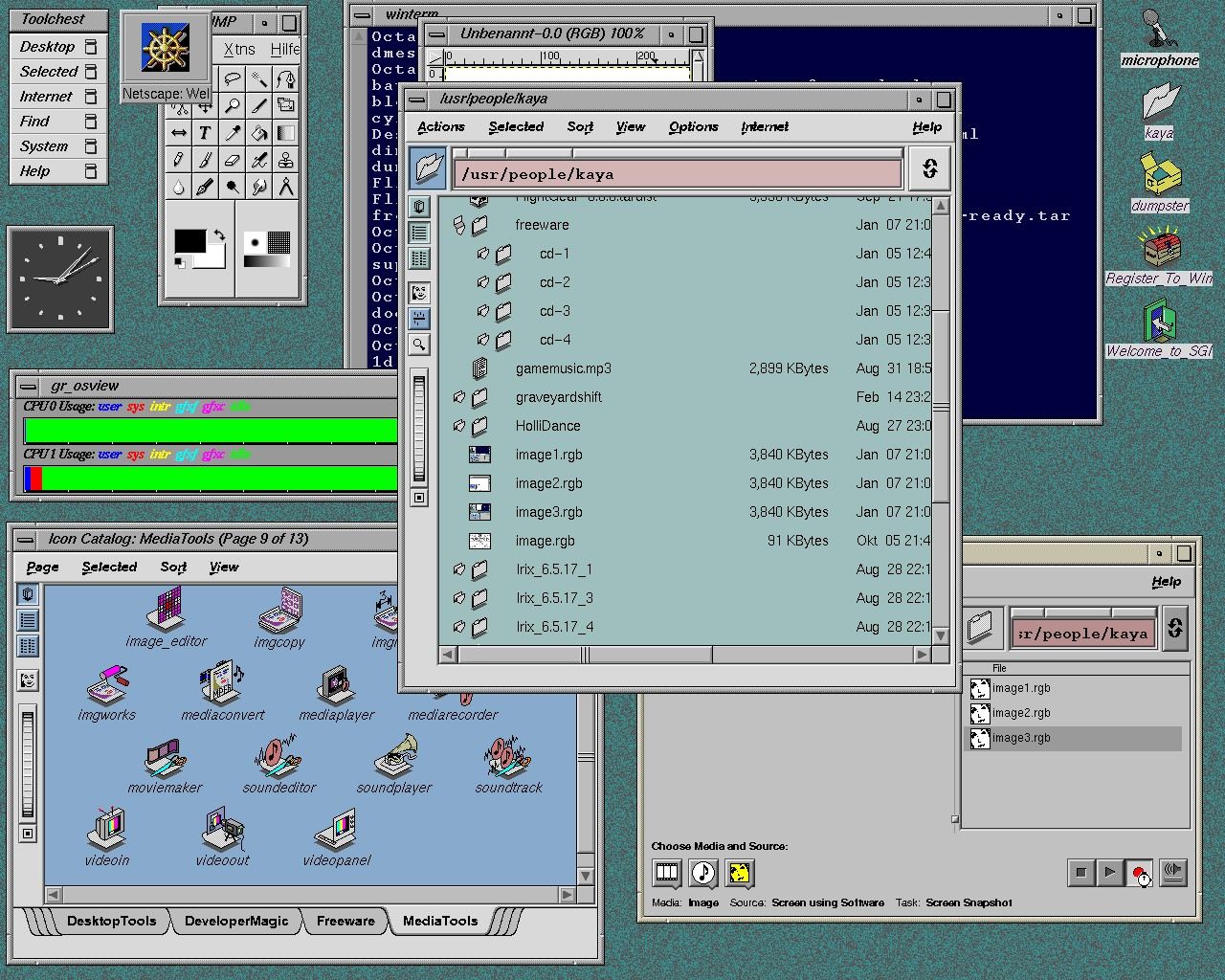
Right, the low fidelity of 32x32pixel icons means they are easy to "read" and make sense of. Conversely, SGI's IRIX OS had vector icons which made them extremely varied and IMO they sometimes required a lot of effort to understand. Check this screenshot[0] to get an idea of what I mean. They are not immediately obvious due to their high level of detail.

That said, I found it super cool that the icons can scale, right in the file explorer (using the "scroll wheel" type thing on the left side of the window)!! :)

[0] https://software.majix.org/irix/screenshots/screen.5.big.jpg

Re: “Origins of the Apple human interface” lecture – an annotated transcription

#40

Earlier quoted context omitted.

Yes, when it comes to icons, pictures, non-trivial logos etc. the "pixel" style has always been the most effective way of coming up with something that will look appealing even with minimal effort. Even on modern screens, a properly-upscaled, pixel-based icon usually looks a lot better than the symbolic, vector-based look you most often see today, while taking a lot less time and effort to create. You can see this ve…

Right, the low fidelity of 32x32pixel icons means they are easy to "read" and make sense of. Conversely, SGI's IRIX OS had vector icons which made them extremely varied and IMO they sometimes required a lot of effort to understand. Check this screenshot[0] to get an idea of what I mean. They are not immediately obvious due to their high level of detail. That said, I found it super cool that the icons can scale, right…

I never had the chance to use SGI's IRIX OS. I was teenager and the pricess where so prohibitive for such workstations. I had the luck to start a job where the owner had 15 Macs, among them, they throw me all the older models so I learnt that way.
Post reply on HN