Live data from Hacker News

The student loan crisis is really an underemployment catastrophe

medium.com

251–260 of 370 posts

Re: The student loan crisis is really an underemployment catastrophe

#251

I'm not sure the author's suggestion that potential students be diverted to trades/coding bootcampts etc., will solve too much, and instead may simply shift the problem into those trade industries as well. Somewhere in the ballpark of 2,000,000 students earn a bachelors degree each year. Let's say 25% of students should be diverted into trade schools instead. That will mean an additional 500,000 student per year ente…

We just need to reduce or eliminate government backed student loans and the problem will take care of itself. This "crisis" is almost a replay of the housing crisis we just had, government backed loans encourage lenders to lend out money to people who are not qualified for the loan. It doesn't make sense to keep loaning out tens of thousands of dollars to 18 year old kids that have no income [yet] and no real plan to…

> We just need to reduce or eliminate government backed student loans and the problem will take care of itself

Why not just go directly to a caste system?
Re: The student loan crisis is really an underemployment catastrophe

#252
post #159

Earlier quoted context omitted.

There are two books that cover this subject well: The Case Against Education : https://jakeseliger.com/2018/03/12/the-case-against-educatio... , which argues that most "education" is really signaling, not human capital acquisition, and Paying for the Party : https://jakeseliger.com/2014/04/27/paying-for-the-party-eliz... , which argues that many schools have evolved some substantive majors and some non-substantive ma…

It behooves one to read the comment thread replying to Dr. Krugman's post. Many arguments emphasizing the disparity between real output vs. employment in manufacturing. Paul Krugman is wrong surprisingly often about these sorts of things. He cherry-picks one graph and says that this graph, combined with the opinions of cherry-picked esteemed colleagues, supports his conclusion, when ample evidence exists and is provi…

>> Paul Krugman is wrong surprisingly often

Not that surprising if you examine his incentive structure. It is best for him to misrepresent issues like this, QE methods during the Bush/Obama administrations, etc.

Re: The student loan crisis is really an underemployment catastrophe

#253

I'm not sure the author's suggestion that potential students be diverted to trades/coding bootcampts etc., will solve too much, and instead may simply shift the problem into those trade industries as well. Somewhere in the ballpark of 2,000,000 students earn a bachelors degree each year. Let's say 25% of students should be diverted into trade schools instead. That will mean an additional 500,000 student per year ente…

There are two books that cover this subject well: The Case Against Education : https://jakeseliger.com/2018/03/12/the-case-against-educatio... , which argues that most "education" is really signaling, not human capital acquisition, and Paying for the Party : https://jakeseliger.com/2014/04/27/paying-for-the-party-eliz... , which argues that many schools have evolved some substantive majors and some non-substantive ma…

>> Then we'd see soaring productivity, which we don't see: https://twitter.com/paulkrugman/status/1140259227908411392

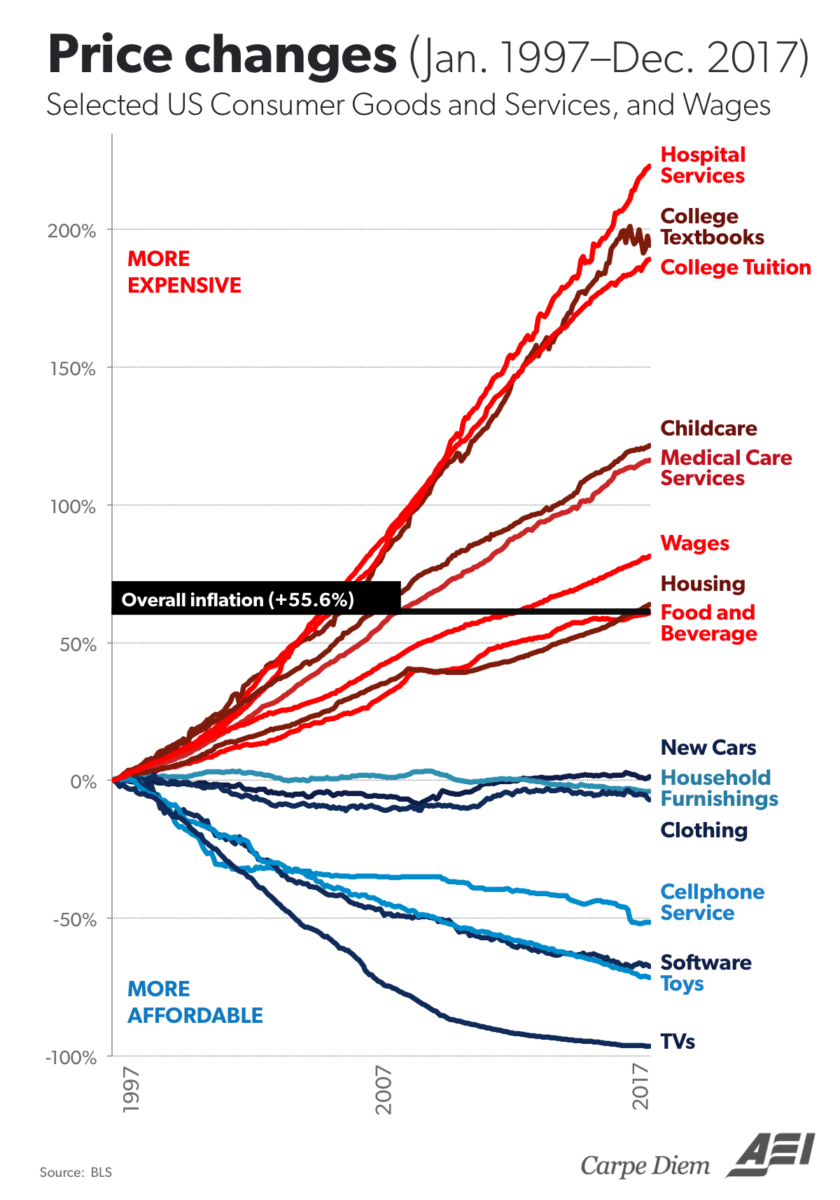
This is like using a total number for "inflation" to assume that costs have not gone up. And yet...

https://ritholtz.com/wp-content/uploads/2018/02/pricechanges...

Childcare, hospital services, college textbooks, college tuition, childcare, and medical services way overindex the average inflation.

TVs, Software, Toys, Cellphone Service, New Cars, and Clothing all underindex the average inflation.

What do those sectors underindexing sound like regarding productivity and purchasing power?

EDIT: Also consider two other effects: We are automating productive jobs, and people are replacing those jobs with very low productivity jobs (service sector).

Re: The student loan crisis is really an underemployment catastrophe

#254
post #237

Earlier quoted context omitted.

We just need to reduce or eliminate government backed student loans and the problem will take care of itself. This "crisis" is almost a replay of the housing crisis we just had, government backed loans encourage lenders to lend out money to people who are not qualified for the loan. It doesn't make sense to keep loaning out tens of thousands of dollars to 18 year old kids that have no income [yet] and no real plan to…

But without the student loans, the under privileged will not be able to afford said education - I don't want to see a society where only those who can afford it go to university.

This simply isn't true. Schools offer crazy financial aid and there are junior colleges / state universities that offer 100% of aid to impoverished individuals.

The people taking malinvestment (student loans for unproductive means / negative ROI) are firmly in the middle class bracket, both lower/upper sides of it.

Re: The student loan crisis is really an underemployment catastrophe

#255
post #72

I'm not sure the author's suggestion that potential students be diverted to trades/coding bootcampts etc., will solve too much, and instead may simply shift the problem into those trade industries as well. Somewhere in the ballpark of 2,000,000 students earn a bachelors degree each year. Let's say 25% of students should be diverted into trade schools instead. That will mean an additional 500,000 student per year ente…

The problem is the government subsidizes loans.

It is that in addition to the fact that they cannot be discharged in bankruptcy under the majority of cases (nearly all).

Re: The student loan crisis is really an underemployment catastrophe

#256

Earlier quoted context omitted.

Net boon to the economy in terms of GDP, but it does have some negative effects on wages and employment.

Not necessarily. A lot of immigrants are job creators. Think of how many startup founders are foreign, and have created a lot of money and jobs for a lot of people. Hell, look at how well represented foreigners are in the upper echelons of the FAANGs. Even Sergey Brin was born in Moscow.

> A lot of immigrants are job creators.

And a lot aren't. There's a reason you throw away outliers in statistics.

Re: The student loan crisis is really an underemployment catastrophe

#257
post #208

This is a bit like saying "People buying luxury cars is just a problem with people not having high-paying jobs". It seems more fruitful to focus on what product is being sold through state-subsidized loans and if they provide the necessary value. Bloated administrations is largely to blame for the increased cost, and a middle class student getting a student loan they can't default on for a degree without earning pote…

In this case, though, the "product that [was] being sold" that made these students originally go to school, is employment—or rather, a proxy signal for employability that the consumers of the product hope will get them employment. People consume education when they can't find a job, in the hopes that they'll become more employable, even though this makes the problem of their unemployment more dire rather than less (b…

Recessions are cyclical though, so it seems a rational decision to go to school during a recession as an investment towards greater employability, if one is unable to find a job, to take better advantage when the economy turns positive again.

Re: The student loan crisis is really an underemployment catastrophe

#258

I'm not sure the author's suggestion that potential students be diverted to trades/coding bootcampts etc., will solve too much, and instead may simply shift the problem into those trade industries as well. Somewhere in the ballpark of 2,000,000 students earn a bachelors degree each year. Let's say 25% of students should be diverted into trade schools instead. That will mean an additional 500,000 student per year ente…

1) if it does turn out to be true that we need "fewer workers", that's great, we just move to a 30-hour work week (or 20, or whatever). We once had 6-day work weeks, or sometimes even 7, and it was productivity gains that allowed us to move to 5. We can move again. 2) But, I'm not sure it's even true. We mostly got to where we are by having all the manufacturing done in 3rd world countries for pennies. It's not that…

> 1) if it does turn out to be true that we need "fewer workers", that's great, we just move to a 30-hour work week (or 20, or whatever). We once had 6-day work weeks, or sometimes even 7, and it was productivity gains that allowed us to move to 5. We can move again.

Shorten the work week and it is hourly workers getting screwed. Unless we think, for some reason, corporations will take it upon themselves to pay more for less, especially since the labor pool would be more competitive with increases in automation.

Re: The student loan crisis is really an underemployment catastrophe

#259

Earlier quoted context omitted.

> Gas mileage is a very marginal improvement in any of the vehicles I'm interested in, on the order of 16 mpg then to maybe 20, now. this says more about the vehicles you're interested in than the overall trend in vehicle efficiency. I get ~34mpg out of my hot hatch with a heavy right foot.

Not really. I used to drive an Saab turbo from the 80s that got close to 30mpg. Old civics pushed 40. 34 mpg isn’t really an improvement over that.

sure, but that was probably a much lighter car. I realize I'm moving the goalposts a bit here, but when you consider the improvements in crash safety, engine performance, and efficiency together, cars really are a lot better today than they were 20+ years ago. the one thing that has suffered is the weight and size of the vehicles, but imo it's worth being a lot less likely to die in a car.

Re: The student loan crisis is really an underemployment catastrophe

#260

This is a bit like saying "People buying luxury cars is just a problem with people not having high-paying jobs". It seems more fruitful to focus on what product is being sold through state-subsidized loans and if they provide the necessary value. Bloated administrations is largely to blame for the increased cost, and a middle class student getting a student loan they can't default on for a degree without earning pote…

Agree with most of this, but there are good reasons to think education costs are not driver by bloated administration. https://marginalrevolution.com/marginalrevolution/2019/05/bl...

I don't know the answer, but it is odd that there's no curve for "faculty share" of university costs. If this were a paper in my field I'd really wonder why the key curve is missing. (Imagine a candy store P&L with no line for "cost of candy.")
Post reply on HN