Live data from Hacker News

Crimes in Concrete

firstthings.com

121–130 of 134 posts

Re: Crimes in Concrete

#121

Earlier quoted context omitted.

But a better way to read it is that regulation is protecting us from the mistakes of the past. Unless you fancy inhaling asbestos?

>But a better way to read it is that regulation is protecting us from the mistakes of the past. Unless you fancy inhaling asbestos? Well since we're playing the false dichotomy game I'd gladly take prosperity with a side of lung cancer over cancer free stagnation.

Progress isn't going to be held up by a couple of acres remaining idle because nobody wants to pay the remediation costs.

Your notion of progress is weak.
Re: Crimes in Concrete

#122

The only pre-20thC buildings that remain are the ones that survive. The ones that survive are the ones we like and that are able to survive (not plywood and well built). Survival is the real measurement of how much we like it - it is the ultimate arbiter of aesthetics/beauty/cultural significance/engineering excellence, and it trumps all the chatter of self-appointed critics. If it's garbage, we tear it down or stop…

Sadly, false: "Survival is the real measurement of how much we like it". Many structures survive because their destruction would release regulated toxins, which were unregulated when built.

On the other hand, they probably aren't still being used, either. Nor are they likely to be civic focal points like a city hall.

Re: Crimes in Concrete

#123
post #85

The only pre-20thC buildings that remain are the ones that survive. The ones that survive are the ones we like and that are able to survive (not plywood and well built). Survival is the real measurement of how much we like it - it is the ultimate arbiter of aesthetics/beauty/cultural significance/engineering excellence, and it trumps all the chatter of self-appointed critics. If it's garbage, we tear it down or stop…

> The only pre-20thC buildings that remain are the ones that survive. The ones that survive are the ones we like and that are able to survive (not plywood and well built). Unfortunately, the city I live in has been burned, bombed, or otherwise destroyed a couple of times since it became a city in the late middle ages. This destruction happened regardless of likeability or sturdiness of the buildings involved.

If the buildings are valued enough, and the society can afford it, they are often rebuilt.

Re: Crimes in Concrete

#124
post #35

The only pre-20thC buildings that remain are the ones that survive. The ones that survive are the ones we like and that are able to survive (not plywood and well built). Survival is the real measurement of how much we like it - it is the ultimate arbiter of aesthetics/beauty/cultural significance/engineering excellence, and it trumps all the chatter of self-appointed critics. If it's garbage, we tear it down or stop…

Comparing buildings by their external appearance is never going away, but many people just don’t care. Brutalist is thus never going away simply because at it’s core it was very utilitarian. The fad was mostly an over reaction, but sometimes you just want a large concrete box and anything else is a waste of resources.

Nobody minds brutalist architecture when it's used for a fortified airplane hangar.

Re: Crimes in Concrete

#125

Earlier quoted context omitted.

It's cheaper to build undecorated boxes. Calling it high art is just a cover. There is also a skill shortage since nobody has paid for quality in generations. The craftsmen that meticulously laid intricate art deco brickwork don't exist anymore and no modern mason can seem to do as good a job. Instead we get uninspired generic concrete and glass prisms designed to maximize square footage for the landlords.

Also work and time was cheaper then, they could spend centuries building the same cathedral with nobody complaining about the ballooning price.

"nobody complaining about the ballooning price."

Very few people would have been in a position to complain about the ballooning price.

Re: Crimes in Concrete

#126
post #22

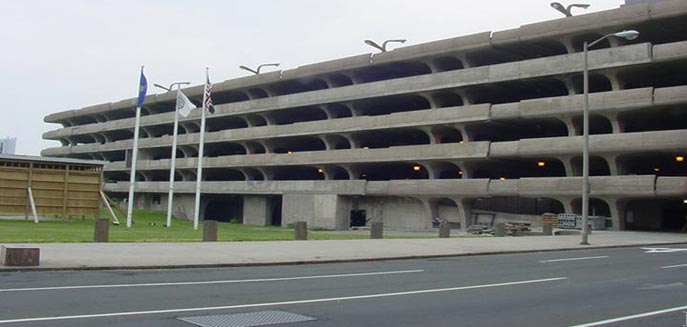
It's always been kind of amazing to me that people will get all upset over a building but that often changes with time. Same thing with a piece of art. Locally here there was a most controversial design for a parking garage. People just hated it but now its almost adored. https://foursquare.com/v/the-habitrail-parking-garage/4eb994... Same thing with the new Broad Art Museum by the late architect Zaha Hadid. Totally…

The color on the parking garage helps.

Compare this monster in New Haven.

https://nrsys.com/site/wp-content/uploads/temple_street.jpg

Re: Crimes in Concrete

#127
post #118

Earlier quoted context omitted.

It's non-sense, past has a lot of example of simple architecture done by people without many resources acommodating the mass. Rome was already 1 million people during the first millenia, there were buildings with 6 or 7 floors, they were not all covered with classical friezes and statues costing extra-labor.

> done by people without many resources [Waits] > Rome was already 1 million people during the first millenia, there were buildings with 6 or 7 floors, Did you really choose an example of a society that used slave labor extensively? It's hard to make a comparison due to opportunity cost. Imagine you are a person with the innate competence and dedication to eventually become a master craftsman. Do you learn woodworkin…

Are you trying to compare cellphone app development with woodworking or stonework ? It needs more time to be a good woodworker but I think more people can learn the job (you don't need to be literate). Any actual construction worker (and there are a lot more than cellphone app developers) could build with ancient building techniques like vaulted ceilings given time and instructions. It's not a problem of craftsmanship or leverage, it's more a problem of standardization without benefits (I do not think concrete flat ceiling are really less expensive than vaulted for one or two floors buildings, Christopher Alexander reports that they still build houses like this in Mexico, doing vaults with simple crossed wood splines[1]).

[1]: http://www.flyingconcrete.com/vaults.html

Re: Crimes in Concrete

#128
post #15

Was just at Umass Amherst for my son's graduation. It's an open air museum of brutalism. Breuer's student center building: https://en.wikipedia.org/wiki/Murray_D._Lincoln_Campus_Cente... The nearby parking garage is better, actually. The Fine Arts Center: https://en.wikipedia.org/wiki/Fine_Arts_Center_(Amherst,_Mas...

> It's an open air museum of brutalism. I am not sure how to interpret your comment. Was this meant to be in a negative sense or in a positive sense? Or without any judgement?

It's from "beton brut" meaning raw concrete.

Re: Crimes in Concrete

#129
post #25

I'm no architect, but I feel it's absolutely crazy to throw completely different styles of buildings into the same box, label them modernist and blanket reject them. I absolutely love some [1], but hate others [2]. I'm sure most people feel the same. [1] https://www.elledecor.com/design-decorate/g8674077/modern-ho... [2] https://www.elledecor.com/design-decorate/g8674077/modern-ho...

Glass houses are a thermal crime. I'm from south of France, suck kind of houses are stupid here, but I think also anywhere. There is a typical architecture here, for countryside houses, that of the "Bastide", which is adapted to the climate. In hot climate, it's too much opening during summer, in cold climate it's too much opening during winter. Maghreb, spain and all countries around the Mediterranean have their own…

> Glass houses are a thermal crime.

I don't think this is true. Some of the most energy efficient houses are passive solar houses that use large glass surfaces for heating that are covered using shades in the heat, but also use high thermal mass materials for heat/cold storage.

From an aesthetics perspective, many people like natural light, I wouldn't want to live in the houses you provided as examples for that reason.

Re: Crimes in Concrete

#130

Earlier quoted context omitted.

The Hobart building is pretty to look at. But if I'm actually going to spend my time in the building, I would much rather have the floor-to-ceiling windows of a generic modern steel-and-glass tower. I wonder how much of this design trend is due to the development of better materials (e.g. more insulating glass).

Why ?

Natural light. View. The illusion of space rather than confinement.
Post reply on HN