Live data from Hacker News

Quake II RTX: Re-Engineering a Classic with Ray Tracing Effects on Vulkan

nvidia.com

101–110 of 169 posts

Re: Quake II RTX: Re-Engineering a Classic with Ray Tracing Effects on Vulkan

#101
post #51

Earlier quoted context omitted.

Maybe teams could use tools like AI Gigapixel (discussed on here yesterday) to upsample older textures? I agree with you that there is asset work to be done, but I bet there are tools out there that can simplify and automate this process quite a bit today.

I couldn’t find the tool you mentioned but I found a thread on another site about a GAN that can upscale images, and using that one to generate highres textures. https://www.resetera.com/threads/ai-neural-networks-being-us...

This was the article linked in the thread from yesterday.. It relates to upsampling TV show special effects but I think similar tools could be used:

https://captrobau.blogspot.com/2019/03/remastering-star-trek...
Re: Quake II RTX: Re-Engineering a Classic with Ray Tracing Effects on Vulkan

#102

Earlier quoted context omitted.

> it's actually due to many factors To add to this point, at 1:35 in the video they compare with / without volumetric ligthing except, well, volumetric lighting has been used in games for a while now. The "before" should show a non-RTX lighting instead of just nothing at all.

I remember one of the big selling points of the Dreamcast in 1998 was volumetric lighting.

Fun fact: The Dreamcast GPU was a precursor to the PowerVR GPUs used in iPhones and many Androids.

Also, Qualcomm’s popular Adreno line on Android GPUs has its roots in the Xbox360 GPU.

Re: Quake II RTX: Re-Engineering a Classic with Ray Tracing Effects on Vulkan

#103
post #51

Earlier quoted context omitted.

Maybe teams could use tools like AI Gigapixel (discussed on here yesterday) to upsample older textures? I agree with you that there is asset work to be done, but I bet there are tools out there that can simplify and automate this process quite a bit today.

I couldn’t find the tool you mentioned but I found a thread on another site about a GAN that can upscale images, and using that one to generate highres textures. https://www.resetera.com/threads/ai-neural-networks-being-us...

And here's the AI Gigapixel tool:

https://topazlabs.com/ai-gigapixel/

Re: Quake II RTX: Re-Engineering a Classic with Ray Tracing Effects on Vulkan

#104

The new lighting makes such a dramatic difference. Despite the same low polygon count, the levels seem much more lifelike. If all the game classics are re-released with raytracing engines, I will be all over it. The next years are going to be good.

I'm very skeptical. This is not just RTT; there's a big amount of rework. Likely, any old game would look significantly better with such development effort (in other words, with any good remastering). This could be considered a great market stunt - the graphical improvement is touted to be due to RTX (ray tracing), while it's actually due to many factors. On top of that, it misleads people into thinking that this typ…

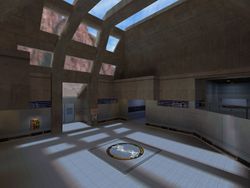
But it's not down to polygons or details in the environment - the simple architecture still looks realistic with the addition of realistic lighting. In the quest for realism, modern games have so many details, dirt and grit everywhere [1]. Perhaps going forward artists can let the lighting do more work and still represent realistic clean environments. I loved this blocky room in Half Life 1 for the dramatic (prebaked) lighting: http://combineoverwiki.net/images/thumb/3/37/C2a4e_lobby.jpg...

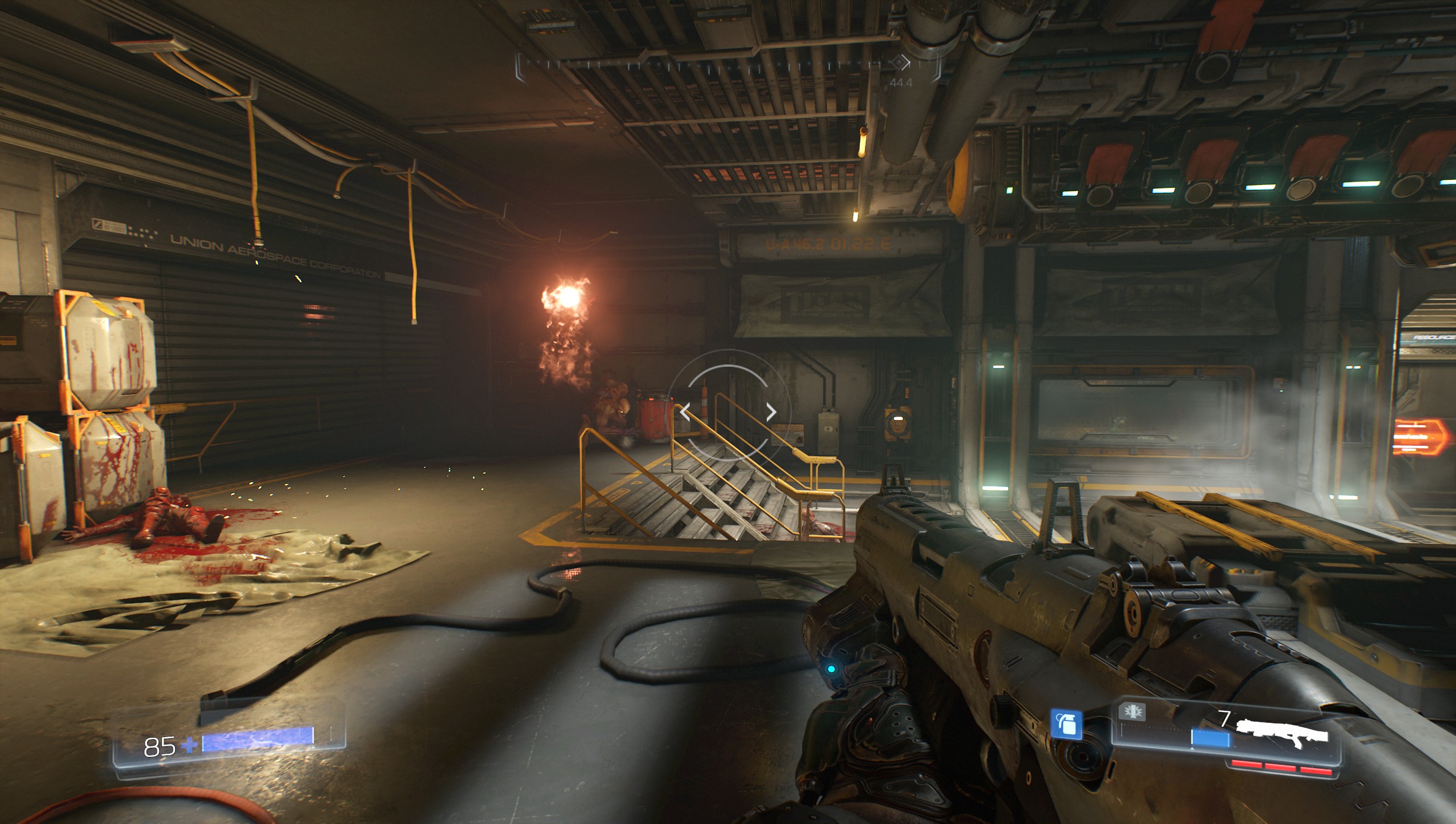
[1] just look at Doom 2016: https://cdn.arstechnica.net/wp-content/uploads/2016/05/20160...

Re: Quake II RTX: Re-Engineering a Classic with Ray Tracing Effects on Vulkan

#105
post #50

Earlier quoted context omitted.

Yeah checking out some of the comparison photos and the textures have definitely received a bump in resolution/quality. Most obvious to me in the quake logo/skull on the left of this[1] image. 1. https://images.nvidia.com/geforce-com/international/comparis...

> Quake 2 XP high-detail weapons, models and textures; optional NVIDIA Flow fire, smoke and particle effects, and much more!

Yes, they should compare it to Quake 2 XP which is already a nice improvement over the original graphics:

https://www.youtube.com/watch?v=0uurJ-zjhok

Re: Quake II RTX: Re-Engineering a Classic with Ray Tracing Effects on Vulkan

#106
can someone help me understand what "ray tracing" means in this case?

i've read a few technical articles about ray-tracing, but they mostly describe it as a rudimentary (largely outdated) way of achieving 3d effects with relatively little code, and with severe limitations (walls must be orthonormal, changes in elevation require extra work, etc.). i understand ray-tracing at this level (break the view into columns, set the fill height of the column according to the distance of the ray).

then i see marketing-style articles like this one that use the same term to describe advanced lighting effects, material reflections, etc. and i don't understand the technological jump. what am i missing?

edit: i was thinking of "ray casting", not "ray tracing". thank you for the corrections below.

Re: Quake II RTX: Re-Engineering a Classic with Ray Tracing Effects on Vulkan

#107

The new lighting makes such a dramatic difference. Despite the same low polygon count, the levels seem much more lifelike. If all the game classics are re-released with raytracing engines, I will be all over it. The next years are going to be good.

It's cool, but even back in the day people that competitively played Quake 2 & 3 would turn down every detail to be very low, sans the resolution. In part because it helped with lag, but it also made spotting enemies much easier. The lighting in this demo is very nice, but at least in the Quake world, no one would really use it because it's very distracting, specifically the lighting.

I would use ray tracing to get a non-linear camera, specifically so I could have a wider field of view with less distortion than the linear camera & wide fov. Back on Q3, everyone would use 120 or 130 degree fov because that was the best compromise between seeing things to your side and everything getting squished into the center of your screen. If I could have played with 180, I would have.

Your lighting point is reasonable in the sense that this demo was made to demonstrate the dramatic lighting without respect to gameplay. On the other hand games are already clearly going toward HDR and physical and dramatic lighting. If Quake had HDR lighting, it would look just as good but it would be less distracting because it would have been directed and designed to support the gameplay.

This version also has dynamic adaptation which would have been awesome to have back in the day - some of the dark areas are too dark and it’s great to have the lighting automatically adjust so that at least I can see.

Re: Quake II RTX: Re-Engineering a Classic with Ray Tracing Effects on Vulkan

#108

can someone help me understand what "ray tracing" means in this case? i've read a few technical articles about ray-tracing, but they mostly describe it as a rudimentary (largely outdated) way of achieving 3d effects with relatively little code, and with severe limitations (walls must be orthonormal, changes in elevation require extra work, etc.). i understand ray-tracing at this level (break the view into columns, se…

What you are describing sounds more like ray casting than ray tracing.

Ray casting is the old Wolfenstein 3D look: https://en.wikipedia.org/wiki/Ray_casting

Ray tracing is what Pixar uses for Toy Story, Monsters Inc, etc... https://en.wikipedia.org/wiki/Ray_tracing_(graphics)

And then the new hotness for offline rendering is Path Tracing, which is a form really good but really hard to accelerate form of ray tracing: https://en.wikipedia.org/wiki/Path_tracing

And yes fundamentally all of these are "shoot rays out from the camera", hence the very specific terminology used for each to disambiguate which approach to shooting out rays from the camera is being used and what happens when rays hit a thing.

Re: Quake II RTX: Re-Engineering a Classic with Ray Tracing Effects on Vulkan

#109

can someone help me understand what "ray tracing" means in this case? i've read a few technical articles about ray-tracing, but they mostly describe it as a rudimentary (largely outdated) way of achieving 3d effects with relatively little code, and with severe limitations (walls must be orthonormal, changes in elevation require extra work, etc.). i understand ray-tracing at this level (break the view into columns, se…

[deleted]

Re: Quake II RTX: Re-Engineering a Classic with Ray Tracing Effects on Vulkan

#110

The original textures were done by Adrian Carmack. I think he's a genius as much as John. He was capable of making a difficult theme really work: a mix between dark future and fantasy. Specially fantasy with guns is terribly difficult and I don't recall having seen a game that succeeded in making that mix as well as the Quake series.

well there's this 40k thing
Post reply on HN