Quote: That doesn’t necessarily mean an end to SNCF’s dominance of high-speed rail. As things stand, most TGV lines don’t turn a profit but are made feasible by subsidies, paid by a state that clearly sees the economic advantages of an extensive high-speed network. Competitors would either need to make substantial savings on operational costs, or limit themselves to the most lucrative connections, such as the profit-…
That's why it's a monopoly. The region can tell companies "who can make these lines (some profitable, some less) for the lowest subsidies, while fulfilling these other requirements?" Then the private companies compete, one wins and has to serve cake routes as well as empty ones, because the contract with the region makes them do it. Everyone wants your region? Great, you can lower the subsidies, or even tax the compa…
France’s new high-speed trains
221–230 of 239 posts
Re: France’s new high-speed trains
#222Earlier quoted context omitted.
Its part of the US attitude of ignoring modern engineering
I would argue that most of modern engineering originates in USA, with possible exception of automotive industry :)
Re: France’s new high-speed trains
#223Earlier quoted context omitted.
Err UK rail was famously terrible before "privatisation". Not that privatisation is the answer, nor that being public was at fault, but I'm not sure rewriting history is helpful. Looking at UK water companies being privatised so their owners can stuff them full of debt to get around the profit caps is probably a better case study. Profit percentage caps are silly because the obvious way to make more money is to make…
I read in a lot of articles that it is actually more terrible for a lot of tracks after privatisation in the UK. What happens is that companies focus on the most profitable tracks, so the other ones are not well maintained. An example: https://www.theguardian.com/commentisfree/2017/dec/05/the-gu...
You can just as easily point to a number of other metrics that 'private' or whatever you want to call it British system has actually improved.
The people dislike of anything to do with privatization ends up people and journalist just looking for the problems. But the problems they find are not actually that much worse then the problems they had before.
Re: France’s new high-speed trains
#224Earlier quoted context omitted.
JR rails makes an important part of its benefits from the huge commercial centers (Atrée & others) they run in their stations. That's a model that works in Japan, but cannot run everywhere. Not every country is a tiny island with such a dense urbanisation.
I read an interesting article about this a while back. Something distinctive about the Japanese rail culture is that they build lots of communal facilities right next to their stations. For example, people routinely stop and do their shopping on the way home from work, even though they're getting home by train (though this idea isn't just about shops). Compare that to typical Western railway stations, where a huge am…
Re: France’s new high-speed trains
#225Earlier quoted context omitted.
> It doesn't need to open up the network to competition. I think this is mandated by the EU. And it could be a good thing. I'm personally fed up to be treated like a thief when I forgot composting my ticket (which happen because there is not gate to access the rails) or when I could not buy it in the first place (some station doesn't have have vending machines). Also the price lottery for TGV tickets is infuriating (…
For english speakers, "composting" here means punching a ticket. I never understood where the word came from, and I'm a native French speaker.
I was wondering why the OP would be treated like a thief for not throwing his ticket away to be composted.
Re: France’s new high-speed trains
#226Earlier quoted context omitted.
> Public rail is a money-losing venture, in every country (except Hong Kong). That's what "public" means. But it's important to have Why ? I wish connectivity to airports here in India would improve and railways would just die
For many connections that are less than 500km or so apart, a train is faster than a plane. A good rail network also connects smaller towns that don't have an airport. It can also be used to transport goods. All these uses would have to be replaced by cars and trucks if you'd only focus on planes, that's not very good for the environment.
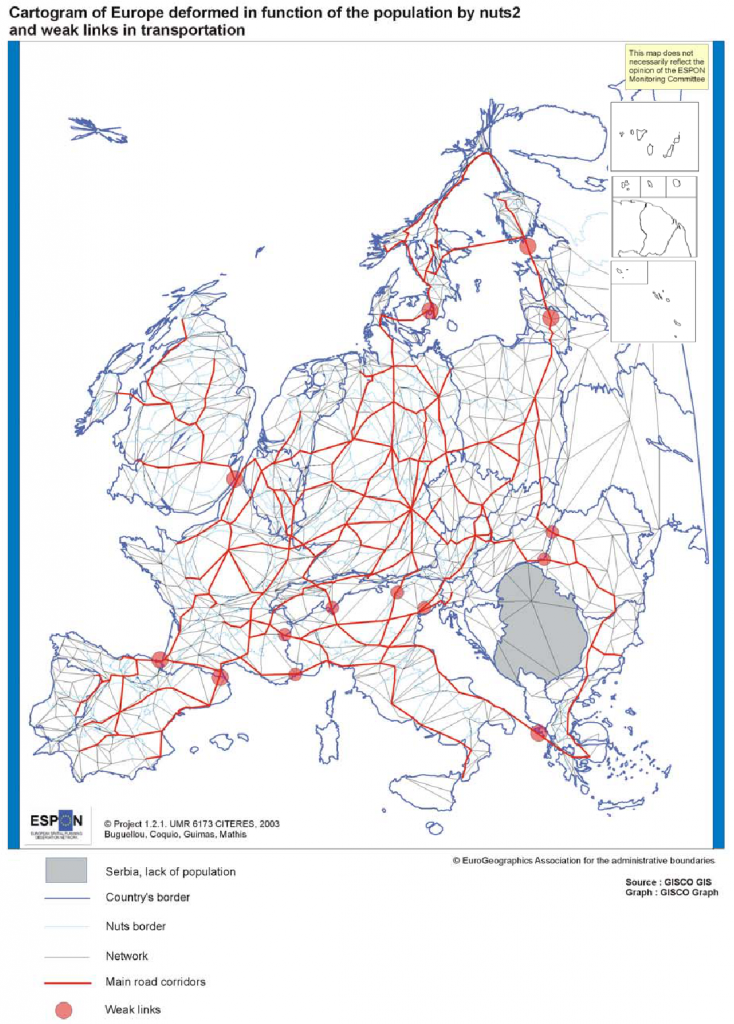
The maps on the ESPON project are interesting in this regard:
http://mapfinder.espon.eu/?page_id=31&category-name=115&proj...
Though I seem not being able to find a more recent version of this "classic" anamorphic (deformed) map (I find these the easier way to visualize the abnormalities in connections):
https://calomelano.it/wp-content/uploads/2013/11/05_populati...
Re: France’s new high-speed trains
#227Earlier quoted context omitted.
Whether by accident, or design, The Netherlands seem much more able to have transport options that join up. Buses that terminate at the train station, tram routes that serve both, park and ride that serves all. With compatible timetables and ticketing. After reading the piece about Delft cycle routes yesterday, I suspect a reasonable part was by design. I'm sure someone native can point out some major holes, but stil…
> The Netherlands seem much more able to have transport options that join up. The Netherlands is a very small country, almost half the size of Panama, with a mostly dead flat geography. It is also one of the most densely populated countries in the world.
Re: France’s new high-speed trains
#228Earlier quoted context omitted.
"Public rail is a money-losing venture" So are public schools, public hospitals and national defence. But they are enablers of everything else that we do and the actual purpose of government and taxes. Public transport needs to be as efficient as it can be while providing the services needed . There are additional benefits like providing a training environment for trades, ensuring that a heavy engineering skillbase i…
So you're saying that a publicly funded utility should provide some kind of beneficial service to the public? Like it's some kind of public service ?
Re: France’s new high-speed trains
#229Earlier quoted context omitted.
I think all land within city limits should be publicly acquired with eminent domain before zoning and building of utilities. No reason to let the land value increase fall to private landowners when it's all due to build-up of public services. Better use the profits for maintaining the services.
That's roughly the case in Amsterdam. All land is technically owned by the city, and homeowners lease it for 50 years. When the lease will run out is always a detail to pay attention to when buying a home.
Re: France’s new high-speed trains
#230"the train’s shorter engine (59 feet instead of the current 72) opens up as much as 20 percent more space for passengers" Does it? Why? The max percentage increase is going to be for the shortest trains, where space isn't an issue anyway. But then even ignoring that, does the driver need a platform? Why not have the two motor units overhang the platform?