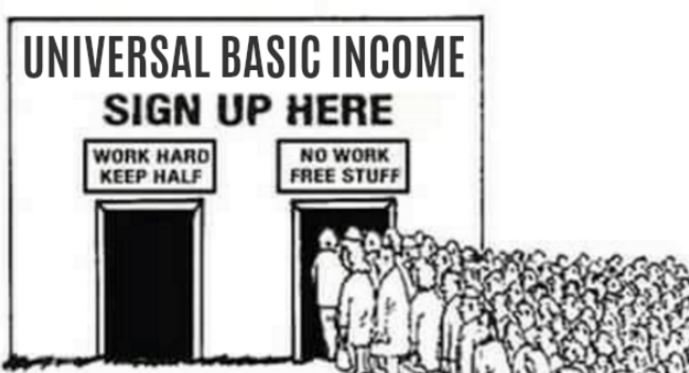
Universal Basic Income:
Work Hard, Keep Half v. No Work, Free Stuff
https://delvedc.com/wp-content/uploads/2018/04/Universal-Bas...
321–330 of 345 posts
Work Hard, Keep Half v. No Work, Free Stuff
https://delvedc.com/wp-content/uploads/2018/04/Universal-Bas...
Earlier quoted context omitted.
> Cost. $3.8 trillion by many estimates. $3.8 trillion would be about right if you set the benefit level equal to the poverty line for a single-person household, and then gave it to every many, woman, and child in the country, starting at birth, irrespective of citizenship or immigration status, while... > That's nearly 20% of America's GDP. ...nearly 20% of GDP would be accurate for the benefit level you suggested,…
> GDP growth per capita over the long term is more rapid than inflation At this point, we're down to conjecture. It will doubtless require higher taxes, which will quite possibly counter or outweigh any benefit of more money to spend. It's a big risk to take with the entire country. > migration for benefits is a problem. You don't have to have immigration controls, just establish residency requirements with a certain…
The cost to send Jeff Bezos $10k/yr is $10k/yr. The cost to NOT send Jeff Bezos $10k/yr might well be higher, because now you need to pay for a system to work out if you should be sending Jeff Bezoz $10k/yr or not.
Earlier quoted context omitted.
They didn't crawl under a rock. They socialized with their families, maybe played on a team, contributed to the Animal Shelter, who knows what-all. Its called a life, and work is not the goal of it.
> Its called a life, and work is not the goal of it. This type of thinking needs to stop. You don't get to enjoy our lavish society without contributing. If you want food and a shack, you can already live this lifestyle for less than 5k/yr. Hanging out with your family, playing sports, and helping animals will not keep an economy moving.
An ever-growing number of folks in 'our' society (presuming Western technological) are making only symbolic contributions. Automation is rapidly overtaking jobs.
Understand what that means. It doesn't just mean unemployment/underemployment. It means nobody has to work to create what automation took over. An ever-increasing fraction of the 'lavish society' has no human cost burden at all.
So that knee-jerk thinking above is growing ever-more irrelevant and obsolete. That's pretty much the whole conversation here.
I still see some big issues with universal basic income, and would appreciate one of its supporters responding to some of them: Cost. $3.8 trillion by many estimates. That's nearly 20% of America's GDP. How is it possible to pull this much money out of the American economy without crashing it? Scope. I am of the opinion that one of the beauties of federalism is that policies can be tested first at the state level bef…
My personal preference, very different from the above article, would be for a wealth tax that helps keep capital flowing, sort of like a company's dividend going back to investors. We the people are the investors in the wealthy's endeavors that led to that wealth. They keep the bulk, but they pay back some to all of us. If they don't make productive use of the wealth, something that benefits others, then their wealth slowly falls until they are like the rest of us.
By some measures of the wealth of the US, we have 100 trillion dollars in wealth and so 4% wealth tax would fund a 13k per person (including children) UBI.
Seriously asking. Is it possible to use your basic income to get a loan? I just envision people buying all sorts of things without understanding what they're signing up for. And from a U.S. perspective, I don't trust a system filled with rent-to-owns, payday lenders, and car dealer/financers stopping anyone from making bad choices.
I view UBI as a way to help ease the debt of many people, particularly those incurred because of lost wages (loss of job, illness). It could also ease the college debt issues because we could stop subsidizing college costs, leading to decreased tuition, and instead the colleges would have to compete with other uses of this money, something they do not have to do with direct college support programs.
Earlier quoted context omitted.
I'm not religious so not sure what god has to do with this. Yes there are no true answer, its open for debate. Andrew Yang, 2020 candidate, for example propose $12000 a year. Its a start. >…But everyone is forced to pay taxes. Not if you are not working. No income (other than basic income) -> no tax. >If I choose not to work, the government still takes your money by force and gives it to me. sure, fine by me. I'll ju…
> Not if you are not working. No income (other than basic income) -> no tax. I think you've completely missed my point here. > For example me, I will still continue to work even if basic income enough to cover my needs. Why? because I enjoy it and fulfilling or maybe I just simply want to earn more money for luxury or whatever. You comprise but a single datum — not enough upon which to base societal economic policy.
So can you reiterate your point?
>You comprise but a single datum — not enough upon which to base societal economic policy.
I'm just giving you one concrete example of why people would still want to work.
Earlier quoted context omitted.
Why don't rents consume all the economic growth without UBI? If there is, in a market (of whatever scale, and whether it's housing rental or anything else), a monopoly or coordinated oligopoly that is abused so as to absorb all income growth, that's a problem calling for government intervention independent of UBI. Maybe these exist in some housing markets, but if they do it's an orthogonal problem to UBI that is just…
> Why don't rents consume all the economic growth without UBI? They sort of do (at least in some cases; see San Francisco, New York, tons of other big cities). > that is just as important to correct even if we don't adopt UBI. It's not, in any way, an argument against UBI. The fact that the we need to address it doesn't mean we easily can. And doesn't mean that just blindly doing it is justified, just because there s…
The mechanism for dealing with an essential service that, left to private industry with only normal consumer protection regulation, is difficult to prevent becoming a rent-extracting monopoly or oligopoly is well-established—you make the service a utility, either privately owned but publicly regulated for price and service requirements, or publicly owned. This isn't a deep mystery.
Now, most of the people that cry “housing is already oligopolistic and would extract rents defeating any UBI” as an excuse for opposing UBI evidently either don't actually believe that market condition really exists or want to preserve it in the absence of UBI even though it has the same impact on income gains without UBI as they complain it would with UBI, but the mechanism for addressing it is obvious and, if it really exists, essential even in the absence of UBI.
Earlier quoted context omitted.
Population growth has been steadily slowing down since 1960s.
Broadly speaking, that is because we're approaching something like a carrying capacity, estimated to be somewhere around 10B. If we increase land use efficiency dramatically, that effectively raises the carrying capacity and population growth can continue much longer
Earlier quoted context omitted.
The Black Death in the 14 century killed a third of the population of Europe, which lead to a surprising rise in wages and standards of living. It's weird and uncomfortable how tragedy sometimes leads to very good things. Similarly in the opposite direction, automation should have been a good thing yet it leads to unemployment and poverty.
So Thanos was right all along, no?
It seems like to him it's more a convenient excuse to kill lots of people.
Earlier quoted context omitted.
I agree with much of what you said including that costs are high due to government subsidies - I just think that the primary subsidy is keeping general interest rates low. That mortgage interest tax deduction really just further reduces the the effective interest rate for home loans. The primary subsidy isn't even acknowledged as an explicit policy, but obscured by describing it as a mechanical application of a purpo…
> I guess my point of disagreement is that since the low interest subsidy is basically turning any mildly dense area into a rent treadmill, then why isn't the goal to directly address that as the problem? Because nobody wants to touch it with a ten foot pole. There are basically two ways to get interest rates back up. The first is that you just do it, and nothing else. We've discovered that doing this at anything fas…
Why should individuals just ideologically accept this regime, rationalizing justifications to further speed up the debt treadmill as actually benefiting us somehow? We're just all supposed to accept living in a negative-sum container, where the financial class gradually takes title to more and more real property as interest compounds? Until the abstraction no longer holds, we get an economic collapse, and then we get to fight and eat one another while the fiction unwinds?
I guess this is just the standard shape US politics take. The bankers buy both candidates and then the voters get to cheer for their preferred window dressing to win - more bread or more circuses. I'd personally rather get my tribe-kicks from watching professional sportsball, and keep my political head screwed on straight.