Live data from Hacker News

German exclaves in Belgium separated by a bicycle path from the rest of Germany

fascinatingmaps.com

131–140 of 156 posts

Re: German exclaves in Belgium separated by a bicycle path from the rest of Germany

#131

Earlier quoted context omitted.

I've occasionally wanted to translate some material from another Wikipedia, in a language I can read, into English. But the referencing in that Wikipedia is often quite bad, so I wouldn't be able to reference it properly in the English Wikipedia. Finding and interpreting good sources then starts to look like a major research project.

And often (I'm looking at you, Hebrew Wikipedia) - the rules for sourcing aren't the same in the first place.

Interesting - do you have an example?
Re: German exclaves in Belgium separated by a bicycle path from the rest of Germany

#132

Odd borders are funny. Here's two other examples: The utter chaos in Baarle. They even have nested enclaves. So area of Netherlands surrounded by Belgium surrounded by Netherlands. https://en.wikipedia.org/wiki/Baarle-Nassau https://www.openstreetmap.org/#map=14/51.4402/4.9316 Between Germany and Switzerland, there's the German exclave Büsingen am Hochrhein. They have odd tax rules as Swiss VAT is applied. https://en…

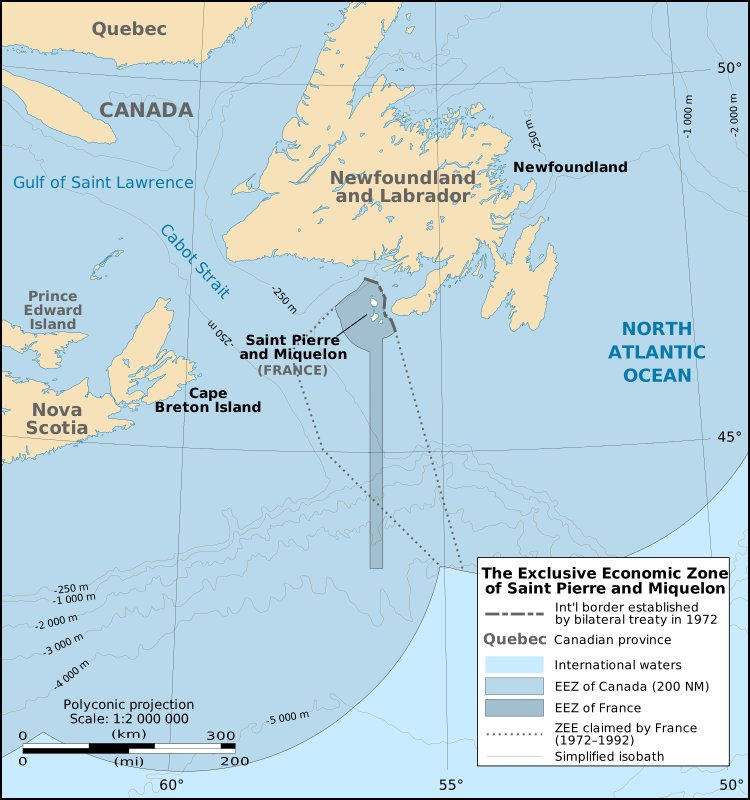
Another interesting one is Saint Pierre and Miquelon (France), fully contained within the eastern maritime borders of Canada. (edit: It is within Canadian exclusive economic zone which are international waters, not sovereign territory).

[0] https://en.wikipedia.org/wiki/Saint_Pierre_and_Miquelon

[1] https://upload.wikimedia.org/wikipedia/commons/7/79/Saint-Pi...

Re: German exclaves in Belgium separated by a bicycle path from the rest of Germany

#133

Odd borders are funny. Here's two other examples: The utter chaos in Baarle. They even have nested enclaves. So area of Netherlands surrounded by Belgium surrounded by Netherlands. https://en.wikipedia.org/wiki/Baarle-Nassau https://www.openstreetmap.org/#map=14/51.4402/4.9316 Between Germany and Switzerland, there's the German exclave Büsingen am Hochrhein. They have odd tax rules as Swiss VAT is applied. https://en…

The german entry for Büsingen is MUCH more detailed https://de.m.wikipedia.org/wiki/Büsingen_am_Hochrhein This really frustrates me about Wikipedia because its like a totally parallel site and experience thats just right there and can even have conflicting information. Not helping the world as much as we think, but its so close to being able to.

So, one interesting tidbit from the German version:

Germany introduced daylight saving time ("Sommerzeit") in 1980, but Switzerland only in 1981. In 1980, Büsingen used CET (like Switzerland), not the daylight saving time (like the rest of Germany). So, while there was only one summer season of deviation from Germany, Büsingen (pop. 1443) is listed separately in some time zone databases, eg the Common Locale Data Repository.

As so often, the devil is in the details.

Re: German exclaves in Belgium separated by a bicycle path from the rest of Germany

#134
post #2

> There is no border control due to the Schengen Agreement, therefore daily life is not really impacted. That's the most interesting part to me. I cross the border every day to go to work. Yet, when a friend came to visit us and we we to the city, he couldn't believe that we were crossing a border that easily (France-Switzerland). It was literally an open fence with a sign welcoming you. It's really awesome when you…

I lived for awhile inside Schengen and enjoyed the near total frictionless border crossing, train, air travel etc.

When I later moved back to the UK, I had a faint hope the UK would one day see sense and join Schengen as well, but I am pretty sure that boat has now sailed...

Re: German exclaves in Belgium separated by a bicycle path from the rest of Germany

#135
post #63
post #52

Earlier quoted context omitted.

I don't think that applies anymore these days. I am from Poland and culturally I have more in common with most Germans than with many of my compatriots. And my point is that the idea of "their piece of earth" is outdated. Apart from silliness and unnecessary politicians it leads to real problems, like countries deciding that they will burn oil and coal on "their piece of earth" and not care about climate catastrophe…

I am Polish too and I’d say were are on average very different from the Germans. A common, Polish-German state would be very hard to govern to due constant conflicts in values.

A lot of Germans feel the same about the Bavarian-German state.

Re: German exclaves in Belgium separated by a bicycle path from the rest of Germany

#136
post #61

Earlier quoted context omitted.

Then what about Switzerland who speak 3 langues (4 officially). We talk English together and the French part is generally more focus on France than Switzerland (I'm from that part)

I guess you are still very distinct from say Belarusians or Japanese? In a world with no borders, the Swiss, Belarusians and Japanese would need to somehow agree on a common set of values that would govern this borderless world. And it’s hard enough to agree on policies in a single country.

We already have a lot of nearly-worldwide treaties, so there is something like a common baseline already.

Re: German exclaves in Belgium separated by a bicycle path from the rest of Germany

#137
post #22
post #9

Earlier quoted context omitted.

Probably not. The Italian Northern border has been repeatedly “closed to Schengen” by neighbours because of the migration crisis. France, Switzerland and Austria basically keep suspending the treaty unilaterally whenever they feel like, as well as carrying out further abuses (like French Police illegally crossing the border and unloading migrants in a forest before driving back).

> like French Police illegally crossing the border and unloading migrants in a forest before driving back Please tell me you have a source for that. / Edit It seems to have been a singular occurrence where two migrants were deported unofficially by French officers. Your phrasing made it sound like a regular occurrence of at least tens of migrants... But it is technically correct, I guess.

There is a single video but reports of multiple separate occasions in which it was done. The video was taken after the story had already broken on newspapers because the current Italian government officially raised it with France. Chances are that it had already happened several times, these things are usually kept quiet and dealt with diplomatically if they are occasional - unless one side is unresponsive and the abuse is repeated, which is probably what happened here.

TBH it's not even the most high-profile case, the stuff at Ventimiglia (where France simply blocks most migrants) is pretty egregious too. The Brits do it as well in Calais, but at least they had the honesty of not signing the Schengen treaty to begin with.

Re: German exclaves in Belgium separated by a bicycle path from the rest of Germany

#138
post #9

Earlier quoted context omitted.

Probably not. The Italian Northern border has been repeatedly “closed to Schengen” by neighbours because of the migration crisis. France, Switzerland and Austria basically keep suspending the treaty unilaterally whenever they feel like, as well as carrying out further abuses (like French Police illegally crossing the border and unloading migrants in a forest before driving back).

They are not suspending the Schengen treaty, obviously. The treaty explicitly allows for temporary border controls. Crossing the border to offload migrants on the other hand is obviously illegal.

How temporary is "temporary"? The border near Ventimiglia has been basically extra-Schengen for more than 3 years. I believe the Austrian border is not that different, just slightly less popular.

Re: German exclaves in Belgium separated by a bicycle path from the rest of Germany

#139
post #55
post #36

Earlier quoted context omitted.

If you want to have government provided services funded by taxes, you need to determine who will be paying those taxes. Borders provide a clean division between the paying customers for a particular government's services, and those who are not.

Agreed — but do we really need so many governments? Why not have a local regional level (city/region, where you live and where things really matter to you) and then a continental level (EU, US, China, Russia, etc)? I really do believe that we have way too many governments, and borders are an artificial construct used to support politicians.

Speaking in vast generalities, a continental level government seems to get big projects done better, but also seems to often treat their citizens much worse.

Personally I like that the world has both types of governments. It provides, to some extent anyways, redundancy against the failures of each type of government.

Re: German exclaves in Belgium separated by a bicycle path from the rest of Germany

#140

Earlier quoted context omitted.

This strikes me as a naive, European way to understand borders (governments are services, you get to choose who to pay your taxes to). Most of the world's people are born to governments they do not endorse, and do not want to pay taxes to, yet they still have to. I was born in a shitty country and even though I've been living in the US last 5 years, I still have duties to my home country such as taxes, military, comm…

But you did decide that you didn't like how your original government runs things, and you switched to a different government. That's very much in line with the European understanding of government. Your only problem is that the US is extremely picky with accepting new customers. Also note how many of your problems are exceptional. Few countries raise taxes from money that never enters or leaves their country, and mil…

USA is an example of raising taxes from money that never enters or leaves the country, I think. US citizens pay taxes from income abroad when they live abroad and non-residents pay taxes for money earned from US companies (like I do).
Post reply on HN