Live data from Hacker News

Successful second round of fusion experiments with Wendelstein 7-X

ipp.mpg.de

81–90 of 223 posts

Re: Successful second round of fusion experiments with Wendelstein 7-X

#81

Earlier quoted context omitted.

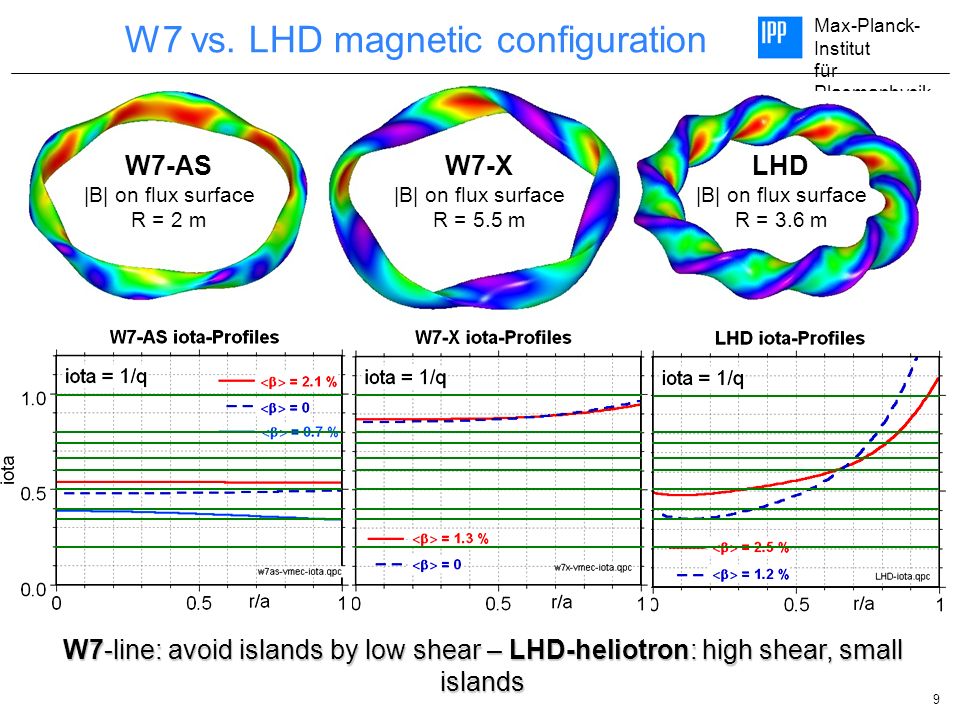
The weird design makes me as a layman skeptical of the tech's potential, but I'd love to hear why I'm wrong: - The randomness and lack of symmetry suggest that we are lacking insight into the problem, like an inelegant physics explanation or an over-fitted model. It's not just that it's complex, but it doesn't even seem to have "parts" that work together. Conceptually fusion seems pretty simple: why in principle does…

It's extremely symmetrical!

It's all about the magnetic surfaces. Some pictures:

https://images.slideplayer.com/33/10482660/slides/slide_9.jp...
https://www.nature.com/articles/ncomms13493/figures/1

https://imgur.com/gallery/eikBLMX

Re: Successful second round of fusion experiments with Wendelstein 7-X

#82

"Although Wendelstein 7-X is not designed to generate energy, the device is intended to prove that stellarators are suitable for use in power stations. With Wendelstein 7-X the intention is to achieve for the first time in a stellarator the quality of confinement afforded by competing devices of the tokamak type." This was at the very end. While competition is certainly a positive, this doesn't sound like they're int…

I would say the opposite. Achieving fusion power is so critical to the long term sustainability of human technological civilization that we cannot afford to put all of our eggs in one basket, and hope that we picked the right one.

Fair enough. And I agree. However, to be clear, that's __not__what this article says. Per the quote I pulled.

Re: Successful second round of fusion experiments with Wendelstein 7-X

#83
post #3

Experiments like Wendelstein remind me that the only thing holding back fusion power is money for research like this. Every year, we spend billions on fossil fuel exploration because the return on investment is quick - just think about all the wells going in to extract shale oil. What if we collectively had the will to invest this much into fusion?

Private money is coming in now: http://news.mit.edu/2018/mit-newly-formed-company-launch-nov... https://www.lockheedmartin.com/en-us/products/compact-fusion...

Also Helion, TAE (formerly Tri Alpha), First Light Fusion, Tokamak Energy, General Fusion, and others. TAE is the biggest, with over $500M invested so far.

Re: Successful second round of fusion experiments with Wendelstein 7-X

#84
post #38

Earlier quoted context omitted.

If they had a clear path to fusion and money were the only thing in the way, money would flow into it from every direction. The problem is that nobody knows how to build a functioning reactor yet or if it's even possible to build a functioning reactor. It's very possible that we could throw trillions of dollars at this and still not figure it out.

It's very possible that we could throw trillions of dollars at this and still not figure it out. Possible, but unlikely (imo). It's just that private business doesn't really do large-scale multi-decade pure research efforts with far-off ROI, and governments have chosen to spend money elsewhere. Hence, progress is steady, but slow.

Yes. It’s a classic market failure. We see examples of this type of thing throughout history. For instance, without the Manhattan Program, civil nuclear power would not have developed, because the enormous investment in risky technology development would not have flowed from the private sector.

Re: Successful second round of fusion experiments with Wendelstein 7-X

#85
post #80
post #44

Earlier quoted context omitted.

If confinement is easier in a large machine, why are not very large machines being built? If this is economically infeasible, then again, building piecemeal may be better, in the same way as taking a credit and paying interest on it might be better if you can't secure the upfront sum anyway.

> If confinement is easier in a large machine, why are not very large machines being built? They are. ITER was designed to be as large as the engineering allows. But that is Expensive. The groups at MIT are trying to take advantage of the fact that newer superconductors allow you to get to ITER levels with smaller designs. However, those are Not Cheap either.

Not cheap, but about an order of magnitude cheaper than ITER.

Re: Successful second round of fusion experiments with Wendelstein 7-X

#86
post #65

If this ends up being the right design for fusion, it may be the most weirdly shaped human artifact, where the shape is fundamental to its operation and not decorative. It's far more complex than a mere turbine blade or venturi. Or can anyone suggest a weirder one? (Define weirdness as the Kolmogorov complexity of the shape, within the precision needed to work properly.)

https://en.m.wikipedia.org/wiki/Evolved_antenna looks weird. Source 1 has another image of a more complex antenna.

Both images for lazy: https://i.imgur.com/ROhfMXb.jpg

Re: Successful second round of fusion experiments with Wendelstein 7-X

#87
post #65

If this ends up being the right design for fusion, it may be the most weirdly shaped human artifact, where the shape is fundamental to its operation and not decorative. It's far more complex than a mere turbine blade or venturi. Or can anyone suggest a weirder one? (Define weirdness as the Kolmogorov complexity of the shape, within the precision needed to work properly.)

The weird design makes me as a layman skeptical of the tech's potential, but I'd love to hear why I'm wrong: - The randomness and lack of symmetry suggest that we are lacking insight into the problem, like an inelegant physics explanation or an over-fitted model. It's not just that it's complex, but it doesn't even seem to have "parts" that work together. Conceptually fusion seems pretty simple: why in principle does…

why state 'I don't know anything about fusion power' but expect that fusion is simple.

nothing is simple, nothing is elegant. Everything is hideously complex, we are just standing on the shoulders of giants. e.g. Try making common things that we take for granted, like building a plane or glider or even writing a text editor from scratch (including the font rasterization code and display driver).

Re: Successful second round of fusion experiments with Wendelstein 7-X

#88
post #65

If this ends up being the right design for fusion, it may be the most weirdly shaped human artifact, where the shape is fundamental to its operation and not decorative. It's far more complex than a mere turbine blade or venturi. Or can anyone suggest a weirder one? (Define weirdness as the Kolmogorov complexity of the shape, within the precision needed to work properly.)

The weird design makes me as a layman skeptical of the tech's potential, but I'd love to hear why I'm wrong: - The randomness and lack of symmetry suggest that we are lacking insight into the problem, like an inelegant physics explanation or an over-fitted model. It's not just that it's complex, but it doesn't even seem to have "parts" that work together. Conceptually fusion seems pretty simple: why in principle does…

> The randomness and lack of symmetry suggest that we are lacking insight into the problem

No, it doesn't.

> Conceptually fusion seems pretty simple: why in principle does harnessing it require super-human complexity?

Because having 2e30 kg ball of hydrogen within a powerplant is extremely unwieldy here on Earth.

> In software, if you are replacing divisions with bit shifts, maybe you really need a different algorithm.

Huh? If your algorithm says "divide by 4", why would you need a different algorithm.

Re: Successful second round of fusion experiments with Wendelstein 7-X

#89
post #3

Experiments like Wendelstein remind me that the only thing holding back fusion power is money for research like this. Every year, we spend billions on fossil fuel exploration because the return on investment is quick - just think about all the wells going in to extract shale oil. What if we collectively had the will to invest this much into fusion?

A company like Apple has a quarter trillion in cash laying around, they could jump start fusion and control near-limitless energy in several decades. I wish there was more of a visionary drive among institutions for intellectual curiosity and pushing the boundaries of humankind. And yes, I know why they don't... shareholders business plans risk blah blah blah. Reality is just so BORING. Maybe one day we'll find a way…

The problem might be that patents are only valid for about 20 years. That might be the time required to perfect the technology and reach the break-even point.

Re: Successful second round of fusion experiments with Wendelstein 7-X

#90
post #65

If this ends up being the right design for fusion, it may be the most weirdly shaped human artifact, where the shape is fundamental to its operation and not decorative. It's far more complex than a mere turbine blade or venturi. Or can anyone suggest a weirder one? (Define weirdness as the Kolmogorov complexity of the shape, within the precision needed to work properly.)

The weird design makes me as a layman skeptical of the tech's potential, but I'd love to hear why I'm wrong: - The randomness and lack of symmetry suggest that we are lacking insight into the problem, like an inelegant physics explanation or an over-fitted model. It's not just that it's complex, but it doesn't even seem to have "parts" that work together. Conceptually fusion seems pretty simple: why in principle does…

Plasma dynamics isn't simple. You're trying to confine fast-moving charged particles with a magnetic field. Those charged particles generate their own magnetic field when they move, and that field creates forces on all the other moving charges. Most configurations are unstable, because tiny asymmetries in the shape get amplified.
Post reply on HN