Live data from Hacker News

Successful second round of fusion experiments with Wendelstein 7-X

ipp.mpg.de

41–50 of 223 posts

Re: Successful second round of fusion experiments with Wendelstein 7-X

#41
post #12

With fusion devices having trouble to confine the plasma for long times, I wonder if a massively-parallel fusion plant woud be feasible. Let's assume that plasma destabilisation does not damage the device, and is a mundane event. Build 10 or even 20 fusion devices (economy of scale!) feeding the common heat buffer, e.g. a large reservoir of a molten salt or metal. Feed conventional turbines off the heat of the heat t…

>BTW the waste heat could be directly reused Yes, for district heating.

Not really. For power generation as in a coal or nuclear fusion or fission powerplant, you run a multi-stage steam turbine cycle to get down to as low a temperature as possible after the final LP turbine. Because that maximizes the Carnot efficiency of the (idealised) Rankine cycle, it also maximizes real world efficiency.

In practice, coing down to ~40 C (~100F) is not uncommon. And then the waste heat is basically unusable, even for district heating.

OTOH, if you need lots of heat (maybe you have a chemical plant or something nearby), you can design you powerplant for cogeneration of heat and power, yielding higher total system efficiency. But you don't do that "just" for district heating.
Re: Successful second round of fusion experiments with Wendelstein 7-X

#42
post #17
post #12

With fusion devices having trouble to confine the plasma for long times, I wonder if a massively-parallel fusion plant woud be feasible. Let's assume that plasma destabilisation does not damage the device, and is a mundane event. Build 10 or even 20 fusion devices (economy of scale!) feeding the common heat buffer, e.g. a large reservoir of a molten salt or metal. Feed conventional turbines off the heat of the heat t…

This doesn’t solve the fact that a single fusion pulse (all existing reactors are pulsed) currently consumes more energy than it produces.

I remember hearing about break-even events for a few years. E.g. from 2014: https://www.nature.com/news/laser-fusion-experiment-extracts...

A design that produces e.g. 2x the energy it consumes for the startup could be viable, even if pulsed (running minutes, not months).

Re: Successful second round of fusion experiments with Wendelstein 7-X

#43
post #39
post #32

Earlier quoted context omitted.

Ok, several issues with this. First restarting these devices takes a lot of electricity, which drastically reduces your net efficiency. So, you still really want to solve this problem. Second, fusion devices scale very well so one device at 10x the scale is vastly better than 10 different devices at x size. Third, storing and pumping heat involves losses, where there is a huge range of great options for storing elect…

> there is a huge range of great options for storing electricity Producers of wind and solar power would love to hear about them! Re SPOF: since the fusion devices are much less reliable, as of now, than reservoirs of hot liquids, I suppose the reservoir is much less of a concern. I understand that fusion efficiency grows with size; this is why we are surrounded with colossal self-initiated fusion reactions, and have…

> Maby we could still

Early computers where huge and broke down all the time. They where built that way because it was the easiest option at the time. Nobody wants to build multi billion dollar devices if you could get away with spending 1/10th as much or even test several designs at the same time they would.

PS: The grid absorbs solar and wind interment nature just fine without much in the way of storage. That might suggest something about large scale energy storage. Building something that can store GW’s worth of heat for minutes at a time is going to be huge and expensive.

Re: Successful second round of fusion experiments with Wendelstein 7-X

#44
post #18
post #12

With fusion devices having trouble to confine the plasma for long times, I wonder if a massively-parallel fusion plant woud be feasible. Let's assume that plasma destabilisation does not damage the device, and is a mundane event. Build 10 or even 20 fusion devices (economy of scale!) feeding the common heat buffer, e.g. a large reservoir of a molten salt or metal. Feed conventional turbines off the heat of the heat t…

Confining the plasma is easier in a larger reactor, so you might be better off building one big reactor instead of 20 small ones.

If confinement is easier in a large machine, why are not very large machines being built?

If this is economically infeasible, then again, building piecemeal may be better, in the same way as taking a credit and paying interest on it might be better if you can't secure the upfront sum anyway.

Re: Successful second round of fusion experiments with Wendelstein 7-X

#45
post #3

Experiments like Wendelstein remind me that the only thing holding back fusion power is money for research like this. Every year, we spend billions on fossil fuel exploration because the return on investment is quick - just think about all the wells going in to extract shale oil. What if we collectively had the will to invest this much into fusion?

If the Stellerator, or any of its descendants, turn out to be the answer to practical fusion, it would have been contingent on vast quantities of computational power being available cheaply. It does not matter how much money you poured into your Stellerator project in 1970, you could never have built the 7-X, because there would have been no way to produce that design in the first place.

Personally, I think one of the answers to "tech seems to have stalled" is that it's easy to underestimate how important cheap computational power is, even without "AI", to moving forward. For another example, as fantastic as the 1960s space projects may have been, I think they just weren't economically sustainable, so it isn't that amazing that they didn't become a self-sustaining industry right away. I think it's easy to look at SpaceX and say "Gee, there's nothing that we couldn't have done there fifty years ago", but again, I suspect you miss just how much of the Falcon rocket is a result of extensive cheap computation abilities. Even if you could use modern computers to produce a design that could have worked fifty years ago, there's still not necessarily a practical path to that design using only tech from fifty years ago. (And of course the Falcon is full of stuff that couldn't exist fifty years ago.)

Modern tokamak designs are of course run through all kinds of computations nowadays too (because everything is), but the stellerator design, in a deep and fundamental way, simply isn't possible without massive computational power, whereas we've been building tokamaks since before massive cheap computational power.

Re: Successful second round of fusion experiments with Wendelstein 7-X

#46
post #21

Earlier quoted context omitted.

Err no, money is not "the only thing" keeping us from having fusion power. I can think of one other thing which is that it's damn hard to create stellar-core conditions inside of a small containment vessel on Earth. It's not obvious that throwing more money at the problem is going to change this. After all, fusion research has been funded in some form or another since the 1950s. I'll bet if you added up all the resea…

Just for the record, you don't re-create stellar-core conditions with earth-bound fusion devices: We don't have the means, and the yield would suck. Now, it is true that there's still fundamental research to be done until energy production via nuclear fusion becomes a reality, but we're reasonably confident that we could make the conventional approaches work. However, that research is Big Science, and there's no poli…

>> and W7-X basically only exists because German reunification happened, and the German government was looking for a big science project - any project - they could leverage to funnel money into East Germany

That's the first time I've heard that. Brilliant!

Re: Successful second round of fusion experiments with Wendelstein 7-X

#47
post #3

Experiments like Wendelstein remind me that the only thing holding back fusion power is money for research like this. Every year, we spend billions on fossil fuel exploration because the return on investment is quick - just think about all the wells going in to extract shale oil. What if we collectively had the will to invest this much into fusion?

Err no, money is not "the only thing" keeping us from having fusion power. I can think of one other thing which is that it's damn hard to create stellar-core conditions inside of a small containment vessel on Earth. It's not obvious that throwing more money at the problem is going to change this. After all, fusion research has been funded in some form or another since the 1950s. I'll bet if you added up all the resea…

If fusion research funding got 1'000 dollars a year, we wouldn't have 1'000'000 dollars worth of research after 1000 years. Just as there are diminishing returns after throwing so much money at a problem, throwing too little means that progress will halt and we get stuck in a local minimum because we need a bigger cash infusion to get over the hump.

Re: Successful second round of fusion experiments with Wendelstein 7-X

#48
post #13
post #5

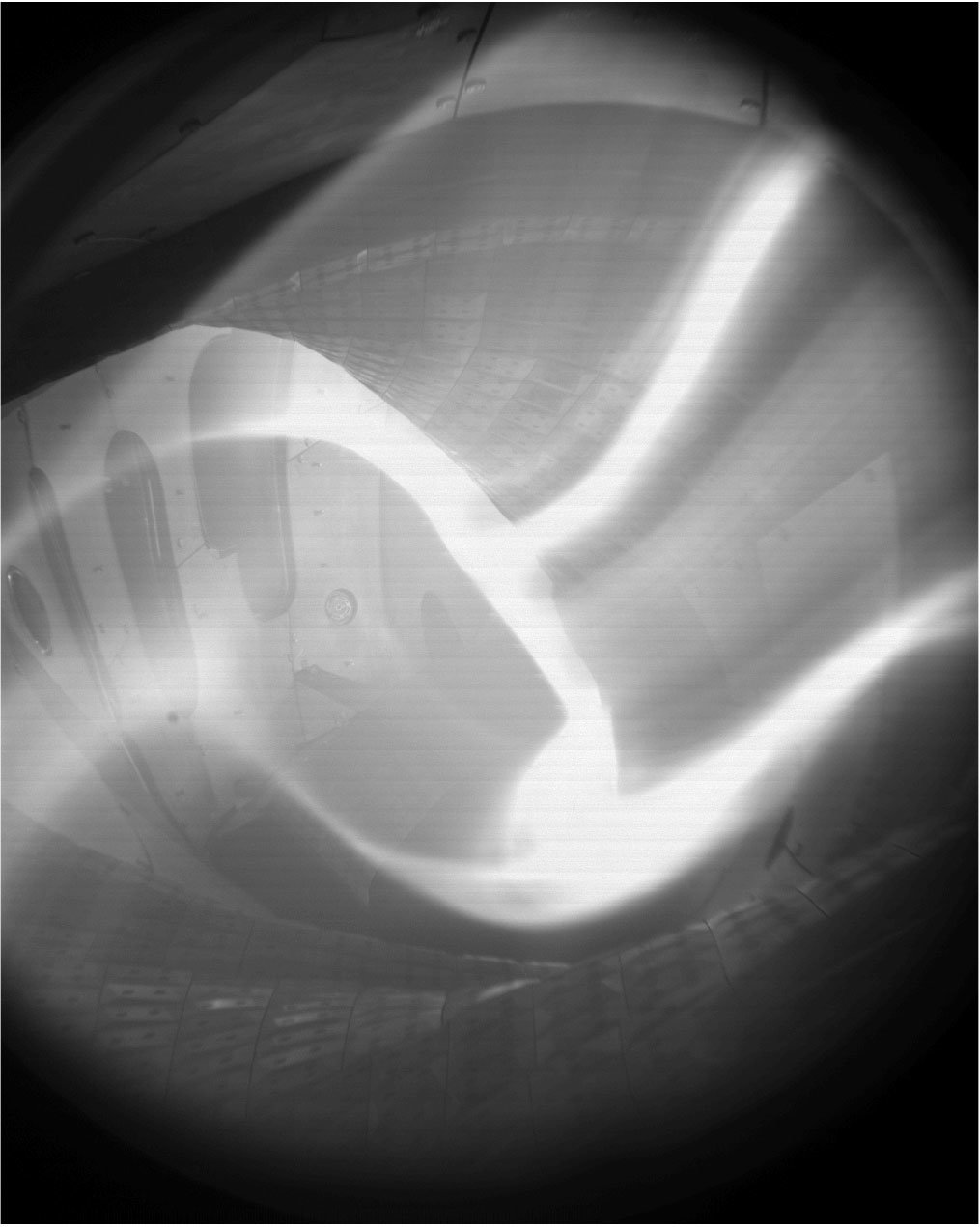
Does anyone have any idea how do they take pictures of the plasma? That seems quite hard considering the temperatures and the strong magnetic field.

I can imagine that this is just the neutron flux picture. The neutron streams should pass the walls pretty well (unfortunately), so registering it should not be hard.

I am obviously very uninformed about this, but in the picture I'm referring to [0] you can see the walls in pretty good detail, so I assumed it was an optical picture.

No idea if a neutron flux picture would provide these details or not.

[0] https://www.ipp.mpg.de/4550362/original-1543230147.jpg?t=eyJ...

Re: Successful second round of fusion experiments with Wendelstein 7-X

#49
post #35
post #5

Does anyone have any idea how do they take pictures of the plasma? That seems quite hard considering the temperatures and the strong magnetic field.

Good question - I worked at the ASDEX Upgrade (AUG), also operated by the IPP but a tokamak instead of a stellarator: At AUG similar images and videos [0] are recorded by IR cameras. These cameras require strong cooling and a magnetic / electric shielding as described in [1]. Per plasma discharge (~10s) around ~8GB of video data is recorded. There are also fast frame cameras for dust tracking [2] and similar things.…

Wow...that's pretty cool!

Re: Successful second round of fusion experiments with Wendelstein 7-X

#50
post #13
post #5

Does anyone have any idea how do they take pictures of the plasma? That seems quite hard considering the temperatures and the strong magnetic field.

I can imagine that this is just the neutron flux picture. The neutron streams should pass the walls pretty well (unfortunately), so registering it should not be hard.

I doubt that. High energy neutrons are difficult to diffract (so no lenses), reflect more like light on fog than light on tin foil (so no mirrors) and pass through material too easily for a pinhole lens to be plausible.

I think you have to go to quite low energies (per neutron, not flux) for neutron optics to be a thing. Neutron cameras use collimated neutron sources to get around this, but that option isn’t available here: https://en.m.wikipedia.org/wiki/Neutron_imaging#Neutron_came...

Post reply on HN