Not very knowledgable in the area but can someone please explain how does kdb fit within this class of time series dbs and whether there are any alternatives available to kdb.
Kdb is a priprietary db that runs using the processor level 2 cache as memory. Therefore it is crazy fast. Also therefore, it does not handle large datasets.
Why Not to Build a Time-Series Database
101–110 of 128 posts
Re: Why Not to Build a Time-Series Database
#102Time-series data handling/storage seems a mostly solved problem in the mining, oil, and manufacturing industries. Deployed in the field since the 80's, https://www.osisoft.com/about-osisoft/#more-about-pi-system Discourse: Industry user now OSIsoft employee
A solved problem at what scale? A kid with pencil and paper can solve the problem when it's small enough.
It's in the same league as timeseries data in financial markets, which I have more direct experience of. Financial timeseries data probably has more metadata (trade/order flags etc) but in terms of raw data it's similar.
Re: Why Not to Build a Time-Series Database
#103TLDR: "Why Not to Build a Time-Series Database? Because we're building one and you should pay us." > Hopefully our story will make you think twice before trying to build your own TSDB in house using open-source solutions, or if you’re really crazy, building a TSDB from scratch. Building and maintaining a TSDB is a full time job, and we have dedicated expert engineers who are constantly improving and maintaing our TSD…
When I'm interviewing a database expert, the one that says: > "You Can Lose a Few Datapoints Here and There" is not the one I'm going with...
Re: Why Not to Build a Time-Series Database
#104TLDR: "Why Not to Build a Time-Series Database? Because we're building one and you should pay us." > Hopefully our story will make you think twice before trying to build your own TSDB in house using open-source solutions, or if you’re really crazy, building a TSDB from scratch. Building and maintaining a TSDB is a full time job, and we have dedicated expert engineers who are constantly improving and maintaing our TSD…
When I'm interviewing a database expert, the one that says: > "You Can Lose a Few Datapoints Here and There" is not the one I'm going with...
Re: Why Not to Build a Time-Series Database
#105Earlier quoted context omitted.
I used to work at a startup that made physical robots. The robot generated several GBs of data every time it turned on. You're correct, most of that data wasn't looked at most of the time. But every now and then, someone would say "Hey, I saw a robot do something funny the other day, what the hell happened?" And having all that data usually made it possible to figure out what happened. To me, "maximum data for the he…
That is a very particular use case, where very high res data is critical. I note that even here, you're interested in data from "the other day", not years ago. In most cases, time spent maintaining terabytes of rapidly aging time series data would be better spent elsewhere.
A particularly good high-frequency trader might be interested in Terabytes of minutia when they're trying to sort out what caused yesterday's spike and crash of ticker XYZ.
Systems and sales analysts that are looking at web store front ends (and back ends, if there are issues) would be interested in large volumes of data, specifically corner cases (users who don't follow a statistically significant path), when trying to sort out a UI/UX redesign.
Traffic and transit analysts might want terabytes of data (especially with date and weather indicators) when considering what kind of freeway interchange to add to a growing area.
I suppose I could go on...
Re: Why Not to Build a Time-Series Database
#106Earlier quoted context omitted.
When I'm interviewing a database expert, the one that says: > "You Can Lose a Few Datapoints Here and There" is not the one I'm going with...
There are some properties of the data that can be exploited to add weaker consistency guarantees. This leads to some desirable design trade-offs in terms of simplicity and performance optimisation. While this could result in data loss, it may be permissible given that queries can span large time ranges where one or two missing datapoints do not carry the same weight as a financial miscalculation, or loss of life. The…
Re: Why Not to Build a Time-Series Database
#107Earlier quoted context omitted.
> Distributed relational column-oriented databases are the best at large OLAP data volumes and queries. KDB+ is one of those, even though they call it a TSDB in marketing terminology because of its FinTech customer base. You're mistaken about Kdb's relational features. Kdb was designed as a time series processing engine using arrays (columns). Column storage doesn't have anything to do with whether a database is rela…
I never said relational is related to column-storage. kdb+ has SQL semantics and relational queries, but it's a combination of the q language integrated into a database so sure, it's a superset of a relational database. Perhaps we disagree on what relational means.
The definition of relational is very precise, whether you use the domain calculus, relational calculus or relational algebra. Wiki has a good summary of what must be natively supported by a database system to be relational: https://en.wikipedia.org/wiki/Relational_algebra
If you don't implement this at the transaction log level, but implement it via emulation at the output level, you can't make full relational guarantees, so these operations are fundamental to database design.
Re: Why Not to Build a Time-Series Database
#108Earlier quoted context omitted.
There are some properties of the data that can be exploited to add weaker consistency guarantees. This leads to some desirable design trade-offs in terms of simplicity and performance optimisation. While this could result in data loss, it may be permissible given that queries can span large time ranges where one or two missing datapoints do not carry the same weight as a financial miscalculation, or loss of life. The…
There's nothing wrong with a special-purpose tool for building approximate graphs, but calling it a "time-series database" or even quoting "inserts-per-second" is intellectually dishonest.
Re: Why Not to Build a Time-Series Database
#109Earlier quoted context omitted.
Relational databases represent a column/row-oriented architecture. Data historians are a specialized, non-relational, time -oriented architecture. Using time as a key in a relational index implies that only ordering is important, but that is not the case. Distance between points in time is extremely important because time operates on a continuous 1d line and data points are represented at varying distances between ea…
I appreciate your links to further reading, and I'm trying to read the Aurora paper right now but after reading the abstract and the intro (I'm in progress right now), I can't find a case that is uniquely fit/perfect for data historians... I know this is already asking a lot, but would you mind giving me one go-to- use case that really made you think "this is what purpose-built data historian-style databases are good…
I'm not a huge fan of historians (I've spent too much of my career working with them), but I can definitely tell you where they make sense. The scenario is this:
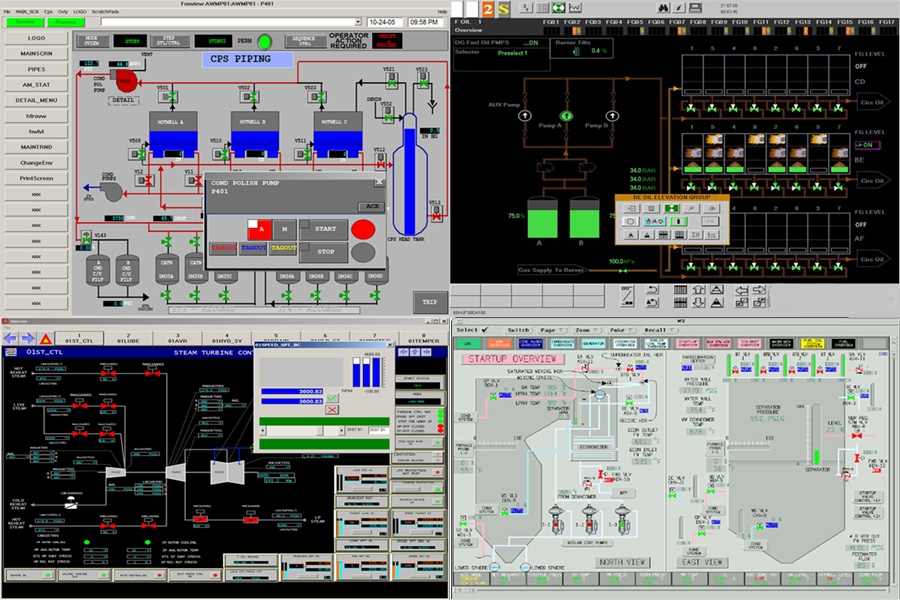
Imagine you have a large facility with thousands of machines, each with a programmable logic chip for controls and monitoring. These machines create lots of data and so often employ data reduction semantics by reducing data to on-change rather than sampling sensors at thousands of hertz. A single machine may have dozens or hundreds of variables to track. These tags might be hierarchical: Machine 1, subsystem 5, variable b. If you say there's 100,000 total tags to track in the facility, and they're on average sampled at 10hz, you need a system capable of writing a million durable timestamped values per second. Now that's child's play for, say, google, but if you're a manufacturer, you can't afford to spend massive amounts of money on cloud systems, and usually want to do this all on a single server on the factory floor because you need realtime monitoring that can display the current value in time for every single tag. ( https://www.ws-corp.com/LiveEditor/images/SLIDES/10/3.jpg ). Ideally, in a single node scenario, you want compression. It's not uncommon to store 100 billion timestamped values per day and keep them for a year or more for audit purposes is something goes wrong. Today, for the sake of predictive maintenance, data retention policies of up to 10 years are becoming more common.
So what would you sacrifice to be able to do efficient realtime monitoring and ingestion of millions of data points per second? You can't use queueing semantics to protect an RDBMS because logging can't take more than a 10th of a second per point. If you think about the use case, what you'd sacrifice is transactional queries and row-level joins, because you just don't need them. At the same time, this data is really sparse when you look at it from a table's perspective, so you'll want something like a column store to underly the data storage.
So what we do is throw out transactional guarantees, choose a storage system that is good at compression (roll-ups in some historians will store a formula approximating the data instead of raw data itself over a window), and prioritize speed of point retrieval for most recent "hot data" by caching it in-memory.
You can of course extend Postgres to achieve many of these things, but having done it myself, in practice it's sub-optimal in the exact same way that using bubble sort for all your programmatic sorting needs is sub-optimal.
One thing you might want to keep in mind is that many of the people involved in Aurora are the authors of Postgres. They're not arguing you can't do things in Postgres, they're arguing that in practice the RDBMS's guarantees are theoretically incompatible with high performance in the area of Complex Event Processing, because alignment between different simple events (recorded as rows in a database) can drift so far that memory requirements become prohibitive if you don't use a stream-processing architecture.
Also keep in mind that Aurora is from 2002 and many of the ideas have been implemented elsewhere over time. The great thing about Postgres is that it's perfect scaffolding on which you can build other stuff.
Re: Why Not to Build a Time-Series Database
#110Earlier quoted context omitted.
Relational databases represent a column/row-oriented architecture. Data historians are a specialized, non-relational, time -oriented architecture. Using time as a key in a relational index implies that only ordering is important, but that is not the case. Distance between points in time is extremely important because time operates on a continuous 1d line and data points are represented at varying distances between ea…
Most data/operational historians are separate programs on top of databases, so is that what you're actually talking about? Your papers seem to suggest that. Stonebraker is talking about OLTP vs OLAP. I agree that they are very different scenarios.
If you read all the way to the end Stonebraker is actually advocating for specialized architectures like, array databases (SciDB) and stream processing engines like StreamBase, which at the time was just gaining GUI-based query creation capabilities because it was difficult to teach its non-relational concepts to SQL users.