Live data from Hacker News

Who needs democracy when you have data?

technologyreview.com

61–70 of 113 posts

Re: Who needs democracy when you have data?

#61
post #39

Democracy is good because it basically allows for a peaceful revolution if a populace is dissatisfied with its government. Democracy is bad because the government risks enduring endless bickering and nothing getting done. Etc, etc. I don't know what the right answer is anymore.

I've always thought that deadlock was a feature instead of a bug. If half the population is for it and half is against it then nothing should happen legislatively.

Re: Who needs democracy when you have data?

#62
post #59
post #57

Earlier quoted context omitted.

I think you could achieve it with a slightly less intense qualifier than "purely rational", actually- if people were more in tune with coordination problems and more willing to make a personal sacrifice on behalf of cooperation, democracy could work. This has implications all over the place- like someone deciding not to throw a tantrum at an airport counter because they didn't understand what "standby" tickets are, o…

"more willing to make a personal sacrifice on behalf of cooperation" The problem is that a lack of checks and balances means a single bad egg is all it takes. It doesn't just take some people being good people - or even most - it takes everyone being a good person to make that work. Humans as a species just aren't like that.

Right. As soon as one person can gain an advantage by sacrificing a common value, that becomes the new default, and anyone that doesn't try to get in on it gets outcompeted.

Re: Who needs democracy when you have data?

#63
post #56

There is nothing in the world right now that I fear more than the creep of Chinese surveillance/authoritarian practices into the rest of the world's society. They are a rapidly growing superpower, and while I hold no fantasies of U.S. supremacy, this specific trend in the use of digital technology terrifies me. There won't be a war, by the way. I honestly think we're past the point as a species where superpowers duke…

> I honestly think we're past the point as a species where superpowers duke it out in such a literal fashion. It's just bad for business. It's bad for business until it's not. Isolationist economic policies will over time make war more likely. > Between the spread of the companies it effectively owns, and the deals being made with the rest of the world's most powerful tech companies, China will soon wield more influe…

"I'm not sure about China wielding more influence than the U.S. That sort of thing is really hard to predict accurately, especially from the perspective of someone who isn't a world leader privy to all available information."

I think at the end of the day it just comes down to the numbers. With four times the population, they have four times the market of consumers and four times the workforce to create value. The U.S. is still in the lead for now, somehow, but China has recently taken up a very potent type of hybrid economic development, where free-market startup-culture is encouraged, but guided and pruned by the government.

Re: Who needs democracy when you have data?

#64
post #56

There is nothing in the world right now that I fear more than the creep of Chinese surveillance/authoritarian practices into the rest of the world's society. They are a rapidly growing superpower, and while I hold no fantasies of U.S. supremacy, this specific trend in the use of digital technology terrifies me. There won't be a war, by the way. I honestly think we're past the point as a species where superpowers duke…

> There won't be a war, by the way. I honestly think we're past the point as a species where superpowers duke it out in such a literal fashion.

Although I agree with you, it's worth noting that this sentiment is not a new one. There were plenty of people who believed that WWI marked the end of war, at least in Europe.

Even after WWII, Pax Americana (in Western Europe) was not an inevitability. Today's relative stability in that part of the world was the result of enormous investments in intentional policy. As well as a fair bit of luck.

> Military might today is usually directed from superpowers to third-world countries, but that's a topic for another day

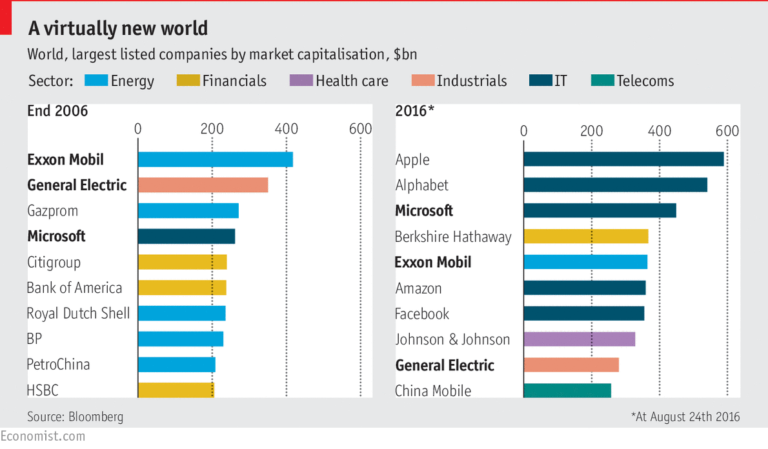
This sentence is a bit of a tautology [1]. But in any case, it's worth remembering that those incursions always find their way back home. Consider the most recent wars. The European migrant crisis has its roots in the most recent wars in Iraq and Afghanistan. Furthermore, the USA will eventually feel the economic impact of those two wars. The fact that [2] could happen while the USA ran up enormous deficits (completely unrelated to that growth) is deeply worrying; what will happen in even a slightly less dynamic domestic economy?

> China's influence and dominance will happen through the private sector, ironically.

This view of the world also has a time-honored tradition. Thomas Jefferson was an early proponent of the view that national power flows from economic might rather than hard power. It's worth noting that the policies he actually implemented while in office diverged substantially from his ideological beliefs.

I agree with you about what the future of conflict between the US and China will most likely look like. I think most people do. The question is how you hedge that bet: is the alternative military&economic peace (because military conflict is unimaginable)? Or, is the alternative military conflict on top of the existing economic conflict?

I think the latter is more likely.

--

[1] https://en.wikipedia.org/wiki/Third_World

[2] http://ritholtz.com/wp-content/uploads/2016/09/virtually-768...
Re: Who needs democracy when you have data?

#65
post #42
post #26

Earlier quoted context omitted.

Do they? Can you really establish a rational need for democracy, or are you just running on cultural reflex? If you take this question as me saying we shouldn't have democracy, maybe it's reflex. It's an interesting question. Democracy isn't an end in itself, but rather a means to an end. What is that end (or those ends)? How else can those ends be achieved?

A rational need for democracy for you would be so that I don't govern you according to my wishes. A rational need for democracy for me would be that you don't govern me according to your wishes. A rational need for democracy for the uyghurs would be that Xi Jumping doesn't govern them according to his wishes. I've always understood this to be what is meant by democracy is the worst form of governance, apart from all…

Government, democracy or not, generally means I am being governed according to some, but not all of my wishes. It's not an on-off switch, it's a continuum of compromise.

Treating it like an on-off switch, my way or the highway on everything, led to much of the weirdness of the 2016 elections in the US.

Re: Who needs democracy when you have data?

#66
post #56

There is nothing in the world right now that I fear more than the creep of Chinese surveillance/authoritarian practices into the rest of the world's society. They are a rapidly growing superpower, and while I hold no fantasies of U.S. supremacy, this specific trend in the use of digital technology terrifies me. There won't be a war, by the way. I honestly think we're past the point as a species where superpowers duke…

>There won't be a war, by the way. I honestly think we're past the point as a species where superpowers duke it out in such a literal fashion. It's just bad for business.

I tried to find the quote and couldn't, but IIRC this exact argument was used for why WW1 never could have happened (prior to WW1).

Re: Who needs democracy when you have data?

#67
post #56

There is nothing in the world right now that I fear more than the creep of Chinese surveillance/authoritarian practices into the rest of the world's society. They are a rapidly growing superpower, and while I hold no fantasies of U.S. supremacy, this specific trend in the use of digital technology terrifies me. There won't be a war, by the way. I honestly think we're past the point as a species where superpowers duke…

It will be an interesting case study to see what they do with the Uyghurs. What can a government do to an enemy population when they've sequenced the DNA of every individual in that population?

Re: Who needs democracy when you have data?

#68
post #66
post #56

There is nothing in the world right now that I fear more than the creep of Chinese surveillance/authoritarian practices into the rest of the world's society. They are a rapidly growing superpower, and while I hold no fantasies of U.S. supremacy, this specific trend in the use of digital technology terrifies me. There won't be a war, by the way. I honestly think we're past the point as a species where superpowers duke…

>There won't be a war, by the way. I honestly think we're past the point as a species where superpowers duke it out in such a literal fashion. It's just bad for business. I tried to find the quote and couldn't, but IIRC this exact argument was used for why WW1 never could have happened (prior to WW1).

Yeah. I'm no expert, but it's my intuition that the hindsight of WW1 and WW2, combined with the existence of the UN and of nuclear weapons, would be enough to change things. But who knows.

At the very least, with how much money America dumps into its military, I think dominating our economy is simply a path of less resistance than trying to dominate our military.

Re: Who needs democracy when you have data?

#69

Data is nothing; interpretation is everything. That's why democracy is needed even in the presence of data: the people still have a need to choose how the data is interpreted and who will do the interpreting.

It's particularly easy to mislead by only collecting data that supports a given position. This is why heterodoxy is so important in the academy, and why it's so concerning that certain fields are so hostile toward unorthodox points of view.

Re: Who needs democracy when you have data?

#70
This might be slightly off topic, and I’m really all for democracy, but I do worry that the system is losing its competitive edge in the age of reputation. It’s just way too easy for an organized party to spread maliciously fake information and sow discord among the populace. We saw this at work with Russia’s Twitter accounts that claim to be from Texas, England, and other Western worlds, writing subtle hate tweets against refugees, Muslims, BREXIT proponents/opponents, etc. Thing is, it’s not just Russia that’s doing this. There is a German study that found social/political bots that root for Japan’s nationalist agenda [1]. South Korea has been having similar issues on their biggest websites. And I’m willing to bet there are organized parties within America that benefit from social division as well.

A non-democratic society is probably better equipped to move forward amidst all the chaos (and in preventing chaos in the first place), whereas a democratic one may be much more likely to tear itself apart from inside out.

[1] https://www.ncbi.nlm.nih.gov/pubmed/29182493

Post reply on HN