Live data from Hacker News

The rich world needs higher real wage growth

economist.com

251–260 of 265 posts

Re: The rich world needs higher real wage growth

#251

Here are a couple of interesting and crucially related graphs: - Nonfarm Business Sector: Real Compensation Per Hour [1] - Nonfarm Business Sector: Real Output Per Hour of All Persons [2] - Real Median Personal Income [3] Nonfarm business sector is defined as "a subset of the domestic economy and excludes the economic activities of the following: general government, private households, nonprofit organizations serving…

These are more interesting graphs. https://fred.stlouisfed.org/graph/fredgraph.png?g=ki8y https://fred.stlouisfed.org/graph/fredgraph.png?g=ki8A https://fred.stlouisfed.org/graph/fredgraph.png?g=kipg Healthcare, education, and housing have all doubled since the turn of the century compared to median incomes. There are a few sectors of the economy that are absolutely crushing people who make a median wage.

On housing there are some caveats:

- it's a consumer-driven market, higher prices made a lot of ordinary citizens rich. It's not money that disappeared into a few rich shareholders' pockets like say in the medical industry.

- [0] mortgage rates have gone down from a peak of 18% to below 3%. That's the money that you'll never see again. Suppose you bought a home 3x your income, you used to be paying 54% of your income on interest alone, now it's 9%. Prices went up, but there was also downward pressure on your actual monthly expenses due to interest rates plummeting.

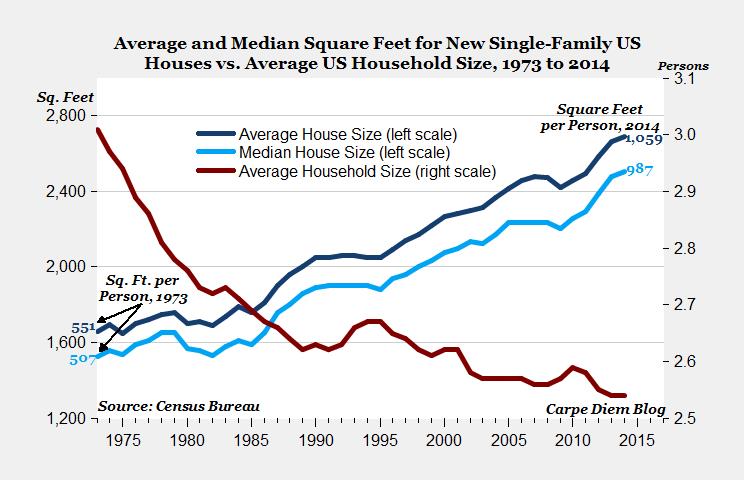
- 'houses' aren't fungible over time. Home sizes are way bigger and household sizes slightly smaller. On average each individual has roughly twice as much home space as before. [1] We choose to live bigger and sharing our space with fewer people. That's at least a sign of shifting preferences, and at best a sign of wealth, not poverty.

Caveats can be made about healthcare, too. We've added 8 years of life to each individual since the 1970s. That's insane.

I'm less excited about education. I see signs of credentialism. Education still has positive returns for individuals, but the story isn't as strong as for societal returns (i.e., at some point the abundance of degrees become a positional good or in other words a zero-sum game).

[0] https://i.stack.imgur.com/eKqLH.gif [1] https://azgolfhomes.com/wp-content/uploads/2016/07/American-...

Re: The rich world needs higher real wage growth

#252

Earlier quoted context omitted.

Your reply sounds like an absolutely classic reply of someone driven very much by social status signalling. Especially the whole “I don’t buy into status-seeking; I just like ‘quality’ experiences” thing — which just begs the question, where does your notion of quality come from? “I enjoy walking to my local shops...” is the same as saying you like being high-status and commanding the existence of a local bazaar that…

You most definitely can separate the fashionable, and status-seeking aspects out from urban culture. I live in Canada. The traditional cuisine is bland, and fresh produce grows only a few months of the year. I see my love of sushi as a product of globalization and urbanization as much as is my ability to get decent fruit from the grocery store in the heart of winter. Sure I could have a root cellar and eat potatoes a…

Somehow this reminds me of the history of lobster as cheap food for the poor and imprisoned. People detested it. Until of course the status of lobster changed.

Or the fact aluminium used to be extremely expensive and thus used for the most precious cutlery, ornaments etc. Until of course it became dirt cheap to produce.

Some things really are related to the ideas we hold, not reality itself. You can see this in blind tests of foods or drinks like wines, the blind ratings often don't correspond with their reputation or price.

Bourdieu's book la distinction is quite a good treatise on this topic. Taste and what we consider artful or high quality is much more constructed by our environment than by any innate or objective measure, we tend to fool ourselves on this point.

Re: The rich world needs higher real wage growth

#253

Earlier quoted context omitted.

Because by the 1970s, Capital was a fully globalized force whose political projects exceeded the power of individual nation state’s ability to resist them. Only transnational labor solidarity has comparable power, which is something that Capital owners had specifically sought to (and succeeded at) undermining in the context of the Cold War.

By transnational you mean American? There are plenty of countries where unionization and labour solidarity remains strong even today. And, if so, what is special about the American workforce in particular that they have such an effect on the entire world?

It’s not what’s so special about the American workforce, but what’s so special about American Capital. And the answer to that is that standing behind their demands is a massive, belligerent, military empire, with a long history of toppling or refusing to defend countries that don’t play along.

Re: The rich world needs higher real wage growth

#254

Earlier quoted context omitted.

Why always hand it over to someone else? You can't say that tons of investment is always a good thing. Look at the Dairy industry in the United States. Wal-Mart has vertically integrated the dairy industry into itself, as a result, many smaller regional farmers no longer have a market at all since there is no way to compete with someone who is so well integrated that they can SELL AT A LOSS in dairy, yet compensate b…

> ALWAYS a positive societal good I didn't say it was. I was responding to "beneficial for anyone else". > value deserts I'm sorry, but this is nonsense. There are some sound reasons for redistributing money from the wealthy to the poor. Benefiting the economy because the rich are hoarding money or are incompetent investors is not one of them.

Value deserts in the sense that no competitors can break into the market to capture share, because the market is essentially defined by the entrenched player. Yes it does happen.

Again, look at Wal-Mart and dairy. Alphabet\Google does the same with digital advertising.

I'm not saying people are crap investors either. I'm saying the definition of a "good investor" (maximize fimancial ROI) and a "good company" (maximize financial profit) leads inevitably to market behemoths forming which WILL degenerate the health of the economy as a whole, and drastically increase barriers to entry for smaller players. A company as a collective stands as much as a danger when it becomes too large as it does a benefit.

A "good company" should not grow infinitely. It should grow as much as is needed to do what it needs to. That is providing it's service to it's community. No living system constrained by finite time and resources can support unceasing growth. The economy is just such a system.

Re: The rich world needs higher real wage growth

#255

Earlier quoted context omitted.

> ALWAYS a positive societal good I didn't say it was. I was responding to "beneficial for anyone else". > value deserts I'm sorry, but this is nonsense. There are some sound reasons for redistributing money from the wealthy to the poor. Benefiting the economy because the rich are hoarding money or are incompetent investors is not one of them.

Value deserts in the sense that no competitors can break into the market to capture share, because the market is essentially defined by the entrenched player. Yes it does happen. Again, look at Wal-Mart and dairy. Alphabet\Google does the same with digital advertising. I'm not saying people are crap investors either. I'm saying the definition of a "good investor" (maximize fimancial ROI) and a "good company" (maximiz…

I think this has wandered way off topic.

Re: The rich world needs higher real wage growth

#256

Earlier quoted context omitted.

You've increased prices for SOME goods, but you've massively massively reduced prices for all others. Urban sprawl is extremely expensive, and the high costs on infrastructure effects the poor the most. If housing and infrastructure were cheaper, because we've built more stuff in cities, then the poor beneift the most due to the lower housing costs (which makes up most of their expenses).

So, do people not understand that all jobs, and demand for people, aren't going to be located in a single point in space? Why have two cities of New York and San Francisco? Why not just one city of New York? Increasing commodity prices raises the price of all good, not just some goods, because that's how economics works. Every cost is transferred somewhere else. So, not sure why you want to raise the price of all goo…

No, we don't need only a singular city.

But the status quo of what we are currently in is way way to far on the wrong end of thing.

So once San Francisco and new york rent prices aren't literally 5 time larger than rent prices in the countryside THEN we can worry about the issues you bring up.

But as long as rent prices ARE 5 times larger in the city, I will not worry a single ounce about the issues you brought up.

You are engaging in the extremism fallacy. It would be like if a bunch of people were in the desert, and everyone was dieing due to dehydration, and then you came along and said "Well, you know, if you drink too much water, then you can die of water poisoning! Why aren't you worried about water poisoning!?!?!?".

Yes, water poising can kill people if you drink 10 gallons of water every day. But we are in a freaking desert and people are dying due to dehydration, so why the hell are you talking about something so ridiculously as water poisoning!?!

Re: The rich world needs higher real wage growth

#257

Earlier quoted context omitted.

So, do people not understand that all jobs, and demand for people, aren't going to be located in a single point in space? Why have two cities of New York and San Francisco? Why not just one city of New York? Increasing commodity prices raises the price of all good, not just some goods, because that's how economics works. Every cost is transferred somewhere else. So, not sure why you want to raise the price of all goo…

No, we don't need only a singular city. But the status quo of what we are currently in is way way to far on the wrong end of thing. So once San Francisco and new york rent prices aren't literally 5 time larger than rent prices in the countryside THEN we can worry about the issues you bring up. But as long as rent prices ARE 5 times larger in the city, I will not worry a single ounce about the issues you brought up. Y…

Yah but you're raising prices on everything anyways by making everyone live in the city where they are unneeded instead of more efficiently where the jobs are.

Re: The rich world needs higher real wage growth

#258

This article really demonstrates how meaningless most economics reporting is, it's nearly as bad as markets/finance reporting. Oil is $75, about average over the last decade. It has almost nothing to do with employment, wage growth or GDP except inasmuch as all major economic measures affect eachother. A year ago oil prices were low, did that mean the opposite of this article (whatever that is) was true? This kind of…

I am reading "skin in the game" from Nassim Taleb. He makes a lot of points against journalits or economists. And it seems right many times. They do not have real contact with the things they talk about.

Re: The rich world needs higher real wage growth

#259

Earlier quoted context omitted.

No, we don't need only a singular city. But the status quo of what we are currently in is way way to far on the wrong end of thing. So once San Francisco and new york rent prices aren't literally 5 time larger than rent prices in the countryside THEN we can worry about the issues you bring up. But as long as rent prices ARE 5 times larger in the city, I will not worry a single ounce about the issues you brought up. Y…

Yah but you're raising prices on everything anyways by making everyone live in the city where they are unneeded instead of more efficiently where the jobs are.

Most of the jobs are in the cities already, even without the hypothetical scenario. Most developed nations are mostly service sector, and demand for services is mostly where the people are, despite remote working being possible in some cases.

(Does anyone call for new primary industry jobs these days, or is that basically robots first now, with the jobs being mostly service and some manufacturing?)

Re: The rich world needs higher real wage growth

#260

Earlier quoted context omitted.

Federal Reserve Bank of San Francisco, even after massaging the numbers by suggesting measurement issues may account for differences, shows a 30% difference between poor and rich in terms of average propensity to consume. https://www.frbsf.org/economic-research/publications/economi...

That paper makes the fundamental error I am talking about. It assumes that if rich people aren't spending on consumption, they are hoarding cash. It then makes economic sense to redistribute that hoarded cash in order to put the money to use. But the rich aren't hoarding cash. They're investing it. The money is put to use. The rich do not have pallets of cash in the basement. You'd think that professional bankers wou…

Consumption != Investment

Imagine a world where everyone put 99% of his income into investments. There would be nothing to invest in, because nobody was consuming.

And by this definition the poor are definitely putting the money to better use because they cause the economy to grow by spending it all.

The rich are currently facing an asset price inflation because there is too much money wanting to be invested and not enough consumption for all those assets to be put to good use.

Post reply on HN