Live data from Hacker News

The rich world needs higher real wage growth

economist.com

231–240 of 265 posts

Re: The rich world needs higher real wage growth

#231

Earlier quoted context omitted.

If those jobs are "needed" then wages will rise, and the market will solve the problem. If wages don't rise for those jobs, then they weren't needed.

Right, and now you just raised inflation, raising prices for everyone and punishing most the poor and elderly on fixed income, since they rely disproportionately on commodity goods and services. If you want a successful economy, you have to plan for it: find where resources are going to be utilized, and build from there.

You've increased prices for SOME goods, but you've massively massively reduced prices for all others.

Urban sprawl is extremely expensive, and the high costs on infrastructure effects the poor the most.

If housing and infrastructure were cheaper, because we've built more stuff in cities, then the poor beneift the most due to the lower housing costs (which makes up most of their expenses).

Re: The rich world needs higher real wage growth

#232
post #85

Earlier quoted context omitted.

This article really demonstrates how meaningless most economics reporting is, it's nearly as bad as markets/finance reporting. The problem is not with the reporting, it’s with the field. Economics is pseudoscience. It has all the trappings but none of the explanatory or predictive abilities. So you get articles like these that use a lot of jargon pretending like they’re making a strong case, but there’s no strong con…

Economics is not pseudoscience. Pseudoscience is essential oils being marketed as medicine. Economics is a social science, just like anthropology, archaeology, history, linguistics, political science, psychology, sociology, etc. etc. It's never going to be something with Laws of Gravity or the like, because humans are never wholly predictable or rational creatures. But that doesn't mean we can't come up with models t…

[deleted]

Re: The rich world needs higher real wage growth

#233

Earlier quoted context omitted.

> I don’t give a rat’s ass about the larger dynamics But just because you don't, doesn't mean they don't exist/matter. You can do a lot on your individual micro-scale, but you will have a very hard time understanding how these changes affect the overall economy on a macro scale. For all we know, "the market" is pretty much just a giant black box. It's not totally black, but we have a very hard time properly defining,…

> you will have a very hard time understanding how these changes affect the overall economy on a macro scale We understand the relationship between the temperature and pressure of ideal gasses without a precise presentation of quantum mechanics. Similarly, we can produce useful production functions without comprehending the complexity of the bulk.

I'm not sure I can agree with that comparison because physics, even quantum mechanics, are a still considered a natural science.

Economics, on the other hand, are usually considered part of the social sciences, due to the heavy sociological influences, which make modeling, predicting and testing extremely difficult.

For all the talk of "the market", especially in the financial sector and by glorifying certain successful individuals, the reality seems to be far less understood than many people would admit to. Probably has to do with these people usually trying to sell their services/financial products with a reputation for "understanding and mastering the market".

Re: The rich world needs higher real wage growth

#234

Earlier quoted context omitted.

Federal Reserve Bank of San Francisco, even after massaging the numbers by suggesting measurement issues may account for differences, shows a 30% difference between poor and rich in terms of average propensity to consume. https://www.frbsf.org/economic-research/publications/economi...

That paper makes the fundamental error I am talking about. It assumes that if rich people aren't spending on consumption, they are hoarding cash. It then makes economic sense to redistribute that hoarded cash in order to put the money to use. But the rich aren't hoarding cash. They're investing it. The money is put to use. The rich do not have pallets of cash in the basement. You'd think that professional bankers wou…

> they are hoarding cash

I don’t think anyone assumes anyone is hoarding cash. It’s just a time to deployment question.

A dollar flowing into a wealthy person’s account may take a week or two to get loaned out or fielded into an investment, and another week or two to pay the investment manager or begin facilitating the purchase of goods and services. A dollar dropped into an empty checking account may buy food that day from an establishment which will sweep it out to a supplier the next day.

Our financial system is efficient, but the last time I saw a statistic for the figure, it takes about two weeks for the average checking account deposit to get turned into a mortgage.

Re: The rich world needs higher real wage growth

#235
post #85

This article really demonstrates how meaningless most economics reporting is, it's nearly as bad as markets/finance reporting. Oil is $75, about average over the last decade. It has almost nothing to do with employment, wage growth or GDP except inasmuch as all major economic measures affect eachother. A year ago oil prices were low, did that mean the opposite of this article (whatever that is) was true? This kind of…

This article really demonstrates how meaningless most economics reporting is, it's nearly as bad as markets/finance reporting. The problem is not with the reporting, it’s with the field. Economics is pseudoscience. It has all the trappings but none of the explanatory or predictive abilities. So you get articles like these that use a lot of jargon pretending like they’re making a strong case, but there’s no strong con…

> Economics can’t be a science yet. It is a branch of sociology

Sociology is a science, and so branches of it are also science. There are differences between the hard/soft or natural/social sciences but that doesn't mean that soft science isn't science.

Re: The rich world needs higher real wage growth

#236

Earlier quoted context omitted.

Why did Canada's wages stop growing at the same time, even though unions continued to strengthen until the mid-1980s, when it peaked at nearly 40% of the workforce?

Because by the 1970s, Capital was a fully globalized force whose political projects exceeded the power of individual nation state’s ability to resist them. Only transnational labor solidarity has comparable power, which is something that Capital owners had specifically sought to (and succeeded at) undermining in the context of the Cold War.

By transnational you mean American? There are plenty of countries where unionization and labour solidarity remains strong even today.

And, if so, what is special about the American workforce in particular that they have such an effect on the entire world?

Re: The rich world needs higher real wage growth

#237

The rich world needs cheaper housing. Fix that and the average family can allocate more resources to other things like health and education instead of diverting more resources to rent seekers.

How though? I mean, houses themselves haven't really gotten much more expensive. Two things have happened.

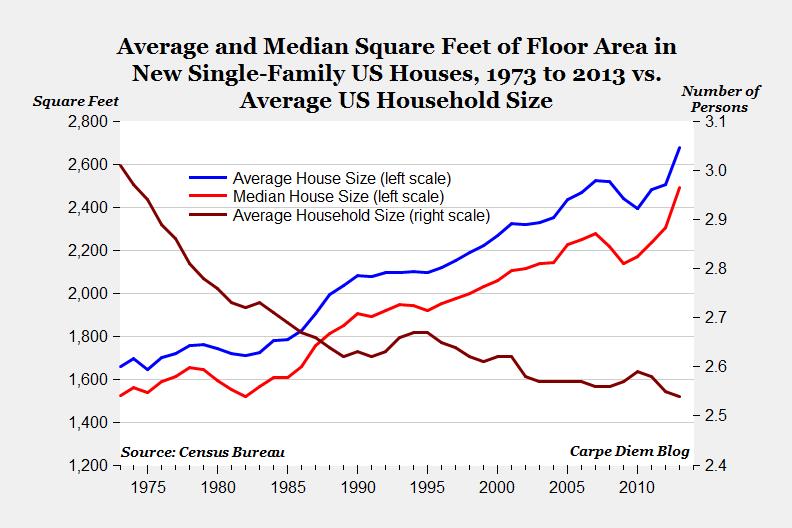
One, we're all living much larger than before. i.e., our average home sizes have doubled in about 50 years, while the number of people per household dropped. [0] That's a sign of wealth more than anything else.

And two, we've all decided to live next to each other. That's a choice. It's a choice coerced by reality, e.g. jobs being in population centres like cities, but it's a tradeoff between affordability and proximity to an economic, cultural, political and social centre.

Housing in and of itself is not unaffordable, only in certain conditions. Affordable housing today would become unaffordable if we decided we wanted homes twice as big with fewer people living there. Or it'd be unaffordable if we all decided to want to live on the same tiny piece of land.

For a little context, if you look at population density in the US, it's 33 per km2 on average. That's about 5.5 football fields per person, or in other words, about 22 football fields of space for parents with two kids. Compare that to a city block in in Washington which holds 38.000 people per km2, more than 1000x the population density of the US. It looks like this [1]. This shows how concentrated we really live in some places we call unaffordable.

Most of the cost of housing actually isn't the home itself. Homes are pretty cheap to build. A 1200 square feet home for two people costs on average about $150k to build, or $75k per person. That's about 2 years of the median personal income in the US. The big expense is in the land, but only in some places. It's unaffordable because we choose to live at 1000x the population density of the average in the country. If you've got 1000 plots of land, and we all decide to live on one of them, and across 50 years double our home size and reduce number of people we share our homes with, no wonder it's unaffordable.

The solution in part has to do with building more homes, zoning laws, construction red tape. But mostly, it has to do with the fundamental fact that we live larger and more concentrated. We need an economic and cultural shift against that. Urbanisation is great, I live in a city, but we have to do away with the model of a few hotspots and decentralise more, invest more in smaller cities, remote working, and infrastructure that connects cities. There's no zoning law that keep ultra-concentration affordable.

[0] https://2static1.fjcdn.com/comments/House+size+and+family+si...

Plenty of similar sources. This occurs in many countries outside the US, too. It occurs in many countries outside the US, too.

[1] https://ggwash.org/images/posts/201608-031125-3.png

Re: The rich world needs higher real wage growth

#238
post #224
post #84

I think the root cause of most of these problems, is that most people don't add economic value. That isn't to say they are bad people (of course not!), but that we have reached a stage in technology driven capitalism where only a small percentage of people can gain large pieces of the pie (software engineers and CEOs), while middle income jobs are too inefficient to survive (lawyers displaced by discovery software, a…

Sorry but the idea that most people will become “economic drains” in the next 20-30 years is ludicrous. Are you saying that there’ll be nothing worth doing, at all, that people can meaningfully contribute to after 2050?

I think the parent means that something like "flipping burgers" or "mopping the floor" will still need to be done - but it will not pay enough to sustain a person, or that it will cost more than the value received for the service.

Re: The rich world needs higher real wage growth

#239
post #149

Earlier quoted context omitted.

That just means I spend less money cars. All thing else being equal I should have more disposable income. Just like the phone example I can say cars are cheaper now. No sense trying to assign mythical extra value to them outside real dollar transactions.

Isn't that the entire purpose of measuring inflation?

Perhaps inflation should be measured in markets that are not changing - like food. And in areas that are not directly affected by interest rates like housing. Commodities are not very exciting, but the ones people rely on are key.

Re: The rich world needs higher real wage growth

#240
post #227

Earlier quoted context omitted.

> But the rich aren't hoarding cash. They're investing it. The money is put to use. The rich do not have pallets of cash in the basement. As a general statement, that's just as much an assumption as the GP's claim. Where are the studies to back it? I could certainly imagine situations where someone owns a lot of wealth but never developed the skill to manage it - classical example being inheritance. Also (unrelated t…

Even putting your money in a checking account causes it to be spent into the economy (as the bank loans it out). There's no rational reason to borrow money and make a pile out of it. Even people who operate cash businesses (like casinos) rush to deposit the cash in a bank ASAP. > If an investor chooses the strategy that gives themselves the best ROI that doesn't mean the investment is necessarily beneficial for anyon…

Why always hand it over to someone else? You can't say that tons of investment is always a good thing.

Look at the Dairy industry in the United States. Wal-Mart has vertically integrated the dairy industry into itself, as a result, many smaller regional farmers no longer have a market at all since there is no way to compete with someone who is so well integrated that they can SELL AT A LOSS in dairy, yet compensate by making up for it with social engineering via loss-leading.

https://www.nbcnews.com/news/us-news/best-advice-u-s-dairy-f...

You CANNOT sit idly by and say that investment is ALWAYS a positive societal good when by definition, the "rational invester" (read: paperclip maximizer for ROI) will naturally tend to converge on creating monolithic structures, which, by their nature as "rational corporate actors" act as, again, paperclip maximizers for profits.

Balance sheets do NOT accurately convey the full story of economic processes at work creating tangible effects in the real world, any more than meteorological climate models do.

If you take into account side effects caused by collectively funded (via rational investment methodologies) creating monolithic industry-consuming behemoths, then the idea the rich are "hoarding money" makes perfect sense.

Wal-Mart in this case is doubling down on automation, and keeping what payroll it pays low, so it's not actually acting to distribute wealth back to those who are so strapped they can't even think of investing, because they need to put the next meal on the table.

EVEN if they could statistically speaking, the most wealthy are the most likely to be able to pick up what stock they'd have to sell, because stock doesn"t put food on the table.

This creates a situation where regardless of who's hand the money is actually in, the outcome is the same. Monolithic businesses will be invested in, they'll integrate until they start creating value deserts in their space, and in order to contribute to continuing growth figures, will optimize away liabilities by minimizing workforce or salary. The only one's benefiting being those already on board.

Does it "GENERALLY" work well though? Yes and no. Yes, given the absence of any actors large enough to create value deserts through excessive vertical integration? Yes! It does!

No. I'm the sense that that isn't what the market seems to produce though. Companies will diversify, merge, or employ externalization of negative outcomes EXACTLY to accomplish making themselves the best looking target for investors.

At some point, enough has to be enough. The economy is one of the few process spaces where eternal growth is EXPECTED. No living system constrained by finite resource and time CAN grow indefinitely without causing major systemic upsets.

An equivalent solution to what Wal-Mart is doing could be achieved with networks of smaller less "fiscally efficient" distribution centers doing business with fewer monolithic industrial behemoths. This keeps the barrier to entry lower, leads to more opportunities for job creation, and increases financial mobility overall. This is something that CAN't exist with uncontrolled maximization of ROI by investors, and profits by corporation. At some point enough HAS to be enough.

Maybe I'm not an economist, but I've seen enough complex systems to recognize when blind spots exist in current modeling. This is something I see never get addressed.

Post reply on HN