Live data from Hacker News

So Long Last /8 and Thanks For All the Allocations

labs.ripe.net

31–40 of 201 posts

Re: So Long Last /8 and Thanks For All the Allocations

#31
post #9

Even in developed countries IPv6 is barely deployed (my UK ISP - BT - pretends that they rolled it out but half of the time my modem tells me IPv6 is not availabled until I force it to reconnect, and no sign of IPv6 on mobile networks). Was looking at whether it was more economical to buy a small address block vs rent it from a datacentre. A /24 address block seems to cost around $4,000 upfront but then you need to p…

Support for IPv6 is weird.

Comcast's IPv6 implementation is rock solid and faster than IPv4 most of the time. I've been running publicly accessible IPv6 HTTP hosts over it for several years now.

The last two Motorola Modems I've had came with IPv6 support and were provisioned by Comcast out of the box.

Access Points from D-Link will autoconfigure via SLAAC but DNS has to be hardcoded.

It's 2018 and yet Ubiquiti's UniFi enterprise networking gear only has alpha support.

IPv6 on Tomato just works and has for years, IPv6 on Raspbian not so much.

Windows just works seems to fuck with nonWindows clients so Enterprises disable it via Group Policy.

Android devices seem to forget IPv4 if they catch a wiff of IPv6 on the network.
Re: So Long Last /8 and Thanks For All the Allocations

#33
post #30
post #9

Even in developed countries IPv6 is barely deployed (my UK ISP - BT - pretends that they rolled it out but half of the time my modem tells me IPv6 is not availabled until I force it to reconnect, and no sign of IPv6 on mobile networks). Was looking at whether it was more economical to buy a small address block vs rent it from a datacentre. A /24 address block seems to cost around $4,000 upfront but then you need to p…

> and no sign of IPv6 on mobile networks Not quite true - EE (so one of the 'big four' providers rather than a small MNVO) has IPv6 support. Right now, my phone has an IP address assigned out of EE's 2a01:4c8::/29 netblock and I can connect to IPv6 only websites. My phone isn't super modern either - a 2016 era OnePlus 3 running Android 8.0.

I thought LTE was IPv6 native? T-Mobile in the US has two APNs available, EPC and Fast, and Fast is IPv6 only.

Re: So Long Last /8 and Thanks For All the Allocations

#34
post #4

>we still have around nine million recovered IPv4 addresses in our available pool. Under current policy and growth rates, we expect these to last a further two years. And by then they will have recovered even more. The end of IPv4 is a lie, and how bad IPv6 is and the lack of good transitioning systems doesn't help.

We do have more and more people in the world. Things like NATing can help get around it to some extent, but at the end of the day there aren't enough addresses to give every human alive today even one IP address. That doesn't strike me as a problem that can be solved by buybacks.

Trouble is that NAT solved a huge chunk of the problem. The current setup is not quite painful enough for people to want to fix it. The good is the enemy of the great, as it were.

Re: So Long Last /8 and Thanks For All the Allocations

#35

Earlier quoted context omitted.

What's wrong with IPv6? The only complaints I've seen are "the numbers are bigger", as if that's not the point, and that makes them harder to remember.

My "main issue" with it is that if people are used to being behind NAT, they now have to be a bit more careful about securing their computers (firewall etc.) because every computer now is publicly accessible. Most routers do not even seem to have an IPv6 firewall.

NAT does not provide access protection. NAT only hides the lack of access protection when it isn't there. A stateful firewall provides access protection, and that works with both IPv4 and IPv6.

Re: So Long Last /8 and Thanks For All the Allocations

#36
post #9

Even in developed countries IPv6 is barely deployed (my UK ISP - BT - pretends that they rolled it out but half of the time my modem tells me IPv6 is not availabled until I force it to reconnect, and no sign of IPv6 on mobile networks). Was looking at whether it was more economical to buy a small address block vs rent it from a datacentre. A /24 address block seems to cost around $4,000 upfront but then you need to p…

Support for IPv6 is weird. Comcast's IPv6 implementation is rock solid and faster than IPv4 most of the time. I've been running publicly accessible IPv6 HTTP hosts over it for several years now. The last two Motorola Modems I've had came with IPv6 support and were provisioned by Comcast out of the box. Access Points from D-Link will autoconfigure via SLAAC but DNS has to be hardcoded. It's 2018 and yet Ubiquiti's Uni…

> Windows just works seems to fuck with nonWindows clients so Enterprises disable it via Group Policy.

well I've seen most enterprise networks with no IPv6 support. (mostly admins thing that this beast is hard to work with) Also Kubernetes has limited IPv6 support (mostly on the documentation site) (of course it's easier to support a IPv6 only cluster, because heck you wouldn't really need BGP or some wierd overlay networks (sadly it still is not there yet)).

In Germany IPv6 within "Deutsche Telekom" is just good. But sadly on the consumer side you still won't get any fixed IPv6 (due to privacy concerns!)

Re: So Long Last /8 and Thanks For All the Allocations

#37
post #34

Earlier quoted context omitted.

We do have more and more people in the world. Things like NATing can help get around it to some extent, but at the end of the day there aren't enough addresses to give every human alive today even one IP address. That doesn't strike me as a problem that can be solved by buybacks.

Trouble is that NAT solved a huge chunk of the problem. The current setup is not quite painful enough for people to want to fix it. The good is the enemy of the great, as it were.

AKA "worse is better", biting us in the arse once again.

Re: So Long Last /8 and Thanks For All the Allocations

#38
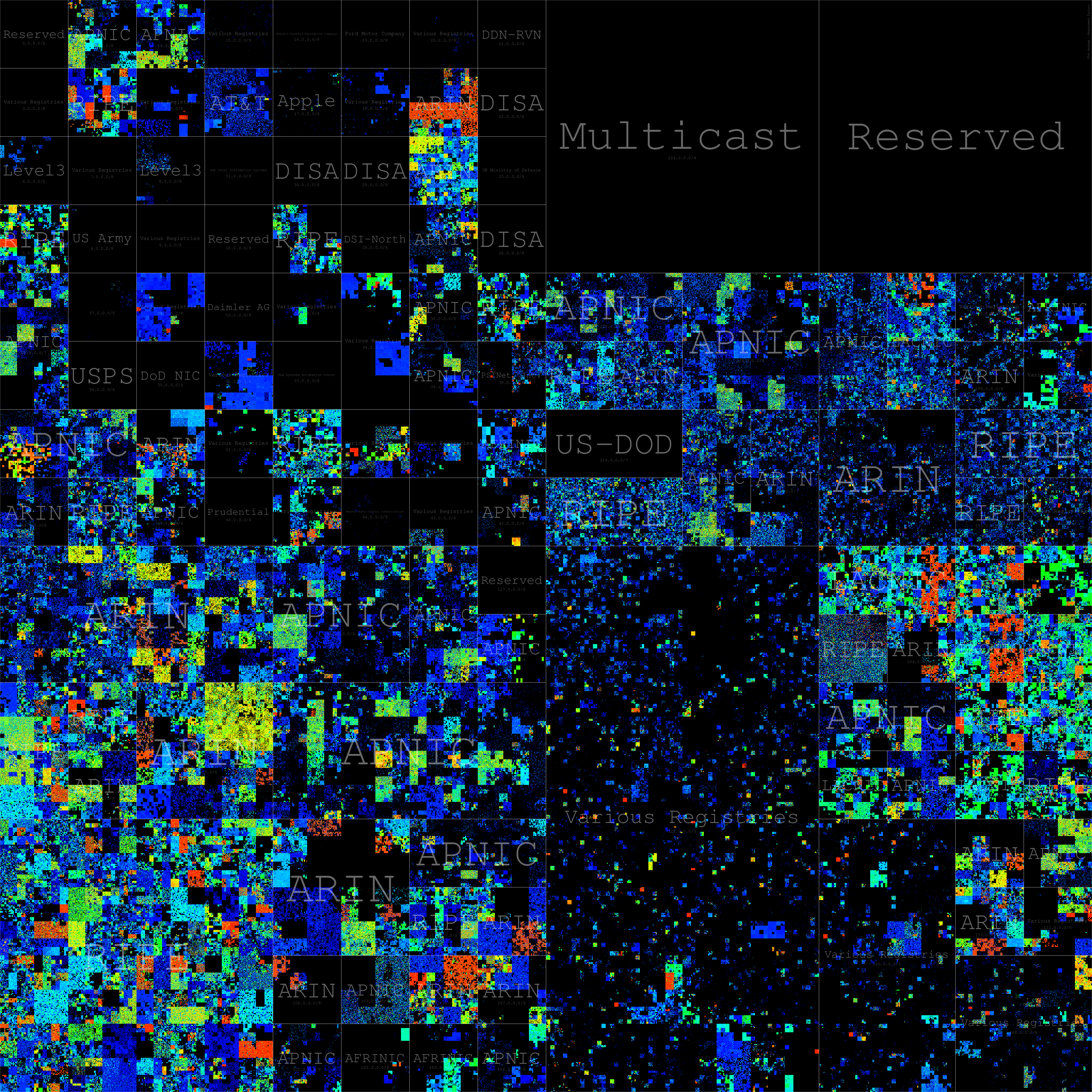
IPv4 address utilization is incredibly low. For example, consider 44.0.0.0/8 - it's sitting around almost entirely unallocated. UCSD Caida uses it for their network telescope (pretending to use it for amateur radio) and won't give it back.

Just look at how dark it is: https://benjojo.co.uk/internet-2018.png (from https://blog.benjojo.co.uk/post/scan-ping-the-internet-hilbe...)

Discussion on r/amateurradio - https://www.reddit.com/r/amateurradio/comments/ohi7j/did_you...

Re: So Long Last /8 and Thanks For All the Allocations

#39
post #9

Even in developed countries IPv6 is barely deployed (my UK ISP - BT - pretends that they rolled it out but half of the time my modem tells me IPv6 is not availabled until I force it to reconnect, and no sign of IPv6 on mobile networks). Was looking at whether it was more economical to buy a small address block vs rent it from a datacentre. A /24 address block seems to cost around $4,000 upfront but then you need to p…

Support for IPv6 is weird. Comcast's IPv6 implementation is rock solid and faster than IPv4 most of the time. I've been running publicly accessible IPv6 HTTP hosts over it for several years now. The last two Motorola Modems I've had came with IPv6 support and were provisioned by Comcast out of the box. Access Points from D-Link will autoconfigure via SLAAC but DNS has to be hardcoded. It's 2018 and yet Ubiquiti's Uni…

> Windows just works

Almost. IPv6 privacy extensions are subtly broken.

https://social.technet.microsoft.com/Forums/windows/en-US/57...

Re: So Long Last /8 and Thanks For All the Allocations

#40
post #9

Even in developed countries IPv6 is barely deployed (my UK ISP - BT - pretends that they rolled it out but half of the time my modem tells me IPv6 is not availabled until I force it to reconnect, and no sign of IPv6 on mobile networks). Was looking at whether it was more economical to buy a small address block vs rent it from a datacentre. A /24 address block seems to cost around $4,000 upfront but then you need to p…

Support for IPv6 is weird. Comcast's IPv6 implementation is rock solid and faster than IPv4 most of the time. I've been running publicly accessible IPv6 HTTP hosts over it for several years now. The last two Motorola Modems I've had came with IPv6 support and were provisioned by Comcast out of the box. Access Points from D-Link will autoconfigure via SLAAC but DNS has to be hardcoded. It's 2018 and yet Ubiquiti's Uni…

Does your Comcast IPv6 address ever change on you? If yes, do you have any tricks to keep your HTTP servers accessible?
Post reply on HN