https://vinepair.com/wp-content/themes/vpcontent/images/brew...
Craft Beer Is the Strangest, Happiest Economic Story in America
31–40 of 168 posts
Re: Craft Beer Is the Strangest, Happiest Economic Story in America
#32I wonder if marijuana will also be able to avoid being crushed and consolidated by monopolies. I don't think the cigarette industry was able to avoid it but I am not well versed on tobacco industry regulations. My gut tells me that since at the end of the day marijuana is an agricultural commodity large players will come to dominate the market. But on the other hand there is a decent variety in strain types and flavo…
It's already happening here in CO. The amount of consolidation going on behind the scenes over the past couple years is staggering. On the plus side it's mainly dispensary owners selling to other owners rather than Philip Morris.
Re: Craft Beer Is the Strangest, Happiest Economic Story in America
#33> Large breweries ignored burgeoning niches, Watson said, particularly hoppy India Pale Ales, or IPAs, which constitute a large share of the craft-beer market. He's reversing cause-and-effect. IPAs are incredibly popular among microbrewers, because it is incredibly hard to brew consistently tasting batches of beer. Smothering all of a beer's other flavours, by dumping buckets after buckets of hops into it is much eas…
That's nonsense. Craft breweries are businesses and they'll sell what makes money. Also, IPAs are incredibly hard to brew, store, and distribute consistently. Hops are probably the most seasonal part of a mash bill, and high quality finishing hops are in heavy demand. And the hop acids are subject to spoilage by heat, light, or oxygen. If you want "smothering a beer's other flavors" then look no further than whiskey/…
That seems to be a current trend like the hyper-hops that everybody is complaining about.
I used to like barrel aged beers because they would take an actively good beer, drop it in a barrel for a bit, and that would add just an extra touch of something. About 5 years ago, I could order just about anything barrel-aged and I was going to like it.
Now, barrel-aged seems to be "massive amount of overpowering, cloying sweetness". "Barrel-aged" is now a warning sign for me to request a taste first.
Re: Craft Beer Is the Strangest, Happiest Economic Story in America
#34> Large breweries ignored burgeoning niches, Watson said, particularly hoppy India Pale Ales, or IPAs, which constitute a large share of the craft-beer market. He's reversing cause-and-effect. IPAs are incredibly popular among microbrewers, because it is incredibly hard to brew consistently tasting batches of beer. Smothering all of a beer's other flavours, by dumping buckets after buckets of hops into it is much eas…
I'm totally with you. Every time I go to a bar or beer garden it feels like the menus are 75% IPAs. I'd rather drink sea water.
Re: Craft Beer Is the Strangest, Happiest Economic Story in America
#35I will be confused if I ever walk into a microbrewery that doesn't look like that!
Re: Craft Beer Is the Strangest, Happiest Economic Story in America
#36Eventually alcohol usage will be looked upon with great fascination of a custom of a barbarian age: "They used to actually drink poison for thousands of years but we have moved on." It'll take time but it'll happen.
Re: Craft Beer Is the Strangest, Happiest Economic Story in America
#37Earlier quoted context omitted.
> It's why eight out of every ten craft beers are incredibly bitter IPAs. I always saw this is a US West Coast phenomenon. Stone, in San Diego, sort of popularized the trend and then people started rolling with it to extremes. I have a similar issue with barrel aging. I love Victory at Sea from Ballast Point (since bought out by Constellation Brands) and similarly dark "toxic sewage" as my friends so happily classify…
San Diegan reporting in! It's gotten absolutely ridiculous. They have tapped out the "like eating a cone of pure hops" quintuple imperial IPA market, and now the trend is additives. Ballast Point and Modern Times are the worst about this. We are at the "add some truffle oil it" stage.
To be fair, Ballast Point always added strange things to their beers. And they had quite a few ... duds ... along the way.
And, yes, I have drunk some of those duds.
Re: Craft Beer Is the Strangest, Happiest Economic Story in America
#38Earlier quoted context omitted.
I don’t care much about smoking but I like edibles. From my own experience it’s entirely possible to differentiate your product as an edible and I see others finding brands they like and sticking to them. When I’m with friends buying plants they don’t seem to care as much about strain/grower (but that’s anecdotal).
I think edibles will be mostly taken over by concentrates. Instead of (in WA for ex.) paying $40 for 10 10mg edibles, I’ll pay $20 for enough concentrate to make 80 edibles.
Re: Craft Beer Is the Strangest, Happiest Economic Story in America
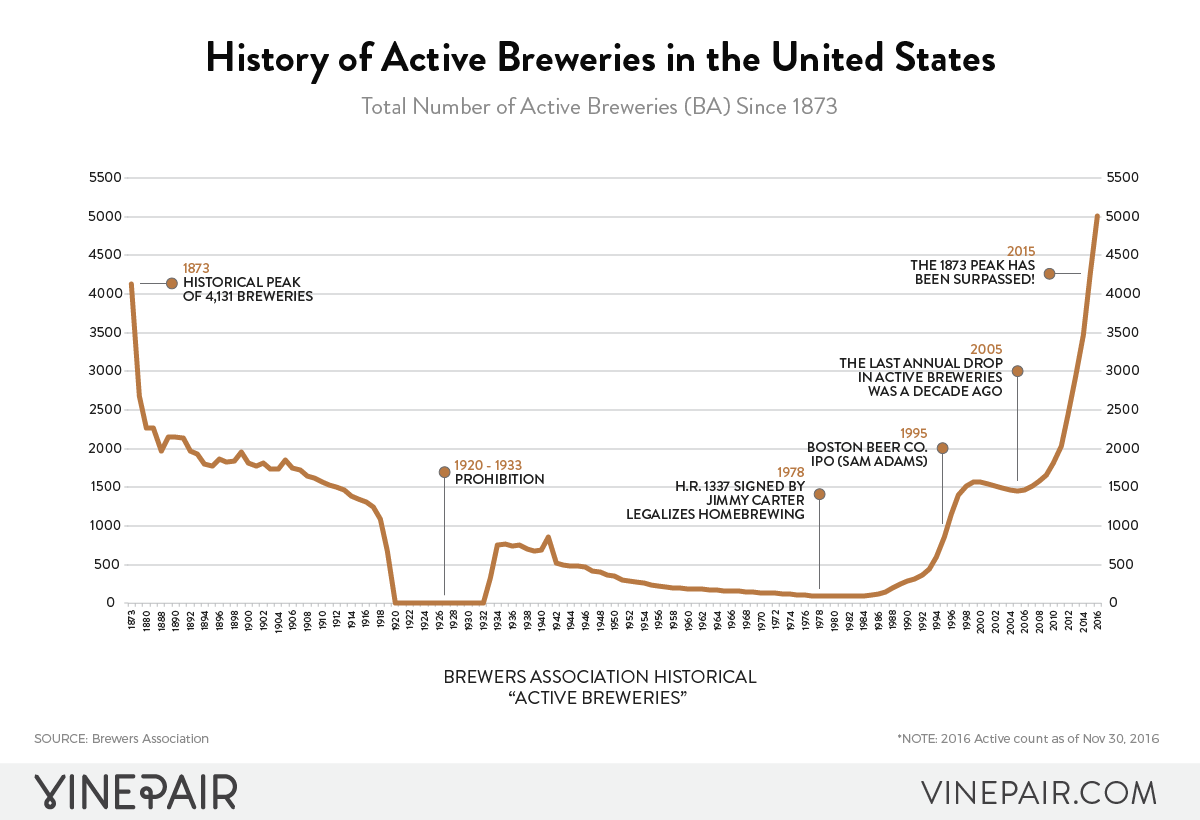
#39One interesting note: The article mentions Ronald Reagan's Justice Department's lax handling of antitrust regulations as leading to consolidation in the brewing industry, but the number of breweries was near its nadir before he was elected; in 1978 Jimmy Carter legalized home brewing, which was close to the very bottom in terms of number of breweries. https://vinepair.com/wp-content/themes/vpcontent/images/brew...
More recently we put together a visualization of the 1977 data at https://vinepair.com/map-american-breweries-1977/
There's also a marked up breakdown by brewery from a 1978 FTC report below the visualization.
Re: Craft Beer Is the Strangest, Happiest Economic Story in America
#40> Large breweries ignored burgeoning niches, Watson said, particularly hoppy India Pale Ales, or IPAs, which constitute a large share of the craft-beer market. He's reversing cause-and-effect. IPAs are incredibly popular among microbrewers, because it is incredibly hard to brew consistently tasting batches of beer. Smothering all of a beer's other flavours, by dumping buckets after buckets of hops into it is much eas…
Back in the 70's an early 80's there was only one style of beer in NA. That style was defined by marketing people and if you didn't like it then there was something wrong with you. It wasn't so much that the large brewers ignored burgeoning niches, they assumed that they could strong arm everyone into accepting the same product that they had been selling for generations.
To imply that micro brewers are unable to brew consistent beer is completely untrue. Sierra Nevada Pale Ale was a revelation mainly because it has only one flavour - hops. The yeast they use is ridiculously neutral. Any flaw in production would stand out a mile. In fact, one of the reasons it was originally bottle conditioned (is it still??? I haven't had it for a very long time) was so that they yeast could slurp up all the residual oxygen in the bottle. This lets nothing stand in the way of the fruity/floral aroma.
If anything, the American micro beer revolution has neglected other styles of beer because that idea is so iconic. It's not without precedent, however. If you look at good Bohemian pilsners, you get the same idea -- a very neutral palate with just enough sweetness to provide a platform for the hops. The main difference is that American pale ales go full on fruit. (Well, being a Morovian malt lover, I have to say that I really enjoy the grassiness of a fresh Bohemian pilsner if I can get it fresh -- very difficult from here, unfortunately).
US micros make hop forward beers because they sell. Not only that, but with recent advances in hop growing (lots of genetically modified varieties -- complete with patents :-P), modern hops are incredibly exciting. However, there are still lots great examples of other kinds of beer available that are not hop forward. If you wander up into French speaking areas of Canada you will find that they are even preferred!
What you won't find very often are good light lagers. This is not because the good breweries can't make them, it's because they can't sell them. You want to go up against the big boys in marketing a light lager? Good luck!
I like a good IPA now and again, but my bread an butter is an ordinary bitter with less than 30 IBUs. It's one of the reasons I brew my own -- I can't buy it outside of the UK. However, if you are just looking for variety, it's worth going a little bit out of your way to try to find it. There are lot's of amazing hefe weizens, wits, fruit beers, bocks, porters/stouts, spice beers, etc, etc, etc brewed in the US. Even in the area of pale ales, there are gobs of ESBs and nice balanced bottle conditioned pale ales. You just have to look for them.