Live data from Hacker News

Light Traffic

senseable.mit.edu

71–80 of 124 posts

Re: Light Traffic

#71

Earlier quoted context omitted.

What I don't understand is why every traffic light doesn't have cameras and some image recognition/machine learning (whether local or remote) to improve the timing - it would be such a cheap and easy fix compared to putting a sensor in each car.

A sensor itself isn't expensive but moving, storing, and processing all of that data to ultimately take action is. Let alone concerns with people about being recorded in public, even if red light cameras are permitted in some states today.

A traffic light would only need to solve a much simpler problem than an autonomous car- after image-recognition, given the number of cars waiting/approaching at each direction, decide which lane(s) to give a green light to. Finding a reasonably optimal policy could be hard, yes, but once one is found that could be applied to all (or most) traffic lights, and it couldn't plausibly be more computationally intensive to run than the image-recognition step.

Meanwhile, if conversation involves a plausible future where all/most vehicles (inevitably including police cars and other government-owned vehicles) are autonomous and have the same kind of sensors, its hard to imagine the anti-surveillance angle being a decisive factor. I'm not for pervasive surveillance, and perhaps the NSA will be nice and claim really convincingly that they can't access records from traffic lights... but that bird has flown, anyway.
Re: Light Traffic

#72
post #46
post #14

There's been a marked tendency to replace intersections with roundabouts and shared spaces ( https://en.wikipedia.org/wiki/Shared_space ) in many places, including the outskirts of Lisbon (as well as a few legendary mazes in Britain). There was even a BBC report on the latter (which I can't find right now, as usual, only a follow-up: http://www.bbc.com/news/uk-33303031 ). Drawing a (admittedly inaccurate) parallel wi…

> Drawing a (admittedly inaccurate) parallel with shared spaces (which are harder to navigate by sensory deprived humans than standard intersections), I'd say roundabouts (which preserve crossings) would be a more sensible short-term approach overall -- especially considering the remaining human drivers. I actually find roundabouts easier to navigate than large crossroads, I think this is partly because they actually…

It wasn't part of my driving test in Virginia, at least when I took it. I'm guessing if your state has a low number of roundabouts [0] then it's pretty unlikely you'll be tested on it. I'd be interested to hear if Marylanders (#1 in roundabouts:intersections) have it on their test.

Personally, I freak out when I see a roundabout coming up, and slow down dramatically. Or, I completely avoid them.

[0] https://www.citylab.com/transportation/2016/03/america-traff...

Re: Light Traffic

#73

I think people are focused on maximizing the wrong metric. Traffic projects like this tend to want to maximize car throughput , when what we really need is to minimize travel distance/time . Maybe then society would start looking at the effects that cars have made to sprawl, and the self-reinforcement cycle that emerges.

I honestly think the real toll is the mental concentration required and the stress caused by driving a car. Self-driving cars automatically fix that problem by removing the need for the passenger to concentrate on not killing people. When I take the bus I don't worry so much about my commute time, because I spend the ride relaxing and reading.

Re: Light Traffic

#74
This all works okay if you can trust every car on the road, but what about XYZ hacker broadcasting false information to slow everything down? Or more nefarious, they could cause an accident.

Re: Light Traffic

#75
post #14

There's been a marked tendency to replace intersections with roundabouts and shared spaces ( https://en.wikipedia.org/wiki/Shared_space ) in many places, including the outskirts of Lisbon (as well as a few legendary mazes in Britain). There was even a BBC report on the latter (which I can't find right now, as usual, only a follow-up: http://www.bbc.com/news/uk-33303031 ). Drawing a (admittedly inaccurate) parallel wi…

How has life been with transportation abstracted away into an app? Any unintended consequences?

Re: Light Traffic

#76

So a system that requires all vehicles on the road to have flawless sensor and communications systems can achieve some improvement over current-day technology (from the paper, approximately a "doubling of capacity" for intersections with this implemented.) This is a profoundly uninteresting result, given the current-day technology in question is "a dozen lights attached to a timer." Add devices that are several order…

> that they only achieve a factor of two improvement (in theory!) reads as a stunning failure of autonomous vehicle technology to pull their weight in this regard. Sounds like a profoundly interesting result to me -- strong evidence that we'd need to look elsewhere to increase transit carrying capacity. Maybe AI cars can't reduce traffic that much afterall.

This, so much. I wonder how much time and grant money is wasted because people don't publish negative results.

Re: Light Traffic

#77

Earlier quoted context omitted.

On roads where you can drive 30+MPH (50 KMPH+), I would suggest removing any possiblity for pedestrians to cross. Either make the road 20MPH (30KMPH) max where all space is shared with pedestrians, bicycles and cars - or make much better, safer & faster 50KMPH+ roads.

Is this satire? How do you walk anywhere otherwise?

Maybe, but it's an interesting concept.

My city put bridges over a lot of the major roads for people to cross. A few roads have a tunnels underneath as well.

Re: Light Traffic

#78

For fucks sake, where are the pedestrians??

On roads where you can drive 30+MPH (50 KMPH+), I would suggest removing any possiblity for pedestrians to cross. Either make the road 20MPH (30KMPH) max where all space is shared with pedestrians, bicycles and cars - or make much better, safer & faster 50KMPH+ roads.

In many large cities in Asia, the solution has been to elevate the pedestrian layer entirely using a system of skybridges, at least at the most congested roads. Of course, this would require a large investment in infrastructure.

Re: Light Traffic

#79
post #30

Earlier quoted context omitted.

That it is normal doesn't mean it's not pedestrian hostile. I catch myself cycling over-aggressively. For example, everyone knows that pedestrians have right of way on a zebra-crossing. Good luck with that in The Netherlands. Cyclists will simply not give you right of way, they'll swerve around you, ignore you, and generally make you uncomfortable. The Netherlands is a cyclists country in much the same way as the U.S…

Interestingly enough, right of way for ships/boats in waterways tends to favor the largest/heaviest over the smallest/lightest. It's oftentimes more dangerous for a larger thing to take evasive action than a smaller thing. I think this should carry over to vehicle/pedestrian right-of-way laws. Pedestrians should assume responsibility for their safety and pay attention (including taking evasive action), just as cyclis…

Your analogy works for 99% of the road, where cars and bicycles are indeed favored and passengers have to risk their lives to use the same pavement. The whole point of traffic crossings is to provide some exception to this rule, wherein pedestrians can use the street without having to exercise athletic skills and hyper-awareness to avoid getting struck. The whole idea that pedestrians are lighter/nimbler is false anyway - a teenager on a bike will react better than a nonagenarian with a walker or a parent with a four-year-old by their hand.

Re: Light Traffic

#80
post #46
post #14

There's been a marked tendency to replace intersections with roundabouts and shared spaces ( https://en.wikipedia.org/wiki/Shared_space ) in many places, including the outskirts of Lisbon (as well as a few legendary mazes in Britain). There was even a BBC report on the latter (which I can't find right now, as usual, only a follow-up: http://www.bbc.com/news/uk-33303031 ). Drawing a (admittedly inaccurate) parallel wi…

> Drawing a (admittedly inaccurate) parallel with shared spaces (which are harder to navigate by sensory deprived humans than standard intersections), I'd say roundabouts (which preserve crossings) would be a more sensible short-term approach overall -- especially considering the remaining human drivers. I actually find roundabouts easier to navigate than large crossroads, I think this is partly because they actually…

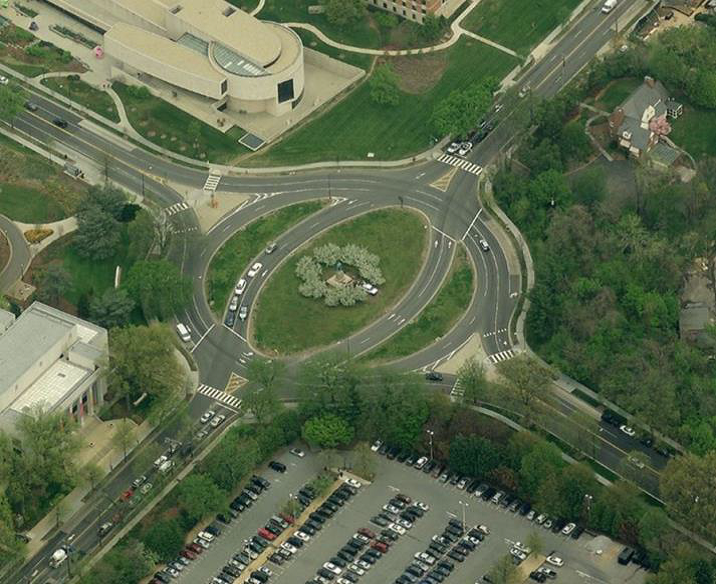
Roundabouts are not part of the driving test in DC. Indeed, roundabouts are so scary to Americans that most of the ones in DC have traffic lights. We also have roundabouts with roads cutting across them: https://ddot.dc.gov/sites/default/files/dc/sites/ddot/ward%2....
Post reply on HN