Live data from Hacker News

Why nature prefers hexagons

nautil.us

41–50 of 64 posts

Re: Why nature prefers hexagons

#41
post #32

You get hexagons because of close-packing.[1] Circles (or a 2D array of spheres) of the same size fit closest together when they are arranged in a hexagonal pattern. Push a bunch of marbles together and that's what you get. The bees don't know anything about hexagons. They just make circles close together and then as the cells are filled, stepped on, and come into contact with other wax cells, they "ballon out" into…

Is this the generally accepted explanation now? (I thought so, but the article itself doesn't mention it - then again, the article seems full of pseudo-science)

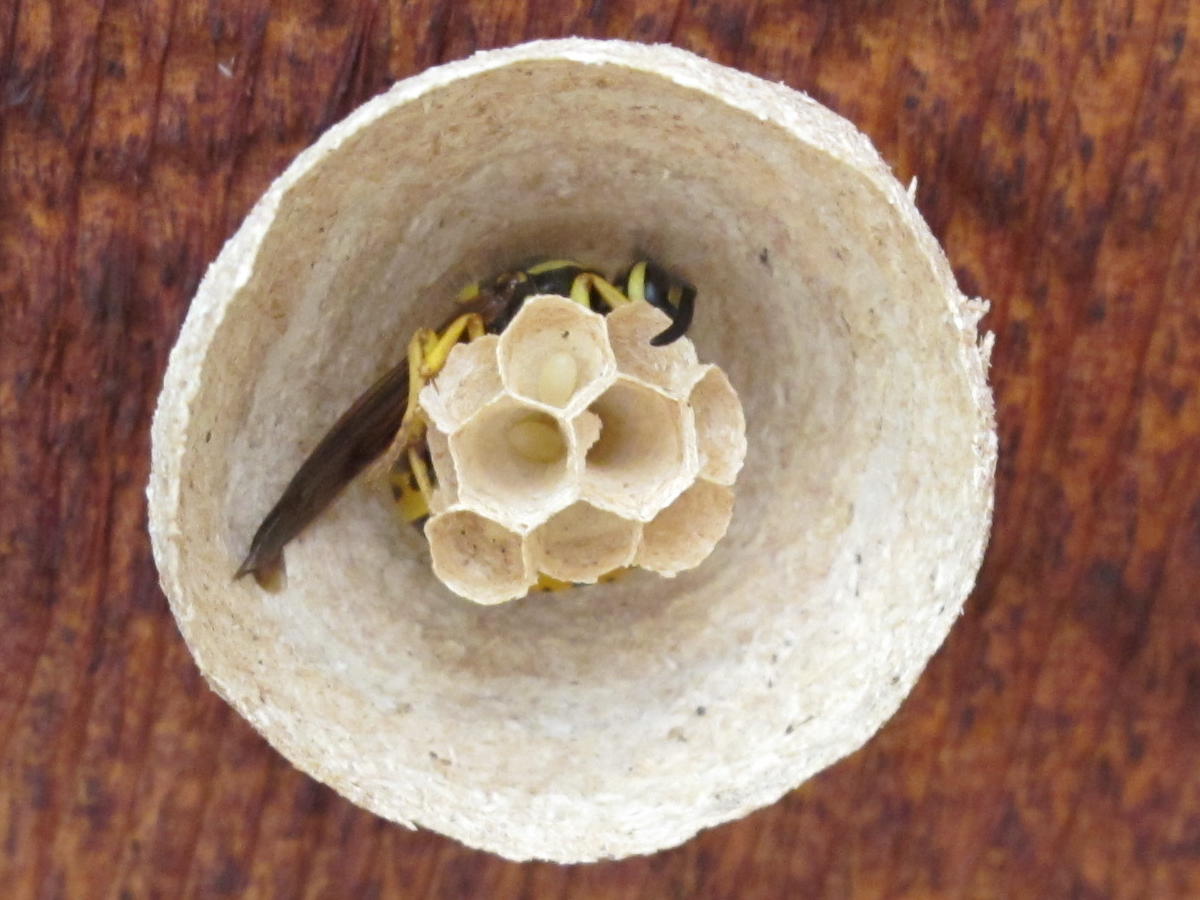
Not sure if bees might do it this way - but just looking at pictures of early stages of nests such as [1] or [2], wasps apparently don't: It looks as if they do construct proper hexagons from the get-go.

[1] http://www.localhoney.co.uk/wp-content/uploads/2010/06/start...

[2] http://1.bp.blogspot.com/-uM7ATVMEcDA/TdcWZm9BPEI/AAAAAAAAI8...
Re: Why nature prefers hexagons

#42
post #41
post #32

Earlier quoted context omitted.

Is this the generally accepted explanation now? (I thought so, but the article itself doesn't mention it - then again, the article seems full of pseudo-science)

Not sure if bees might do it this way - but just looking at pictures of early stages of nests such as [1] or [2], wasps apparently don't: It looks as if they do construct proper hexagons from the get-go. [1] http://www.localhoney.co.uk/wp-content/uploads/2010/06/start... [2] http://1.bp.blogspot.com/-uM7ATVMEcDA/TdcWZm9BPEI/AAAAAAAAI8...

Good find, that definitely looks hexagonal from the start.

Re: Why nature prefers hexagons

#43
post #35
post #33

Earlier quoted context omitted.

A spiral scan circuit would just be something like: x = r cos (theta) y = r sin (theta) when you vary r so it gives you a spiral instead of a circle. So it shouldn't be too hard to generate the signals required. Or there could be a different arrangement of the beam deflectors that didn't give you independent control of X and y.

But getting equal time on each pixel as you spiral out would be crucial to trigger the right phosphorescent equal luminance from your light-emitting material. Theta would not be linear with time.

The intensity of the beam could be modulated to counter this.

Re: Why nature prefers hexagons

#44
post #8

Earlier quoted context omitted.

I think the worst case of this in science is the way that evolution is described in a way that implies an active process rather than just random mutations which may or may not make organisms more fit for survival.

Yeah, I think that's the most common one. Strongly connected with the idea that evolution is "improvement" or some kind of step along a road to being "better", which I've seen trip up a lot of people who normally don't get confused about this kind of thing.

This reminds me of a thing a comedian said, or at least that's where I heard it first.

"also told you we're descended from apes ... you lot might be, I'm ascended from the apes" - Steve Hughes[1]

1. https://www.youtube.com/watch?v=CYk5k-vL_Ek#t=1m50s -- caution, course language

Re: Why nature prefers hexagons

#45
Started working on a game with hexagons a while back, and there are really weird/cool things related to hexagons online.

Global Hexagonal Awareness Resource Center: https://hexnet.org

> It is likely that HEXAGONS will continue to increase in popularity over the coming years, as humanity enters a glorious new hexagonal golden age, and all sentient beings on our planet ascend to a new, higher state of hexagonal consciousness.

http://hexagons.info

Re: Why nature prefers hexagons

#46
post #32

You get hexagons because of close-packing.[1] Circles (or a 2D array of spheres) of the same size fit closest together when they are arranged in a hexagonal pattern. Push a bunch of marbles together and that's what you get. The bees don't know anything about hexagons. They just make circles close together and then as the cells are filled, stepped on, and come into contact with other wax cells, they "ballon out" into…

Is this the generally accepted explanation now? (I thought so, but the article itself doesn't mention it - then again, the article seems full of pseudo-science)

Jürgen Tautz's "The Buzz about Bees" mentions this.

It says the bees build cylindrical cells around themselves initially, but then raise the temperature of the wax to 37-40 degrees C, when the wax is warm enough to flow into the hexagonal shapes.

(Pages 172-176)

Re: Why nature prefers hexagons

#49
post #33
post #30

Earlier quoted context omitted.

Analog circuits aren't my area of expertise. However it seems likely that the complexity of a stable and identical spiral scan circuit is either extremely difficult or possibly improbably expensive. Compare the above to what we have in reality: it seems that there were some vacuum tube tricks that made a grid system much easier. https://en.wikipedia.org/wiki/NTSC#Technical_details

A spiral scan circuit would just be something like: x = r cos (theta) y = r sin (theta) when you vary r so it gives you a spiral instead of a circle. So it shouldn't be too hard to generate the signals required. Or there could be a different arrangement of the beam deflectors that didn't give you independent control of X and y.

There are sync pulses on every line of analog video, as well as to color burst in most analog video standards. You couldn't just sweep theta and r continuously for a whole frame.

Re: Why nature prefers hexagons

#50

You get hexagons because of close-packing.[1] Circles (or a 2D array of spheres) of the same size fit closest together when they are arranged in a hexagonal pattern. Push a bunch of marbles together and that's what you get. The bees don't know anything about hexagons. They just make circles close together and then as the cells are filled, stepped on, and come into contact with other wax cells, they "ballon out" into…

Bees make hexagons. I've seen tons of horizontal and odd shaped burr comb that is still hexagonal - which if they were truly making circles would remain circles as there is no vertical load.
Post reply on HN