Live data from Hacker News

Why nature prefers hexagons

nautil.us

31–40 of 64 posts

Re: Why nature prefers hexagons

#31

You get hexagons because of close-packing.[1] Circles (or a 2D array of spheres) of the same size fit closest together when they are arranged in a hexagonal pattern. Push a bunch of marbles together and that's what you get. The bees don't know anything about hexagons. They just make circles close together and then as the cells are filled, stepped on, and come into contact with other wax cells, they "ballon out" into…

[deleted]

Re: Why nature prefers hexagons

#32

You get hexagons because of close-packing.[1] Circles (or a 2D array of spheres) of the same size fit closest together when they are arranged in a hexagonal pattern. Push a bunch of marbles together and that's what you get. The bees don't know anything about hexagons. They just make circles close together and then as the cells are filled, stepped on, and come into contact with other wax cells, they "ballon out" into…

Is this the generally accepted explanation now? (I thought so, but the article itself doesn't mention it - then again, the article seems full of pseudo-science)

Re: Why nature prefers hexagons

#33
post #30
post #12

Earlier quoted context omitted.

I wonder how hard hexagonal pixel layout would have been to do on a CRT? Two ways come to mind. If the basic scan line is kept horizontal, then a small vertical modulation on each scan line could result in a hexagonal layout if you timed it right. Alternatively, if the grid is tilted (so that the basic scan line is diagonal instead of horizontal), then you just have to offset the odd scan lines by half a pixel from t…

Analog circuits aren't my area of expertise. However it seems likely that the complexity of a stable and identical spiral scan circuit is either extremely difficult or possibly improbably expensive. Compare the above to what we have in reality: it seems that there were some vacuum tube tricks that made a grid system much easier. https://en.wikipedia.org/wiki/NTSC#Technical_details

A spiral scan circuit would just be something like:

x = r cos (theta) y = r sin (theta)

when you vary r so it gives you a spiral instead of a circle. So it shouldn't be too hard to generate the signals required.

Or there could be a different arrangement of the beam deflectors that didn't give you independent control of X and y.

Re: Why nature prefers hexagons

#34
post #12

Earlier quoted context omitted.

I wonder how hard hexagonal pixel layout would have been to do on a CRT? Two ways come to mind. If the basic scan line is kept horizontal, then a small vertical modulation on each scan line could result in a hexagonal layout if you timed it right. Alternatively, if the grid is tilted (so that the basic scan line is diagonal instead of horizontal), then you just have to offset the odd scan lines by half a pixel from t…

Well, the problem there is that CRTs used a triangular-patterned phosphor screen, excepting Trinitrons which had their phosphors lined up in a row. How would you handle the missing spot for a phosphor in a hexagonal arrangement? I guess with current tech, we could make ultra-fine phosphor groups that we'd not be able to see. an 8K CRT at 32" would be quite nice .

Well to be honest, I'm thinking more of how pixels as data are stored in images rather than implemented in hardware. But still, if you follow the link, its something I posted on Quora 5 years ago, and shows an image I pulled from somewhere of a LED or OLED or whatever device where the hex arrangement is already there. It makes a lot of sense. In hardware, though, it makes the most sense for R, G and B components to not share a "center point" for each pixel, instead having their own center point that is spacially offset.

Re: Why nature prefers hexagons

#35
post #33
post #30

Earlier quoted context omitted.

Analog circuits aren't my area of expertise. However it seems likely that the complexity of a stable and identical spiral scan circuit is either extremely difficult or possibly improbably expensive. Compare the above to what we have in reality: it seems that there were some vacuum tube tricks that made a grid system much easier. https://en.wikipedia.org/wiki/NTSC#Technical_details

A spiral scan circuit would just be something like: x = r cos (theta) y = r sin (theta) when you vary r so it gives you a spiral instead of a circle. So it shouldn't be too hard to generate the signals required. Or there could be a different arrangement of the beam deflectors that didn't give you independent control of X and y.

But getting equal time on each pixel as you spiral out would be crucial to trigger the right phosphorescent equal luminance from your light-emitting material. Theta would not be linear with time.

Re: Why nature prefers hexagons

#38
post #37
post #36

Is this why France is hexagonal I wonder? Why aren't there more hexagonal countries?

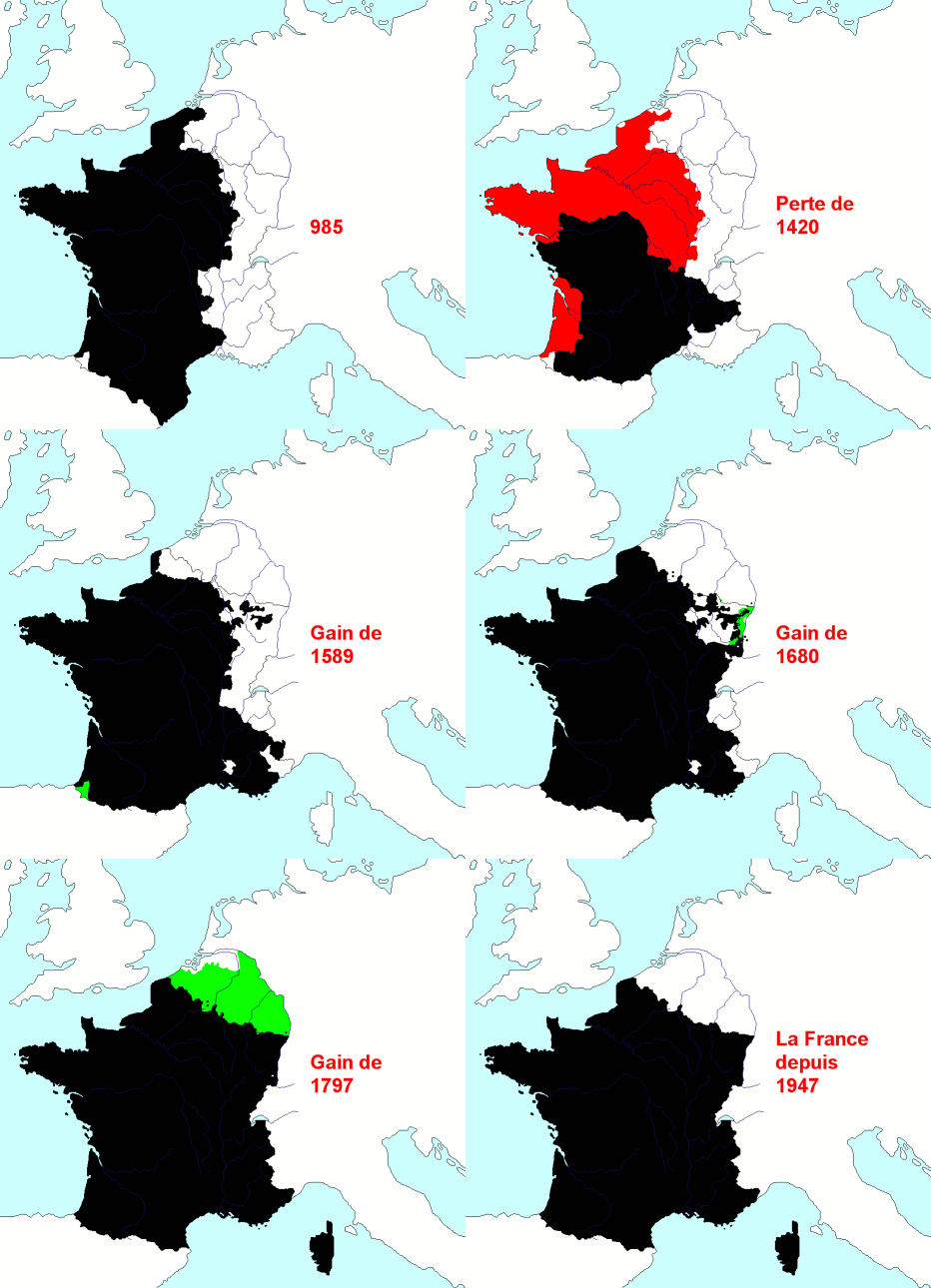
France is only a hexagon if you squint really hard... its shape has also been very arbitrary over the centuries https://upload.wikimedia.org/wikipedia/commons/a/ae/Frontier...

I think downvoters may be unaware of the history of the term: https://en.m.wiktionary.org/wiki/Hexagone

Re: Why nature prefers hexagons

#39
post #12

Earlier quoted context omitted.

I wonder how hard hexagonal pixel layout would have been to do on a CRT? Two ways come to mind. If the basic scan line is kept horizontal, then a small vertical modulation on each scan line could result in a hexagonal layout if you timed it right. Alternatively, if the grid is tilted (so that the basic scan line is diagonal instead of horizontal), then you just have to offset the odd scan lines by half a pixel from t…

Well, the problem there is that CRTs used a triangular-patterned phosphor screen, excepting Trinitrons which had their phosphors lined up in a row. How would you handle the missing spot for a phosphor in a hexagonal arrangement? I guess with current tech, we could make ultra-fine phosphor groups that we'd not be able to see. an 8K CRT at 32" would be quite nice .

There was no correlation between the phosphor dots on a typical color CRT and "pixels" as we think of them. It wasn't like the way we use an LCD or OLED display at all. A color CRT had no native resolution: display pixels were not locked onto specific phosphor dots.

Consider all the analog adjustments a CRT offered: you could tweak the overall height and width of the displayed image and nudge it up or down and left or right. A high end CRT would have additional controls to adjust the shape of the image to correct for pincushion or barrel distortion. You could also drive the CRT with different display resolutions. Obviously the phosphor dots didn't move around when you did this.

Even on a Trinitron display there was no connection between logical pixels and the aperture grill spacing.

A good analogy for today's displays would be an LCD/OLED display that you can't run in native resolution, and can't even discover what its native resolution might be: the pixels you generate in software are not directed to specific physical points of light on the screen.

A monochrome CRT came much closer to having something that today we would recognize as "pixels", because there was no shadow mask or phosphor dots.

Whatever problems might have stood in the way of using a hexagonal pixel layout on a color CRT, the phosphor dot or stripe layout wasn't among them.

Edit/meta: I really wish people would not downvote comments like lightedman's parent comment, which may have been wrong on the facts but provided an opportunity for me to jump in with some hopefully interesting information that not everyone may have known about CRT technology.

Some of the best conversations I've had have been where I've had a misconception about something and someone was kind enough to set me straight on it.

Yes, yes, I know, we're not supposed to complain about downvotes. So if my complaint bothers you, here's my offer: downvote this comment and upvote lightedman's parent comment, which received some downvotes that I think were undeserved. Fair deal?
Re: Why nature prefers hexagons

#40
post #37
post #36

Is this why France is hexagonal I wonder? Why aren't there more hexagonal countries?

France is only a hexagon if you squint really hard... its shape has also been very arbitrary over the centuries https://upload.wikimedia.org/wikipedia/commons/a/ae/Frontier...

Quite often I looked at it and saw a Pentagon. Also using the loose hexagone definition, you could probably retrofit it on any point in time anyway :D
Post reply on HN