Live data from Hacker News

How Fear and Outrage Are Sold for Profit

medium.com

181–190 of 262 posts

Re: How Fear and Outrage Are Sold for Profit

#181

Earlier quoted context omitted.

I guess to me that comes off as a meaningless platitude. Ads on TV (and other mediums) absolutely do show new things, including each of the things I noted in the very comment you responded to. Megacorps benefit from pushing brand, but they'd benefit even more from nobody being able to push brand, because they already have one established.

no platitudes around here. you can't deny (well you can but you shouldn't) that the vast majority of ads are all brand. Not talking about absolutes or semantics but: Without the Big Advertising people would drift off-brand. maybe boredom, maybe trying what their friend uses, maybe (surely not) be affected by price and quality.

> Ads on tv do not show new things. They push brand. brand is mother, brand is father.

This is a platitude.

> you can't deny (well you can but you shouldn't) that the vast majority of ads are all brand.

Maybe it is--it's just meaningless to my point. Even if 99% of ads are all entrenched megacorps reminding people they exist, that other 1% could be Netflix disrupting Comcast, or Uber/Lyft disrupting taxis, or whatever else. Those disruptors who were previously unknown benefit much more from their advertising than Coke reminding people to not stop buying Coke.

> Without the Big Advertising people would drift off-brand. maybe boredom, maybe trying what their friend uses, maybe (surely not) be affected by price and quality.

Imagine how much more effective that off-brand would be if it could tell consumers about its lower price or higher quality, rather than having to just hope they found out somehow... versus a known competitor and brand.
Re: How Fear and Outrage Are Sold for Profit

#182
post #73

A nicely laid out and illustrated article that's well written. That's about the best I can say. The worst is why? Who is the audience for this? I firmly believe that if you found this article by clicking on a link on the HN homepage, then you already know all this. It's exactly the kind of article we've been reading about in one form or another for 20 years. If you didn't find this article on the homepage of HN, then…

I shared the article in my Facebook feed. It will reach at least a couple of friends that are habitual troll victims. I guess to your point, that probably won't stop them from being victims/easy bait. At least they'll read it, hopefully.

I highly doubt it will matter. I was at the dentist's office about 6 months ago, and as I'd had a few dental procedures done over a spread-out timeline, I'd made friends with the dental assistants.

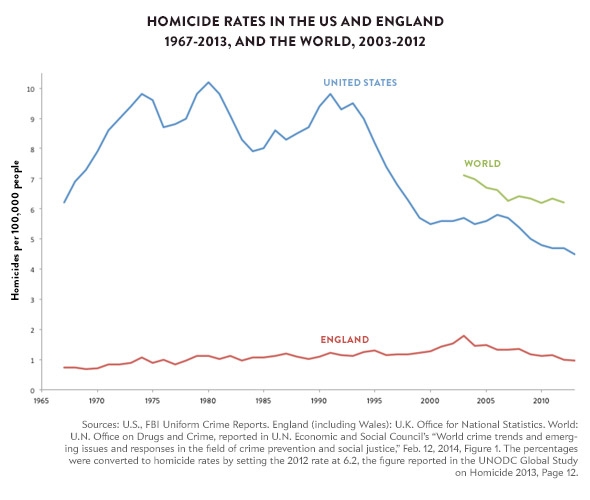
We were talking about the news (which was on in the background) and I cautioned the lady at the desk to not put too much stock in it, and to wait around for updates before drawing any conclusions. She asked why, and I explained that the 24 hour news cycle often drops facts -- a couple of segues later, and I made the point that everybody thinks America is more dangerous than ever, largely because of the constant fear-mongering in the news, but crime statistics actually show falling crime rates over the past few decades.

She didn't believe me, so I asked her to Google it on the computer in front of her, which resulted in a search result something like this[1], but before she started giving too much credence to it, she Googled a few more times until she found an article about Baltimore crime rates going up, even though we weren't in Baltimore, and neither of us lived in Baltimore, and she'd previously admitted to not having been in Baltimore in more than a decade -- none of that mattered, because her confirmation bias was slaked.

[1] - http://www.slate.com/content/dam/slate/articles/news_and_pol...

Re: How Fear and Outrage Are Sold for Profit

#183

Worship power, you will end up feeling weak and afraid, and you will need ever more power over others to numb you to your own fear. Worship your intellect, being seen as smart, you will end up feeling stupid, a fraud, always on the verge of being found out. But the insidious thing about these forms of worship is not that they're evil or sinful, it's that they're unconscious. They are default settings. They're the kin…

The most evident and problematic might be the worship of youth though. I'm curious if cultures in which the elderly are more respected and admired, are generally also happier.

They are not. Judging people by qualities outside of their control winds up giving respect and power to many who do not deserve it, with the pain that inevitably follows. This holds true regardless of whether the bias is towards youth or age.

Source: have lived for years in both types of culture

Re: How Fear and Outrage Are Sold for Profit

#184

Earlier quoted context omitted.

There's a difference between at least attempting to be unbiased, and knowingly exaggerating.

Hence the humility. But I don't know if the shrill voices aren't less dangerous than the supposedly "impartial" ones. At least you can usually tell what horse are they betting on.

What if there are only shrill voices left?

Re: How Fear and Outrage Are Sold for Profit

#185

Earlier quoted context omitted.

no platitudes around here. you can't deny (well you can but you shouldn't) that the vast majority of ads are all brand. Not talking about absolutes or semantics but: Without the Big Advertising people would drift off-brand. maybe boredom, maybe trying what their friend uses, maybe (surely not) be affected by price and quality.

> Ads on tv do not show new things. They push brand. brand is mother, brand is father. This is a platitude. > you can't deny (well you can but you shouldn't) that the vast majority of ads are all brand. Maybe it is--it's just meaningless to my point. Even if 99% of ads are all entrenched megacorps reminding people they exist, that other 1% could be Netflix disrupting Comcast, or Uber/Lyft disrupting taxis, or whateve…

>Imagine how much more effective that off-brand would be if it could tell consumers about its lower price or higher quality, rather than having to just hope they found out somehow... versus a known competitor and brand.

imagine you have an army of 100 and you are against an army of 1000.

now imagine how much more effective you would be if everyone had machine guns instead of swords.

Re: How Fear and Outrage Are Sold for Profit

#186
In the US, people from places that not even a scholar with a geography major can find on a map are afraid of being attacked by people that don't even know their town exists, and even if they did, I highly doubt they even bothered to go all the way there to just to harm an average rural guy that nobody knows. It's nonsense.

Re: How Fear and Outrage Are Sold for Profit

#187

Earlier quoted context omitted.

If you don't mind sharing, where did you grow up? Was it a political influence that resulted in the lack of ads? Was everything state-run as a result?

Just an educated guess but it is most likely Cuba. [0] [0] https://www.theatlantic.com/business/archive/2016/03/how-do-...

Well then the OP ignores the biggest advertiser of them all: the communist party.

Re: How Fear and Outrage Are Sold for Profit

#189

Earlier quoted context omitted.

I would like to think that no, my spending tends to be largely on things that do not tend to be advertised (craft beer and bills, mainly). But no doubt you are right. Still, if its so passive that I can barely detect it happening, all power to them.

Which craft beers? Most of them are manufactured by huge corporate breweries. Do you own a car? What kind? Is it an older honda civic or something similar? In North America your choice of cars is almost certainly the result of advertising, both on you and on the people who's opinion about you you care about.

NZer here. Our craft beer is still mostly owned by small companies, with some notable recent exceptions. But for whatever reason I don't see ads for beer, either NZ or otherwise, online.

I own a BMW, but have no interest in cars and so don't see car ads online (nor would they be effective - the BMW was chosen by my wife).

I take your point, and I am not arguing I am the exception, however your specific examples probably don't apply.

Maybe the choice of utility companies? Internet, power etc. We have more choices here than the US tends to have, due to the smaller market and more government regulated competition. It's hardly a dire violation of my personal liberty if I am manipulated into picking one or another provider of fibre though.

Post reply on HN