Live data from Hacker News

Raising a Truly Bilingual Child

nytimes.com

191–200 of 228 posts

Re: Raising a Truly Bilingual Child

#191

> “There is certainly no research to suggest that children need to have languages lined up with speakers or they get confused.” This goes against the mantra that each parent should speak to their child in their native language, which I hear all the time but I've always thought was complete bs. As parents we're both fairly proficient in each other's language and speak to our children in both languages depending on con…

Perhaps it's anecdotic but here we I live almost nobody changes language when speaking to a certain person, always we use the first language we talked to that person.

I come from Spanish speaking parents, but half of my family spoke Catalan and my wife is Italian.

I speak always in Catalan to my son, he speaks always to me in Catalan, my wife talks to my son in Italian and he talks in Italian to her. I spoke in Spanish to her.

And the usual thing is change language in the middle of the speak when we change interlocutor. So I can start in Spanish if I look to my wife and end in Catalan when I look at my son.

My friends to the same changing from Catalan to Spanish depending who they are looking at.
Re: Raising a Truly Bilingual Child

#192
A very significant part of the population in most 'third world' countries is actually trilingual. Fir example, Pakistan is divided into 4 provinces, each with its own language and culture. So people there end up learning their local language and the national language Urdu. Most children who go through schools also learn English as a core subject in their curriculum which makes them trilingual. Well, now the government is also pushing Arabic language in schools as a core subject which would make most children in Pakistan tetra-lingual?

Re: Raising a Truly Bilingual Child

#193

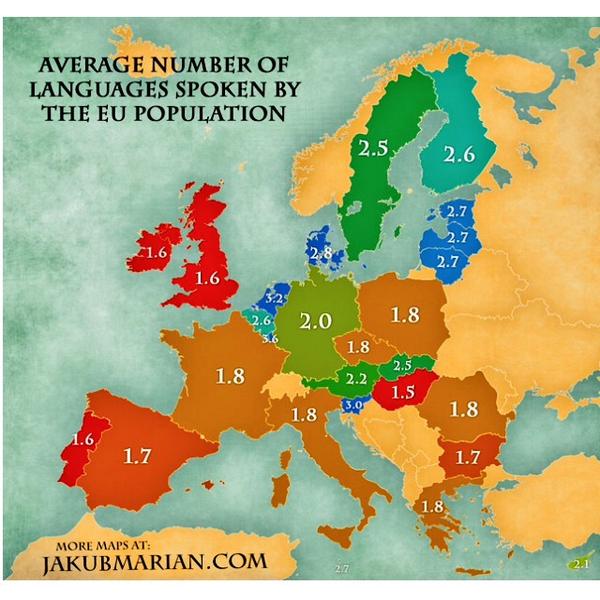
It's interesting that the article starts with the line "True bilingualism is a relatively rare thing". That's probably the case in the US or English-speaking world, but definitely not the case in many other areas. I live in Catalonia, it is very normal for locals to be fully fluent in Catalan and Spanish, I've seen the same in the Basque region. Go to India and almost every person you meet at all levels of society sp…

Yes. I’m Latvian, born in the Soviet Union. Many of my generation grew up speaking Russian and the language of their country (Ukraine, Polish, Georgian, etc). Sure, I moved to the US when 10 but true bilingualism seems pretty normal to me. In my case speaking Russian with one parent and Latvian with the other.

https://pbs.twimg.com/media/BzrbmiFCIAEE5HT.jpg

Re: Raising a Truly Bilingual Child

#194

Earlier quoted context omitted.

Interesting! For me, French is the language I like to be negative in. It's not a language I'm native-level fluent in, but I'm at the level where I can carry out those mental self-conversations you have with yourself when thinking in French as well. In french, negating a statement involves two words sandwiched around the verb (usually ne...pas, e.g. "il ne trouve pas"). I think for me this gives the negation a lot mor…

In French doesn't the negation get partially swallowed sometimes/often, like "il trouve pas" or is that my poor listening?

In spoken French it's definitely on its way out, effectively leaving only "pas" as a single negative particle. It's a good example of what is called the Jespersen's Cycle

0: https://en.wikipedia.org/wiki/Jespersen%27s_Cycle

Re: Raising a Truly Bilingual Child

#195
post #123

> screen time doesn't count Absolutely false. Screen time is an excellent way of exposing the child to a language and thus learning to distinguish the phonemes that make it up. It can be argued that screen time alone doesn't help too much in learning to speak a language (if by screen we mean a non-interactive one, of course). But it's great for listening comprehension. Source: starting when she was a baby, I let my k…

I think it is accepted that Danes and Swedes are so good at English because movies and tv shows are not dubbed, only subtitled in their countries.

Re: Raising a Truly Bilingual Child

#196
post #123

> screen time doesn't count Absolutely false. Screen time is an excellent way of exposing the child to a language and thus learning to distinguish the phonemes that make it up. It can be argued that screen time alone doesn't help too much in learning to speak a language (if by screen we mean a non-interactive one, of course). But it's great for listening comprehension. Source: starting when she was a baby, I let my k…

"Screen time" is also a great motivator to learn any language, if the fancy entertainment on the screen you'd like to understand is in a language you don't yet understand. (Similar effects apply to the written communication, of course.)

However, this is coming from my "learning a new language as a teenager / adult" experience than "raising bilingual kid" viewpoint, but it seems sensible that it would be also a powerful incentive for small kids, too.

Re: Raising a Truly Bilingual Child

#197
post #31

What are the best technologies to help an English-speaking household even introduce other languages?

Try Duolingo. I use it mostly on the web but they also have really great apps and at least a dozen languages supported.

I really like Mango for two reasons: it has Québécois French (since I'm in Montreal now) and it has a feature where you can compare your pronunciation to a native speaker. It's really helped me learn the unvoiced consonants that lurk at the end of French words.

Re: Raising a Truly Bilingual Child

#198
post #31

What are the best technologies to help an English-speaking household even introduce other languages?

Realized I left out a recommendation for Baby Signing Time.

Anecdata-ly, speech may be delayed since sign language becomes sufficient for minimal communication.

Also, the following tool has been specifically recommended for teaching toddlers to read English: https://amzn.com/dp/0671631985/

Re: Raising a Truly Bilingual Child

#199
post #138
post #36

Earlier quoted context omitted.

Regarding your Chinese, you will need to spend 10x effort than an ordinary Chinese kid. I can't imagine how it could be of use to your career, but once you grasp the language, there are so many interesting and subtle things to discover that you probably won't regret the time.

You don't necessarily need 10x effort (depending on your definition of "effort"). I'm a Hongkonger. I had lived in Montreal since I was 10 until I finished my bachelor's degree. I didn't really do Saturday schools. I tried that for one or two years but those really had no effect on my proficiency in Chinese. Yet, I can confidently say that I'm fluent in four languages, if you count Mandarin and Cantonese as separate…

Montreal has been a revelation to me since I moved here from the US. My daughter came as an infant and enjoys conversing with her friends in French and with us in English. Working in tech, English is inescapable in programming contexts so I can understand the subject of conversation in French once I tune in to the accent.
Post reply on HN