Earlier quoted context omitted.
Can you tell when the US had a Democrat controlled Congress by looking at this global greenhouse gas emissions per year chart? I can't. https://www.epa.gov/ghgemissions/global-greenhouse-gas-emiss... I'm not saying there's no reason to worry, but there's also no reason to pretend that having the Democrats move pollution overseas solves global problems.
Democrats have controlled both Congress and the Presidency for only two two-year sessions out of the past three decades. You might be expecting a bit much for them to have put a stop to the rise in carbon emissions with such brief windows of control.
Improving air conditioner efficiency could reduce worldwide temps
331–340 of 349 posts
Re: Improving air conditioner efficiency could reduce worldwide temps
#332Earlier quoted context omitted.
You realize the world's birth rate has already been on the decline for decades, correct? And in general, the bulk of this occurred not because of coercion, but because of economic development and the ensuing shifts in optimum family strategy.
When you say "birth rate is falling" its effectively the second derivative on "number of people" right? As in, if we have go from 2 children born per person to 1.5 children born per person, we are still growing the number of people. Even if "children per person" falls slow enough you could even indefinitely increase the rate that new people are added right?
Re: Improving air conditioner efficiency could reduce worldwide temps
#333Earlier quoted context omitted.
> an indifference for any sort of sustainability. That's a pretty apt general description of Las Vegas.
I would actually put Vegas as one of the most sustainable cities in the US out of necessity. Vegas's per capita water use is about 1/4 of the US average including all of those crazy fountains on the strip. They don't irrigate anything compared to places like Phoenix and almost all municipal water hookups use reclaimed water unlike most other cities where people have an aversion to drinking filtered piss. Vegas also g…
s/Las Vegas/PhoenixRe: Improving air conditioner efficiency could reduce worldwide temps
#334Trump's 2018 budget zeroes funding for Energy Star, which among other things, helps consumers pick the most efficient devices, save money in the long run. What other ways can consumers compare the efficiency of A/C units? I would think some standardized testing and labels would be required.
Re: Improving air conditioner efficiency could reduce worldwide temps
#335Earlier quoted context omitted.
Democrats have controlled both Congress and the Presidency for only two two-year sessions out of the past three decades. You might be expecting a bit much for them to have put a stop to the rise in carbon emissions with such brief windows of control.
What serious legislation have you seen proposed that would stop India from burning coal?
Re: Improving air conditioner efficiency could reduce worldwide temps
#336Re: Improving air conditioner efficiency could reduce worldwide temps
#337Earlier quoted context omitted.
What serious legislation have you seen proposed that would stop India from burning coal?
The United States remains the top emitter per capita and it's near the top in absolute terms too.
Re: Improving air conditioner efficiency could reduce worldwide temps
#338Earlier quoted context omitted.
Sure, it's cost, but that's solvable. 1. Drilling the wells is not actually that expensive depending where you are. For me, 3 300 ft wells, bored, piped, and grouted, was about 5k. 2. The units can be gotten for that price with install. You need to take into account the fact that they are significantly more efficient at both heating, and cooling, and hot water, over their lifetime. (also, their specs and submittal da…
That's cheap for drilling from what I've been quoted. Most systems I looked at when I had a house before were in the $30k range installed. I have three friends/co-workers that had the systems installed. None were particularly impressed with the average cost savings. They said bills went down, but not dramatically. One person had the whole system redone at the suggestion of another HVAC contractor (saying the first cu…
Yeah, i lived near a place where wells were incredibly common, so there were plenty of well drillers. I can believe 30k installed. With the 30% federal tax credit that used to exist, and Maryland's 30% state tax credit, it can be worth it. Now, without the 30% federal tax credit, it's probably only worth it on new home construction.
"I have three friends/co-workers that had the systems installed. None were particularly impressed with the average cost savings. They said bills went down, but not dramatically. One person had the whole system redone at the suggestion of another HVAC contractor (saying the first cut many corners) the re-done system wasn't much better. "
This depends a lot on where you live, the climate, etc. Also how much you are spending on heating/cooling. You know all this. I was in a fairly large house in a climate that seems 90+ summers and ~25-30 winters. This kinda sucks for heat pumps. It's also the case that, as it's become more popular (relatively), there are some crappy untrained contractors looking to make a buck. I definitely did a bunch of research, and talked to a bunch of contractors before doing the system. I think out of 5-6 contractors, 1 was clearly a snake, and 1 didn't really know what they were doing based on the questions i asked. 3 could tell me intricate technical details about the systems (IE one launched into a discussion of the merits of parallel vs series vertical piping and reynolds numbers), etc.
FWIW: I've also meant plenty of happy vertical closed loop people. I haven't met any happy horizontal open or closed loop people.
That said, unlike the air based units[1], all, for example, of the waterfurnace units have detailed submittal that tell you, for a given entering water temperature, what the EER/COP will be, what the pressure drop should be, the leaving air temperature, etc.
http://www.waterfurnace.com/literature/7series/SD2700AN.pdf
Most of these things are easily amenable to sensors. I had an arduino and a bunch of sensors that told me whether the system was performing okay.
After they first flushed the lines, they weren't sure they got everything out of it and told me to try it. So I did, and the measurements told me something was off. System worked, when cooling, water temps were raising too quickly. They ended up digging the manifold back up, and there was a rock in it (terrain is fun!) After redoing the manifold, everything was perfect.
So i can also believe that if you aren't watching the till, you may not know if the system is doing okay. But at least, unlike most random heat pumps, i feel like I could know and track that stuff pretty well. Overall, my system actually overperformed (which means they probably didn't need to go as deep as they did, but such is life).
[1] This data exists, it's just not usually easy to get for air source heat pumps unless you are an installer/technician.
Re: Improving air conditioner efficiency could reduce worldwide temps
#339Earlier quoted context omitted.
Sure, it's cost, but that's solvable. 1. Drilling the wells is not actually that expensive depending where you are. For me, 3 300 ft wells, bored, piped, and grouted, was about 5k. 2. The units can be gotten for that price with install. You need to take into account the fact that they are significantly more efficient at both heating, and cooling, and hot water, over their lifetime. (also, their specs and submittal da…
May I ask where you live to get the drilling done in that price range? Just curious. At $10k it's insanely compelling.
Re: Improving air conditioner efficiency could reduce worldwide temps
#340Earlier quoted context omitted.
Sure, it's cost, but that's solvable. 1. Drilling the wells is not actually that expensive depending where you are. For me, 3 300 ft wells, bored, piped, and grouted, was about 5k. 2. The units can be gotten for that price with install. You need to take into account the fact that they are significantly more efficient at both heating, and cooling, and hot water, over their lifetime. (also, their specs and submittal da…
Do you know if there are any effects on groundwater? Like polution, mixing of different layers?
So they do something like:
outlet | | manifold inlet in the ground | a bunch of pipes formed into U's, stuck in very deep vertical holes filled with thermal grout | | manifold outlet in the ground | | inlet
The manifolds look like this: https://www.geohydrosupply.com/index.php/fittings/socket-fus...
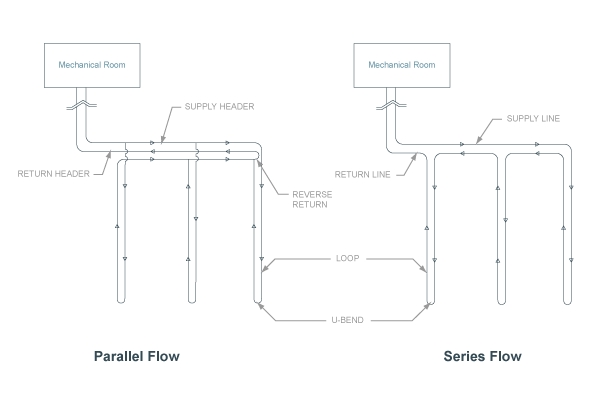
If it's done in series, each u-bend connects to a set of two outlets on that manifold. If it's done in parallel, each u-bend connects to a single outlet on each of two manifolds, one in, one out.
Here's a drawing: https://blog.heatspring.com/wp-content/uploads/2012/01/paral...
If you can imagine a really huge refrigerant loop, that's what they are, with water+glycol as the refrigerant going through the pipes. But the water only moves in this loop, it's never going into the ground, etc.
Open loop systems exist, and those are the ones where they are sucking something in one pipe, and pushing it out the other.
Sometimes this is done in a pond, sometimes a well, etc. What happens depends a lot of the design (horizontal, vertical, etc).
Open loops are pretty uncommon.