It's funny to me, because at this point, there's glaring scientific evidence to demonstrate not-trivially-reversible anthropogenic climate change, and we're sort of at that same point where we were with leaded gasoline, where it's not about whistle-blowers anymore, but there's still an intractable scientific payola to plant the seed of doubt in any conversation. Action is required at this point, regardless of transna…
I agree that there is human caused changing of the global climate due to emissions from fossil fuels, among other things. With that said, did you read the article? > The calving of icebergs is a natural process. While climate change is affecting Antarctica in a variety of ways, this week's event does not signal that the region is entering a new state. That is happening in the Arctic, which has already been dramatical…
Things to know about the A68 iceberg
41–50 of 58 posts
Re: Things to know about the A68 iceberg
#42TLDR: The calving of the 1.1 trillon ton ice berg (2x amount of water used in the US each year) marks the end of a decades long splintering, first seen by satellites in the 1960s. 1. What's next? It will drift north along the coast of the Antarctic Peninsula, then northeast into the south Atlantic Ocean. Likely no threat to ships navigating the area. Can take months to splinter apart. 2. Is this climate change? Calvi…
>"2. Is this climate change? Calving is a natural process and Antarctica is not breaking apart, but climate change can't be ruled out." "Climate change" doesn't make specific enough predictions about this type of stuff to ever be ruled out, people could just keep coming up with ideas about X indefinitely: Climate Change -> X -> Larsen C rift A more accurate way to put it is that, up until now, all proposed ideas for…
I think if you compare historical rates of iceberg calving to current rates of iceberg calving, you should be able to find some significant quantifiable difference.
Although ultimately the important thing is the influence on flow rates of land-based ice.
Re: Things to know about the A68 iceberg
#43Earlier quoted context omitted.
While desalinated is technically doable, is it scalable yet so that it could even be offered? I honestly don't know much about it but was under the impression it simply wouldn't work to provide California water because it's not yet able to scale enough to meet a large enough fraction of the need. I could certainly be wrong though. I couldn't find much info googling.
Most of California's appetite for water is due to agriculture. For that, you need cheap inland water. The Gulf countries offer desalinated water at city scale, but it's not cheap enough for irrigation.
Re: Things to know about the A68 iceberg
#44We deal with this frequently in medicine. There are lots of questions that the non-expert doesn't know how to ask, or asks clumsily. When patients ask "doctor: does this medication have any risks?" The literal answer is "yes; dozens of side effects are possible, ranging from mild to life-threatening".
But that answer is so accurate that it's useless. What almost all patients really want is "help me understand the most common side effects, and tell me what to watch out for regrading rare-but-serious side effects".
With respect to global warming, we don't really care whether this event can be tied back to antropegenic climate change in a linear way. What we really are asking is "should we be taking climate change seriously?". And the answer is an emphatic "hell yes".
This is an opportunity for people to focus on climate issues. I worry that HN will think I'm a paternalist jerk, but scientists shouldn't get bogged down in the literal answer to the literal question in this case.
My best answer would be "climate change is real, accelerating (meaning getting worse every day we continue to consume more fossil fuels), and the biggest threat we have to face as a species".
Re: Things to know about the A68 iceberg
#45Earlier quoted context omitted.
>"2. Is this climate change? Calving is a natural process and Antarctica is not breaking apart, but climate change can't be ruled out." "Climate change" doesn't make specific enough predictions about this type of stuff to ever be ruled out, people could just keep coming up with ideas about X indefinitely: Climate Change -> X -> Larsen C rift A more accurate way to put it is that, up until now, all proposed ideas for…
> Climate Change -> X -> Larsen C rift I think if you compare historical rates of iceberg calving to current rates of iceberg calving, you should be able to find some significant quantifiable difference. Although ultimately the important thing is the influence on flow rates of land-based ice.
So? The rates could increase/decrease for many reasons. If all your X mechanism predicts is that the rate should change (or only slightly better, increase/decrease) it isn't going to be distinguishable from any other reason.
Edit:
It really sounds like you are making the usual NHST error of thinking a significant difference means your theory is true.
Re: Things to know about the A68 iceberg
#46Earlier quoted context omitted.
As I understand it - the sea ice extent is a quite different matter being thin and regenerating yearly. These lost iceshelves (including Larsen B in 2001) were hundreds of meters thick. I wonder what age these shelves were and what a sustainable rate of such events would be. Without seeing such information I dont trust general statements on the events meaning. As another massive iceshelf breaks off - it really looks…
I cited sea ice as an example of counterintuitive effects of climate change. These shelves move fairly rapidly, and will calve with or without global warming. The Ross Ice Shelf, for example, moves northwards at about 1 km/year.
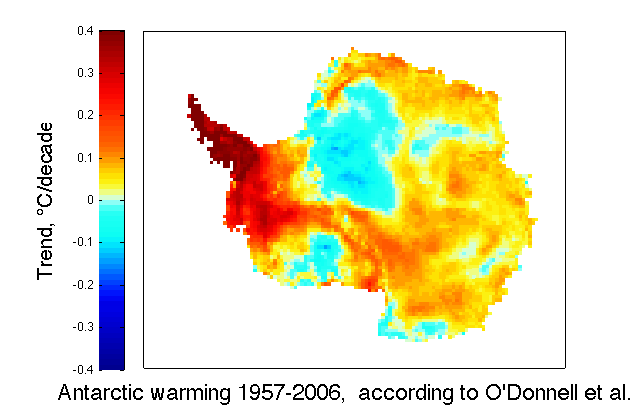
If we are with the consensus on climate change, there is very little doubt this event is affected by it. It occurred in most warmed area of this map:
http://www.realclimate.org/wp-content/uploads/ODonnell1.png
From here:
http://www.realclimate.org/index.php/archives/2010/12/a-brie...
I dont see any sense in excluding these quite rare events from the confidence of climate change, unless we are not confident in climate change.
Re: Things to know about the A68 iceberg
#47Earlier quoted context omitted.
> "Climate change" doesn't make specific enough predictions about this type... Actually it does. In a warming world more frequent calving events are expectable. This part of Antarctica shows quite some positive temperature anomalies. So, asking whether Larsen C would be still intact today without Climate Change the answer is certainly yes.
As I said a month ago when this coverage started, it is very strange how there are so many people (in the media and internet posters) who are so sure about that, when the actual people studying it claim otherwise: https://news.ycombinator.com/item?id=14577296 >“Although this is a natural event, and we’re not aware of any link to human-induced climate change, this puts the ice shelf in a very vulnerable position. This…
Re: Things to know about the A68 iceberg
#48Earlier quoted context omitted.
As I said a month ago when this coverage started, it is very strange how there are so many people (in the media and internet posters) who are so sure about that, when the actual people studying it claim otherwise: https://news.ycombinator.com/item?id=14577296 >“Although this is a natural event, and we’re not aware of any link to human-induced climate change, this puts the ice shelf in a very vulnerable position. This…
Look, I did not answer the irrelevant question whether Larsen C calved because of Climate Change. Attributing single events in remote areas is hard. That's why I answered a different question, the key words are 'today' and 'more frequently', please read the comment carefully again.
Re: Things to know about the A68 iceberg
#49Earlier quoted context omitted.
I cited sea ice as an example of counterintuitive effects of climate change. These shelves move fairly rapidly, and will calve with or without global warming. The Ross Ice Shelf, for example, moves northwards at about 1 km/year.
I appreciate your reply but I find the argument is vague. If we are with the consensus on climate change, there is very little doubt this event is affected by it. It occurred in most warmed area of this map: http://www.realclimate.org/wp-content/uploads/ODonnell1.png From here: http://www.realclimate.org/index.php/archives/2010/12/a-brie... I dont see any sense in excluding these quite rare events from the confidence…
The grandparent says that the ice shelf moves into the ocean at about 1km/yr.
This specific calving has been going on in stages since at least the 1960's.
Within the order of magnitudes of estimation, that lines up entirely with natural process that has been going on at roughly the same rate since the 60's. Climate change hasn't had a measurable effect so far, based on this limited data point.
I think the scientist's quoted cautious skepticism is entirely appropriate.
Re: Things to know about the A68 iceberg
#50Earlier quoted context omitted.
I appreciate your reply but I find the argument is vague. If we are with the consensus on climate change, there is very little doubt this event is affected by it. It occurred in most warmed area of this map: http://www.realclimate.org/wp-content/uploads/ODonnell1.png From here: http://www.realclimate.org/index.php/archives/2010/12/a-brie... I dont see any sense in excluding these quite rare events from the confidence…
TFA doesn't offer dimensions, but it does say the total area of the berg is 2,200 mi^2, which if square (overestimation given the picture) would give a depth of about 75km to this calving. The grandparent says that the ice shelf moves into the ocean at about 1km/yr. This specific calving has been going on in stages since at least the 1960's. Within the order of magnitudes of estimation, that lines up entirely with na…
The maps show the very location of these events, raised by several degrees C since 1950. The rate of this event is quite certainly strongly affected by local temperature, which is known to be elevated due to global warming. So the event has quite certainly been strongly affected by global warming.
I can conclude this very confidently because global warming is already a given for me. Only when we doubt global warming has raised the temperature of the location of these calving events does it make any sense to say, "this could be happening naturally"
However fast this could happen naturally - it is happening faster due to global warming.