First of all, it's not a 'sharp' s, as one can see compairing 'Maße' and 'Masse'. I doubt this will be used in practice. Many people nowadays are confused by last orthography rules and even write 'Straße' wrongly with double-s.
The capital sharp S in now part of the official German orthography
221–230 of 377 posts
Re: The capital sharp S in now part of the official German orthography
#222Earlier quoted context omitted.
Annoyingly, English uses "th" for two rather different phonemes: þ ("thing") and ð ("this"). Icelandic maintains this useful distinction. I feel like English spelling would need at least half a dozen more letters to disambiguate. As it is, English is actually a not great choice for a global language because it's so unphonetic.
> As it is, English is actually a not great choice for a global language because it's so unphonetic. English would be a more-useful global language — in that it'd be easier for non-native speakers to learn and use it — if we pedants who secretly look down on anything less than "proper" spelling and grammar (and I'm embarrassed to be one of them) would get over ourselves and accept simpler, easier forms as they natura…
"It's" vs "its" is also bothersome, but for a different reason - this probably has to do with learning English in a way that emphasized formal sentence structure, rather than just the way it sounds. But I think that's not all that uncommon for non-native speakers. When I studied in college in New Zealand, I once had a chance to converse with our ethics teacher (native Kiwi) one on one, where she remarked on my spelling in a recent essay. From there she quickly went on to a general rant about how immigrants are much better than natives at spelling, citing "its" vs "it's" as one of the examples - according to her, she had never seen a non-native speaker substitute one for the other inappropriately.
On the other hand, "if I were" never made any sense to me, and is one of the more common mistakes I still make, even after 8 years of speaking and writing English 99% of the time.
Re: The capital sharp S in now part of the official German orthography
#223Earlier quoted context omitted.
Every language has something dumb about it that makes it "not a great choice for a global language". English spelling is a nightmare, but the grammar isn't too bad, and most importantly, it has no gendered nouns .
That's silly. Gendered nouns seem difficult to you, as an English speaker, because you speak a language that doesn't have them, and not because they're inherently harder than any other language feature.
Re: The capital sharp S in now part of the official German orthography
#224Earlier quoted context omitted.
What a coincidence that English manages fine with just the letters in ASCII. Seriously though, what definition of "special Latin characters" are you using? Italian does just fine with fewer...
G, J, K, U, W, Y, and Z are all characters that aren't used in Latin (in the case of G, J, U, and W, because they didn't exist; in the case of Y, it is used in Greek words but doesn't represent a sound that's possible in Latin; I'm not sure if Z was used in Greek words or not. K is just a Greek letter -- since it represents the sound written with C in Latin, it is never used at all).
Re: The capital sharp S in now part of the official German orthography
#225Earlier quoted context omitted.
>"ß" is not a defining feature of the German language. It is though. As a language-lover and German-learner, AFAIK, no other language uses this letter. "ß", along with less exclusive "ä", "ö", and "ü" are what distinguishes German orthography from other languages.
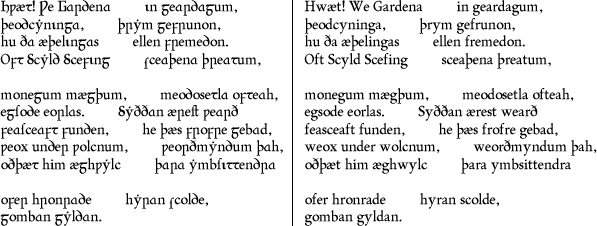
English seems to manage okay with no 'special' latin characters.
https://www.omniglot.com/images/langsamples/smp_oldenglish.g...
Re: The capital sharp S in now part of the official German orthography
#226Earlier quoted context omitted.
Of course nobody is going to fault you for succumbing to such practicalities, and it's perfectly fine to use substitutions when necessary. But there's something to be said for preserving a few aspects of the diversity of cultures, as each one acts as its own preserve of centuries of wisdom. Hey, it's the German language that gave you Uber (the name). Which should actually be Über, but I digress. (and it'll be Over so…
Agreed on that, but culture to me goes a lot further than exchanging messages on the net. I'm thinking of France here, which has something called the 'Academie Francaise' (apologies for butchering the c-cedille in this context, the accent aigu 'e' in cedille and acedemie). The only effect this seems to have had is some token re-inforcement of French as a 'world language', but in practice it became a 'come up with Fre…
Now, emoji, OTOH, just feels to me like unnecessarily polluting the character space. I'd much rather have a capital ß in the codespace than some smiling poo family.
[1] http://www.unicode.org/L2/L2015/15327r-n4704-medieval-punct....
Re: The capital sharp S in now part of the official German orthography
#227As a german, I see this as a step in the wrong direction. The sharp S is a PITA to begin with, so I'd rather abolish it completely. Now there's a whole bunch of complications coming from this - how do I type this? To type lowercase "ß", I press the key above "p" (in the same position as with qwerty) and "ü" (to the right of it), which will do "?" when pressed together with shift. So do we move "?" somewhere else? QWE…
A language should not be optimized for easy keyboard typing. The power of German comes through it's richness and beauty of expression, including ß. Downgrading this for easy typing would be the wrong direction.
Re: The capital sharp S in now part of the official German orthography
#228Earlier quoted context omitted.
> I see this as a step in the wrong direction. Agreed. The council's press release mentions that this will enable the use of the character in passports. The horror for the poor people who have this in their name! I hope for their sake they will have a say in this. Otherwise, filling in any form abroad will become a headache.
For us Poles it's a toss-up whether MICHAŁ is interpreted as MICHAL or MICHAK at borders.
Re: The capital sharp S in now part of the official German orthography
#229Earlier quoted context omitted.
Foreign officials ignore the umlaut when looking at your passport or when transcribing what you scribbled onto a paper form. It's (rightly) viewed as a modifier of a letter they know. (In contrast, the sharp S is a letter they don't know. Many people think it's a B.) When filling in electronic forms, you're typically better off leaving off umlauts. Source: A lifetime of experience with funky accents in my name, not l…
I see your point. But wouldn't this problem be better addressed with an additional field on one's passport, which states the name in a standardized alphabet, e.g. ASCII? Asian passports seem to include something like this.
The only problem is that often there isn't a good clearly unambiguous set of rules on how to do that. For the forms, it doesn't matter, so long as the country chooses one and sticks with it. But it can mess up the pronunciation of your name real bad.
Re: The capital sharp S in now part of the official German orthography
#230Earlier quoted context omitted.
As an ignorant English speaker who has learned enough German to get by, I wonder: - what utility do you think a language gains from gendered nouns? - (more immediate to my experience) how do you know what gender a noun is? I assume there are "themes" that might inform you. But if you're unclear, how do you do find out? Is there a social cost to getting it wrong? - how are new genders decided? I'm struggling to think…
I speak Russian, which is gendered (masculine/feminine/neuter) as my native language. > what utility do you think a language gains from gendered nouns? None whatsoever. When speaking of things that don't have any meaningful gender, it makes things unnecessarily complicated. When speaking of things that do have physical gender, it often forces you to make assumptions about it even when it's completely irrelevant. > ow…
Much like English spelling it's all a mess now.