Live data from Hacker News

A crashed advertisement reveals logs of a facial recognition system

twitter.com

481–490 of 550 posts

Re: A crashed advertisement reveals logs of a facial recognition system

#481
post #15

You'd be surprised / scared / outraged if you knew how common this is. Any time you've been in a public place for the past few years, you've likely been watched, analysed and optimised for. Advertising in the physical world is just as scummy as it's online equivalent. Check out the video here http://sightcorp.com/ for an ultra creepy overview. You can even try their live demo: https://face-api.sightcorp.com/demo_basi…

That demo is amusing. I did a Google image search for "N year old faces" for N = 5, 9, 10 and 14, and eliminated results where the accompanying text did not confirm the age, and then gave some of the remaining ones to it. It was always at least 10 years too old on its guess for these children. It got the gender right maybe 3/4 of the time.

I also tried it on a few internet porn images. It looks like it is definitely only relying on the face for determining gender, or it thinks that there are a lot of women with hairy flat chests and large penises...
Re: A crashed advertisement reveals logs of a facial recognition system

#482
post #402

Earlier quoted context omitted.

Not on iOS anymore, that value is scrambled on a regular basis.

This is super cool. Was there any announcement or documentation for this? We used a Cisco Meraki router once for a client and rigged it up to know who was in the office (for fun, to be aware that it could be done). It'd be nice to know the iPhone/iPad scramble themselves if possible.

Apple made this change in 2014, it was widely reported. [1] Apparently it exists on Android now also, though I don't follow that platform closely.

1. https://arstechnica.com/apple/2014/06/ios8-to-stymie-tracker...

Re: A crashed advertisement reveals logs of a facial recognition system

#483

I've sifted through 80% of the comments here, and I couldn't find a mention about the unintended consequences of this technology. Ethical vs. Unethical, Pro-Privacy vs. Against Privacy are the two common discussion points. I, however, think the bigger problem here is that there's a very non-zero probability that this technology may cause unintended consequences simply by relying on false/inaccurate data. For one, I w…

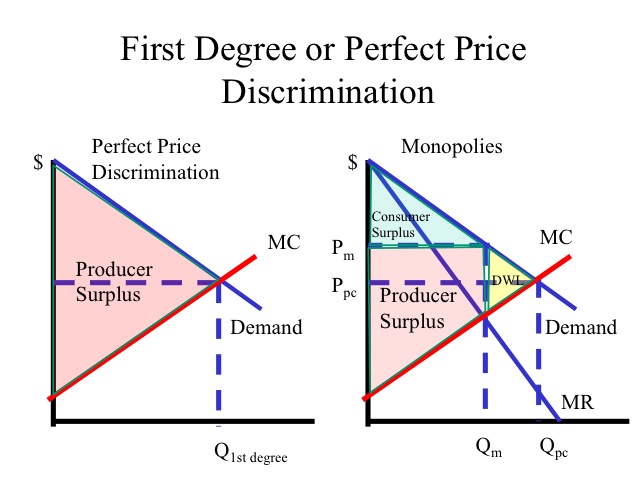
IMHO, perfect price discrimination is not usually a good thing. It's often discussed more in the context of monopolies . Under simple market models (e.g. no externalities, downward sloping demand curve etc.), a profit-maximising monopolist will set prices above the market clearing prince, resulting in dead-weight loss (market inefficiency). However, there is one situation where monopolies achieve market-efficiency: w…

Yes, I agree that it's not the optimal outcome. (I should have not used "win-win" and instead used "win-win for some consumers.") I was trying to emphasize the individual consumer only having to pay what they were willing to pay- not making a judgement call on what is optimal.

Furthermore, The scenario you highlight is price discrimination to the first degree, where the monopolist captures all the "surplus." Economists generally claim this outcome to be "unrealistic" but it helps us understand the more traditional outcome: https://courses.byui.edu/econ_150/econ_150_old_site/images/8...

As you can see, there is still consumer surplus from a monopoly price discriminating, but at the cost of a deadweight loss.

Re: A crashed advertisement reveals logs of a facial recognition system

#484

Earlier quoted context omitted.

IMHO, perfect price discrimination is not usually a good thing. It's often discussed more in the context of monopolies . Under simple market models (e.g. no externalities, downward sloping demand curve etc.), a profit-maximising monopolist will set prices above the market clearing prince, resulting in dead-weight loss (market inefficiency). However, there is one situation where monopolies achieve market-efficiency: w…

Yes, I agree that it's not the optimal outcome. (I should have not used "win-win" and instead used "win-win for some consumers.") I was trying to emphasize the individual consumer only having to pay what they were willing to pay- not making a judgement call on what is optimal. Furthermore, The scenario you highlight is price discrimination to the first degree, where the monopolist captures all the "surplus." Economis…

Fair enough, I agree that we could be here all day if we opened the value-judgement can of worms (though I do wish we did this when discussing public economic policy).

Economists generally claim this outcome to be "unrealistic" but it helps us understand the more traditional outcome

I agree with this. Just to add, pretty much every simplified market model you would find in an undergraduate-level textbook won't correspond to any market in reality. As you suggest, they're just very simplified models designed to 'kinda point you in the right direction', rather than be taken as a description of reality. The most dangerous people tend to be those who took micro 101 but were never told the latter :)

Re: A crashed advertisement reveals logs of a facial recognition system

#485

Earlier quoted context omitted.

Ethically, neither your consent or knowledge is required for someone to see you in public and remember that image. Why they do it isn't really relevant. If they use that image to do something unethical, like commit fraud, it is the fraud that is unethical, not the imaging.

I think many people would disagree. It might be legal, but that doesn't mean it's not unethical. If a stranger on the street started following me, taking pictures without permission, and taking notes about my appearance of actions and storing it in their database, I would say he was behaving unethically. Ask street photographers - it's a delicate balance. Many people really dislike having their pictures taken without…

That is a lot of words to simply say that some people think it is unethical. Which is an essentially empty statement. Couldn't you at least say most people and make it an argumentum ad populum?

Re: A crashed advertisement reveals logs of a facial recognition system

#486

Earlier quoted context omitted.

Ethically, neither your consent or knowledge is required for someone to see you in public and remember that image. Why they do it isn't really relevant. If they use that image to do something unethical, like commit fraud, it is the fraud that is unethical, not the imaging.

Until relatively recently, unavailability of large stockpiles of consumer data (at least, stockpiles at the scale now possible) was a significant impediment to a large and probably mostly-undiscovered class of potentially unethical behavior. Do you not suppose the removal of that impediment, with no other equally powerful compensatory regulations or oversight, to at least potentially be a serious problem now or at an…

Until relatively recently, unavailability of large stockpiles of consumer data (at least, stockpiles at the scale now possible) was a significant impediment to a large and probably mostly-undiscovered class of potentially ethical behavior, as well as behavior that actively combats unethical behavior. Data itself is amoral and can be used for either good or bad.

Re: A crashed advertisement reveals logs of a facial recognition system

#487

Earlier quoted context omitted.

Thanks for the detailed comment. Couple clarifying questions if you don't mind: - do you know that loyalty cards are often used in stores to collect customer data (a kind of offline cookie)? do you consider it a bad/dangerous/unethical or does it sound ok for you? - if instead of a camera there was a person looking at customers and recording his observation, would you feel bad about it?

I'm not the parent commenter but: - do you know that loyalty cards are often used in stores to collect customer data (a kind of offline cookie)? do you consider it a bad/dangerous/unethical or does it sound ok for you? Yes I do know that loyalty cards are used to collect data. I think most people do. I don't take loyalty cards for this reason and I'm glad that they are opt in although there is some financial pressure…

> I would feel bad about it and I think the person should ask my permission first.

But if that person just memorizes customer reactions to understand how people on average react to particular products or actions, that's ok, right? Because this is what sellers and business owners do to improve their product. So is it about human-to-human interaction or some more subtle detail? I'm biased here, so sorry if I miss something obvious in this situation.

Re: A crashed advertisement reveals logs of a facial recognition system

#489

Earlier quoted context omitted.

Thanks for the detailed comment. Couple clarifying questions if you don't mind: - do you know that loyalty cards are often used in stores to collect customer data (a kind of offline cookie)? do you consider it a bad/dangerous/unethical or does it sound ok for you? - if instead of a camera there was a person looking at customers and recording his observation, would you feel bad about it?

Loyalty cards are opt in. Security surveillance can be unsettling but customers understand its purpose and limited scope. What you're proposing is more invasive, and most people would not appreciate it if they knew about it. Look, give up trying to justify it. Customers don't want it. You should find another application for this technology.

Well, I definitely do have other applications for it. For example, I know that similar software has been used in labs to estimate people's reaction to videos and game features, in mobile applications to improve interaction with a user, etc.

My interest to offline applications comes from personal experience: recently we demonstrated our product (not emotion recognition, but also capturing user's face) on an exposition. People came to our stand, used the product (so they clearly opted-in), asked questions, etc. After 2 days, we asked a girl at the stand "What do people think about the product"? "Well, in general, they are interested" she answered. Not much info, right? Definitely less informative than "65% expressed mild interest, 20% had no reaction and 5% found it disgusting, especially this feature".

So I don't try to justify this use case - my life doesn't depend on it - but I find it stupid not to try to understand your clients better when it doesn't introduce a moral conflict.

Re: A crashed advertisement reveals logs of a facial recognition system

#490
post #410

Earlier quoted context omitted.

> there are emotions that are impossible to detect using external information. We can hide our emotions very well. This is an assumption which I'm not convinced holds true. Just because we can hide our assumptions well enough to fool other people doesn't necessarily imply that's it's impossible to detect using external information.

I've seen some pretty convincing expressions of emotions from actors who were obviously not at the time, in love, in pain, in anger etc. I'm pretty certain that any system that takes your facial appearance and no other information (e.g. you are an actor, you are currently on a movie set), it would have no way to distinguish genuine from false emotion.

If we are talking about professional actors trying to trick the tracker, then yes, it should be pretty hard to design software to overcome it. But most people aren't that good, and although they can mislead their friends or collegues, they still leave clues to detect a fake emotion. If you are interested, Paul Ekman has quite a lot of literature on the topic, e.g. see [1].

[1]: http://www.ekmaninternational.com/paul-ekman-international-p...

Post reply on HN