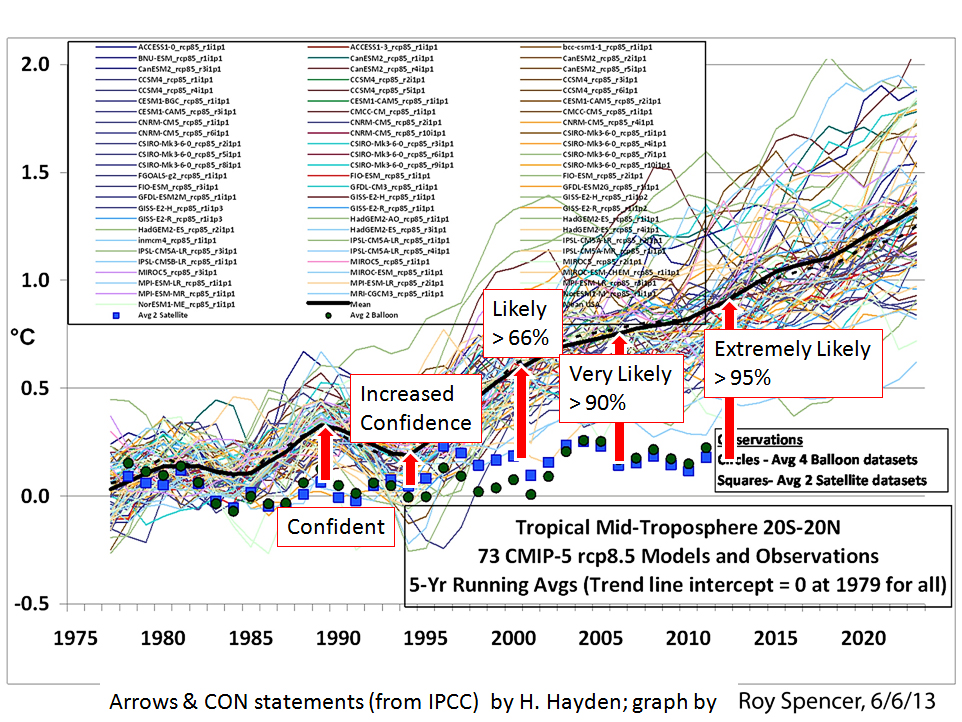
> You're wrong. The predictions are very good, and your claims are based on... some wrong sources obviously.
The main reference I have in mind is just
http://www.energyadvocate.com/gc1.jpg
that for dozens of climate models plots the predicted values of global temperature along with the observed values. Nearly all the predicted values are wildly too high. So, if we believe the graph, then in science we essentially junk nearly all the models.
As I tried to outline, the model builders were on a long walk on a short pier: Nearly all their modeling efforts, with whatever approximations, short cuts, etc. they took, failed.
Then, really, to return to first principles, they had to solve the Navier-Stokes equations for the surface of the earth, the oceans and the atmosphere. Doing a good job with that would be essentially minute by minute weather prediction, and as we know we can't do that accurately for more than two weeks or so.
That's what the model builders ran into -- the Navier-Stokes equations. IIRC we've had some good progress with those equations for, say, some boat hulls and some aircraft wings. The whole earth? Not a chance.
> It's irrelevant that you don't know.
Sure it is relevant if accept a little diplomatic circumlocution: I've tried to follow some of the global warming issue for years, and so far I have not seen the data. Without the circumlocution and diplomacy, the more literal and blunt remark is that nearly all of us are short on such data either because it has not been collected very well or the people writing the main arguments don't include it. Or, the situation is like I was a customer at a fast food restaurant, got a hamburger, opened it up, and asked "I don't know where the beef is".
> No "denier" was able to make anything scientifically relevant up to now. That's the fact.
Well, in the graph in the link I gave above, a few of the models, maybe only one, were fairly accurate -- they predicted nearly no increase in global temperatures. So, maybe the author of that model was a "denier" in which case at least one "denier" did something "scientifically relevant".
For more on "scientifically relevant" from deniers, there is the argument that at least for the past few thousand years, we know the cause of the temperature changes, and CO2 had nothing to do with the changes. Really, basically the greenhouse effect -- from CO2, methane, water vapor, etc. -- didn't either.
Instead the cause of global cooling was more clouds -- they have a net cooling effect (net, not a greenhouse effect). The clouds were from some water molecules in the atmosphere collected into water droplets from the action of cosmic rays. Of course, the cosmic rays come at essentially constant rates over time but maybe with some variation with direction. So, when there was fewer cosmic rays, there were fewer clouds and some global warming. Why fewer cosmic rays? Well, when the sun has sun spots, there is more solar wind -- think really 3D all around our solar system, not just in the plane of the orbit of the earth, and reducing the rate of cosmic rays from all directions including way out and high above the plane of the earth's orbit.
So, when the sun has more sun spots, there is more solar wind, more cosmic rays blocked from hitting the earth, fewer clouds, and global warming. When the sun is quieter, there is some global cooling.
IIRC, over the past few thousand years or so, and maybe longer, the data on variations in sun spots do well fitting the variations in global temperatures while data on CO2 concentrations does not.
So, people with the sun spot explanation are "deniers" and may have found the real cause of global warming/cooling for the last few thousand years or so at least and, thus, been "scientifically relevant".
More generally, science needs to be subject to review, and a reviewer, even a "denier", who does find actual errors is also "scientifically relevant".
Along the lines of reviewing, I would note that so far it appears that over the past 800,000 years, the cases of global cooling were not preceded by lower concentrations of CO2. E.g., the Little Ice Age was not preceded by lower concentrations of CO2. Neither was the cooling from 1940 to 1970.
For more, yes, sure, CO2 is a greenhouse gas. Fine. We agree on that. So, CO2 can warm the earth -- we agree. But we can also agree that lighting a match will warm the earth. So, for CO2 warming the earth, the question is how much? Hate to say: (A) Just looking at the historical record from the past few thousand years, maybe the past 800,000 years, it appears that more CO2 has no detectable warming effect. (B) For some solid science, e.g., evaluating the effect of CO2 just from first principles of mathematical physics, including the Navier-Stokes equations, we can't do the calculations and, thus, for this approach, are stuck-o. Here maybe (A) is a review and "scientifically relevant". For (B), that's also "scientifically relevant" but so obvious that it is a trivial contribution.
There are a lot of research problems without good solutions -- some of the details of the big bang, dark energy, dark matter, the origin of the highest energy cosmic rays, the origin of life on earth, quantum mechanics and relativity inside a black hole, a cure for cancer, how good natural intelligence works, etc. Well, one more is prediction of the temperature of earth for the next 100 years. Sorry 'bout that. While I've solved some problems in applied math and published the results, I can't apologize for not solving all outstanding problems. Sorry I don't know how to predict the temperature of earth for the next 100 years, but maybe I should say that I can't see that anyone else knows how either. In that case, my view is that carbon taxes are not justified.