Live data from Hacker News

What's Really Warming the World?

bloomberg.com

191–200 of 223 posts

Re: What's Really Warming the World?

#191
post #166

Earlier quoted context omitted.

Thank you for the link. This is a fantastic lecture that presents a very accessible synthesis of geologic and atmospheric science. Starts off a bit slow, but I suggest sticking with it. It addresses a number of the arguments presented in this thread.

I just watched it: It has a lot of interesting stuff on time scales of some millions or billions of years. Yup, in particular, there have been some huge swings in temperature and CO2 concentrations and big effects in weathering rocks, the pH of the oceans, what plants have to do differently in their breathing in response to big CO2 concentration changes, etc. He wants to claim "The Biggest Control Knob: Carbon Dioxid…

The problem I'm having, and I have a masters in statistics, is that this data is generated after the fact. If you compare the predictions of the 2000-2010 period with the "after-the-fact" predictions of the 2000-2010 period ... There's a huge difference. According to the prediction EVERY year between 2000 and 2010 was between a 3 and 5-sigma event. In the after-the-fact model this is simply ignored, and the data follows the graph much better and ... nothing special happened apparently.

Sorry no. This is an indication that your predictions are worthless. And of course, after such a massive fuckup, it's going to take a bit of work to convince people otherwise. But none of that is happening, I wonder why not.

The worst of it all is that I used to make a similar argument, first about 1990-2000, then about 1995-2005. They all had the same result. Suddenly, and without explanation they were far, far cooler (compared to the prediction). Not quite 5-sigma years, but 3 sigma years were in there. 2000-2010 is the worst of the lot, but there isn't any decade-long period where one can say ... well climate scientists ... well done. You were right. The IPCC AR's, predicted temperature anomaly versus observed temperature anomaly.

Given these circumstances, how can we give any credence to the idea that the IPCC predictions about the future will match reality ? The joke is that in order for their 95% prediction to actually be true in 95% of cases they now have to be correct for 20.000 years. They don't even predict out that far. It's a joke, but it's also true. You'd think it would give people pause.

And all this is still ignoring the many fundamental theoretical problems climate science has. When they say "it's worse than ever before" ... well they're right, in terms of many variables. Ok ... but that means their methods are invalid. Statistics can fill in expected values in an observed population of values. And yet their claim is that the observed populations are VERY different from the ones seen before. Ok, fine claim. You can even prove that to some extent with statistics. And they've done that. After that, of course, you cannot use statistics to predict these values anymore ! This alone could explain why their predictions are so horribly bad.

I get the utilitarian argument. We don't have any better way of making predictions about the climate. That's great, but that doesn't make our best prediction adequate, nor is it even value-free. In some ways, it's just a political argument : "this looks worrying, let's fix it". It should be treated as such.

Re: What's Really Warming the World?

#192
post #188

Earlier quoted context omitted.

> He's not really talking about some significant effect of Joe's gasoline powered lawnmower on the temperature in NYC in year 2050 thus justifying carbon taxes on Joe's gasoline. Of course not. First "on the temperature in NYC" is wrong. The topic is the whole Earth. Second it's not "Joe's gasoline powered lawnmower" that we worry about, but the amount of CO2 pushed by the whole Earth, all actions of all humans, meas…

I suspect that we are mostly in agreement but are not reading English the same way. What I said about Joe, a generic guy, his lawnmower, a generic emitter of CO2, gasoline, a generic source of carbon to burn, and NYC, a generic city highly interested in CO2 and pushing carbon taxes, were all generic examples; looks like I should have had a prefix of "such as". But my main point was that the lecture was talking about…

> A lot of work was done trying to predict what the realistic CO2 levels would do to global temperatures, and now we can see that nearly all the temperature predictions from that work were way, way too high.

You're wrong. The predictions are very good, and your claims are based on... some wrong sources obviously.

The rest of your post is also wrong. Specifically:

> I don't know what to compare it with so don't know if that amount is, for all of the earth and sources of CO2, methane, etc. just a tiny, insignificant, nearly invisible drop in the total bucket or a major change.

It's irrelevant that you don't know. Your "ignorance" won't make global warming disappear. Ditto for your claiming that the scientific methods aren't to your taste. No "denier" was able to make anything scientifically relevant up to now. That's the fact.

Re: What's Really Warming the World?

#193
post #181

Earlier quoted context omitted.

> As a result, if we cut our carbon foot print to zero, we are still 100% at risk of extinction from climate change. No, not in the comparable time frames. Please do see that https://xkcd.com/1732/ if you haven't. > we don't have the necessary understanding, and models, needed to drive it in one direction or another. No. We know that we drive it to very fast warming with filling the atmosphere with CO2. https://www.y…

I love Randall's illustrations. And to be clear I don't have any argument at all with the data that shows humans dumping lots and lots of CO2 into the air. I wish it went back 40,000 years though. My interest is about the systemic response of the planet to heat. Not CO2, heat. Because over time the planet has gone from very hot to very cold and back again. Richard Alley in that youtube video makes this point nicely w…

> we haven't yet figured out how the Earth is going to react to that destabilization.

Oh yes we did. It will get warmer. And remain much longer warmer than we'd like. Unless the CO2 production is cut. It's that simple.

Re: What's Really Warming the World?

#194

Earlier quoted context omitted.

Who is "them"? There are many smart people who acknowledge that climate change is happening, but also acknowledge that there's no proof that there's a clear urgent action we need to do.

Case in point.

You didn't actually make a point.

Re: What's Really Warming the World?

#196

Earlier quoted context omitted.

A trap most of us will fall in to is to assume intents of the anonymous strangers with which we talk on these message boards. In serious academic-ish discussion, I think we should stick as closely to the topic at-hand and avoid pointing out patterns of argumentation where we're easily led into the abyss of us-vs-them and accusations of manipulation. (Manipulation might be rampant, but hard to objectively define anony…

> In serious academic-ish discussion, I think we should stick as closely to the topic at-hand and avoid... So does that mean you're willing to do the legwork to dig up the IPCC reports, chase down the studies they reference, and put together an academic-quality rebuttal? Or are you just asking for someone else to do it? In either case I offer my sincere gratitude to anyone willing to fight the weighted odds. It ain't…

I'll rephrase: I'm asking for less speculation on the [malicious] intent of someone with whom one may disagree on HN. Poisons the discussion even worse.

Re: What's Really Warming the World?

#197
post #192

Earlier quoted context omitted.

I suspect that we are mostly in agreement but are not reading English the same way. What I said about Joe, a generic guy, his lawnmower, a generic emitter of CO2, gasoline, a generic source of carbon to burn, and NYC, a generic city highly interested in CO2 and pushing carbon taxes, were all generic examples; looks like I should have had a prefix of "such as". But my main point was that the lecture was talking about…

> A lot of work was done trying to predict what the realistic CO2 levels would do to global temperatures, and now we can see that nearly all the temperature predictions from that work were way, way too high. You're wrong. The predictions are very good, and your claims are based on... some wrong sources obviously. The rest of your post is also wrong. Specifically: > I don't know what to compare it with so don't know i…

> You're wrong. The predictions are very good, and your claims are based on... some wrong sources obviously.

The main reference I have in mind is just

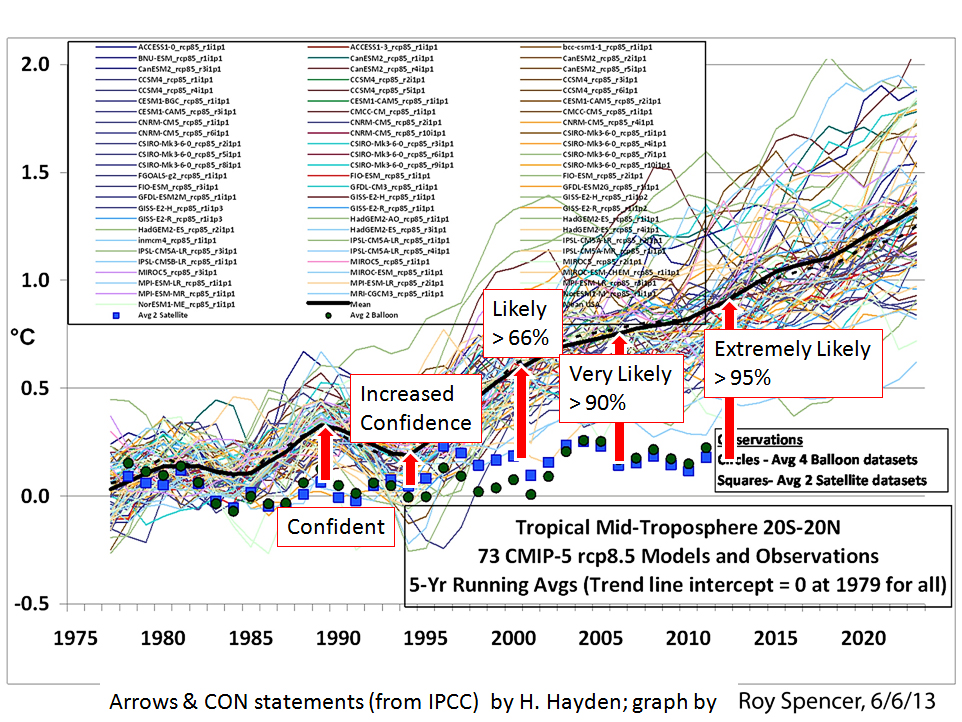
http://www.energyadvocate.com/gc1.jpg

that for dozens of climate models plots the predicted values of global temperature along with the observed values. Nearly all the predicted values are wildly too high. So, if we believe the graph, then in science we essentially junk nearly all the models.

As I tried to outline, the model builders were on a long walk on a short pier: Nearly all their modeling efforts, with whatever approximations, short cuts, etc. they took, failed.

Then, really, to return to first principles, they had to solve the Navier-Stokes equations for the surface of the earth, the oceans and the atmosphere. Doing a good job with that would be essentially minute by minute weather prediction, and as we know we can't do that accurately for more than two weeks or so.

That's what the model builders ran into -- the Navier-Stokes equations. IIRC we've had some good progress with those equations for, say, some boat hulls and some aircraft wings. The whole earth? Not a chance.

> It's irrelevant that you don't know.

Sure it is relevant if accept a little diplomatic circumlocution: I've tried to follow some of the global warming issue for years, and so far I have not seen the data. Without the circumlocution and diplomacy, the more literal and blunt remark is that nearly all of us are short on such data either because it has not been collected very well or the people writing the main arguments don't include it. Or, the situation is like I was a customer at a fast food restaurant, got a hamburger, opened it up, and asked "I don't know where the beef is".

> No "denier" was able to make anything scientifically relevant up to now. That's the fact.

Well, in the graph in the link I gave above, a few of the models, maybe only one, were fairly accurate -- they predicted nearly no increase in global temperatures. So, maybe the author of that model was a "denier" in which case at least one "denier" did something "scientifically relevant".

For more on "scientifically relevant" from deniers, there is the argument that at least for the past few thousand years, we know the cause of the temperature changes, and CO2 had nothing to do with the changes. Really, basically the greenhouse effect -- from CO2, methane, water vapor, etc. -- didn't either.

Instead the cause of global cooling was more clouds -- they have a net cooling effect (net, not a greenhouse effect). The clouds were from some water molecules in the atmosphere collected into water droplets from the action of cosmic rays. Of course, the cosmic rays come at essentially constant rates over time but maybe with some variation with direction. So, when there was fewer cosmic rays, there were fewer clouds and some global warming. Why fewer cosmic rays? Well, when the sun has sun spots, there is more solar wind -- think really 3D all around our solar system, not just in the plane of the orbit of the earth, and reducing the rate of cosmic rays from all directions including way out and high above the plane of the earth's orbit.

So, when the sun has more sun spots, there is more solar wind, more cosmic rays blocked from hitting the earth, fewer clouds, and global warming. When the sun is quieter, there is some global cooling.

IIRC, over the past few thousand years or so, and maybe longer, the data on variations in sun spots do well fitting the variations in global temperatures while data on CO2 concentrations does not.

So, people with the sun spot explanation are "deniers" and may have found the real cause of global warming/cooling for the last few thousand years or so at least and, thus, been "scientifically relevant".

More generally, science needs to be subject to review, and a reviewer, even a "denier", who does find actual errors is also "scientifically relevant".

Along the lines of reviewing, I would note that so far it appears that over the past 800,000 years, the cases of global cooling were not preceded by lower concentrations of CO2. E.g., the Little Ice Age was not preceded by lower concentrations of CO2. Neither was the cooling from 1940 to 1970.

For more, yes, sure, CO2 is a greenhouse gas. Fine. We agree on that. So, CO2 can warm the earth -- we agree. But we can also agree that lighting a match will warm the earth. So, for CO2 warming the earth, the question is how much? Hate to say: (A) Just looking at the historical record from the past few thousand years, maybe the past 800,000 years, it appears that more CO2 has no detectable warming effect. (B) For some solid science, e.g., evaluating the effect of CO2 just from first principles of mathematical physics, including the Navier-Stokes equations, we can't do the calculations and, thus, for this approach, are stuck-o. Here maybe (A) is a review and "scientifically relevant". For (B), that's also "scientifically relevant" but so obvious that it is a trivial contribution.

There are a lot of research problems without good solutions -- some of the details of the big bang, dark energy, dark matter, the origin of the highest energy cosmic rays, the origin of life on earth, quantum mechanics and relativity inside a black hole, a cure for cancer, how good natural intelligence works, etc. Well, one more is prediction of the temperature of earth for the next 100 years. Sorry 'bout that. While I've solved some problems in applied math and published the results, I can't apologize for not solving all outstanding problems. Sorry I don't know how to predict the temperature of earth for the next 100 years, but maybe I should say that I can't see that anyone else knows how either. In that case, my view is that carbon taxes are not justified.
Re: What's Really Warming the World?

#198

Earlier quoted context omitted.

I just watched it: It has a lot of interesting stuff on time scales of some millions or billions of years. Yup, in particular, there have been some huge swings in temperature and CO2 concentrations and big effects in weathering rocks, the pH of the oceans, what plants have to do differently in their breathing in response to big CO2 concentration changes, etc. He wants to claim "The Biggest Control Knob: Carbon Dioxid…

The problem I'm having, and I have a masters in statistics, is that this data is generated after the fact. If you compare the predictions of the 2000-2010 period with the "after-the-fact" predictions of the 2000-2010 period ... There's a huge difference. According to the prediction EVERY year between 2000 and 2010 was between a 3 and 5-sigma event. In the after-the-fact model this is simply ignored, and the data foll…

You claim to have a "masters in statistics" but that doesn't really help me in understanding the main points of your argument. In a nutshell what you are saying is that a lot of the statistical models developed have changed over the last 20 years or so to accommodate the data that has actually emerged. That each of these models if they were applied today would diverge significantly in their predictions from the actual situation we're seeing today? I find this a stunning indictment of mainstream scientific consensus, especially considering many of the actors in that field probably have Masters in statistics and other fields, PhDs and professorships.

But, we do see this kind of skew in other fields, in particular economics comes to mind, where an overarching consensus on what is and is not good seems to promote the viewpoints selected for discussion, while neglecting counter-theses.

Re: What's Really Warming the World?

#199
post #192

Earlier quoted context omitted.

> A lot of work was done trying to predict what the realistic CO2 levels would do to global temperatures, and now we can see that nearly all the temperature predictions from that work were way, way too high. You're wrong. The predictions are very good, and your claims are based on... some wrong sources obviously. The rest of your post is also wrong. Specifically: > I don't know what to compare it with so don't know i…

> You're wrong. The predictions are very good, and your claims are based on... some wrong sources obviously. The main reference I have in mind is just http://www.energyadvocate.com/gc1.jpg that for dozens of climate models plots the predicted values of global temperature along with the observed values. Nearly all the predicted values are wildly too high. So, if we believe the graph, then in science we essentially jun…

Ah! Circumlocution. My new favourite word :)

I had a look at the Navier-Stokes stuff and what I found was incredible complicated maths. I'd like it if you'd linked out to some discussions on this topic but in any case I was able to find this [0] which takes the position that many climate scientists have invoked Navier-Stokes as a theoretical basis but mathematicians in general consider the finer details of NS behaviour at this scale to be (practically) unknowable.

My personal insight from an information science pov is that NS would be the wrong tool to use. It looks like an exhaustive model used at a fine-grained scale that would be simply too complex at macro level.

[0] https://climateaudit.org/2005/12/22/gcms-and-the-navier-stok...

Re: What's Really Warming the World?

#200
post #192

Earlier quoted context omitted.

> A lot of work was done trying to predict what the realistic CO2 levels would do to global temperatures, and now we can see that nearly all the temperature predictions from that work were way, way too high. You're wrong. The predictions are very good, and your claims are based on... some wrong sources obviously. The rest of your post is also wrong. Specifically: > I don't know what to compare it with so don't know i…

> You're wrong. The predictions are very good, and your claims are based on... some wrong sources obviously. The main reference I have in mind is just http://www.energyadvocate.com/gc1.jpg that for dozens of climate models plots the predicted values of global temperature along with the observed values. Nearly all the predicted values are wildly too high. So, if we believe the graph, then in science we essentially jun…

> Sorry I don't know how to predict the temperature of earth for the next 100 years, but maybe I should say that I can't see that anyone else knows how either. In that case, my view is that carbon taxes are not justified.

That summarizes how you see the issue. If the scientists can't convince you that they can "predict" the values exactly in the shortest time period ("100 years") the "carbon taxes are not justified."

Everything else is trying to rationalize that, taking the info from these who cherry-pick their argument of the day that nothing important is going on.

In reality the global warming issue is not about meteorologically "predicting" "100 years" at all. It's about recognizing the impact, which will happen no matter how much cherry-picking origin-adjusting short-term charts could be produced.

Yes, "the models" are not giving meteorological predictions. I don't know how old are you, but if you're going to live even just the next 20 years, you'll see for yourself that in the 20 years even if "the models" would wiggle between, the Earth will be much warmer on average, just like 2016 broke all the records since we measure. It will happen again and again. And if you plan to have children or have them already, please write one single letter to them with your "predictions" of how they are going experience Earth warming. You probably won't live enough to see that, but they will be able to see how much you were wrong, that's I'm sure.

Post reply on HN