Live data from Hacker News

Announcing the first SHA-1 collision

security.googleblog.com

321–330 of 524 posts

Re: Announcing the first SHA-1 collision

#321
This point seems to be getting re-hashed (no pun intended) a lot, so here's a quick summary: there are three kinds of attacks on cryptographic hashes: collision attacks, second-preimage attacks, and first-preimage attacks.

Collision attack: find two documents with the same hash. That's what was done here.

Second-preimage attack: given a document, find a second document with the same hash.

First-preimage attack: given an arbitrary hash, find a document with that hash.

These are in order of increasing severity. A collision attack is the least severe, but it's still very serious. You can't use a collision to compromise existing certificates, but you can use them to compromise future certificates because you can get a signature on one document that is also valid for a different document. Collision attacks are also stepping stones to pre-image attacks.

UPDATE: some people are raising the possibility of hashes where some values have 1 or 0 preimages, which makes second and first preimage attacks formally impossible. Yes, such hashes are possible (in fact trivial) to construct, but they are not cryptographically secure. One of the requirements for a cryptographically secure hash is that all possible hash values are (more or less) equally likely.
Re: Announcing the first SHA-1 collision

#322
post #183

Earlier quoted context omitted.

That's not an issue with the torrents. It's an issue with the magnet URI format for referncing torrents. The "good" torrent would not be susceptible to attack via this receiving the entire torrent file directly (say over HTTPS) is fine.

Torrent files have been deprecated for a while. Magnet URI is the the preferred/default method of sharing. TPB did this in 2012[1]. [1] https://torrentfreak.com/the-pirate-bay-dumps-torrents-12022...

Looks like it's time to update the magnet link format to use a newer hash.

Re: Announcing the first SHA-1 collision

#324
post #321

This point seems to be getting re-hashed (no pun intended) a lot, so here's a quick summary: there are three kinds of attacks on cryptographic hashes: collision attacks, second-preimage attacks, and first-preimage attacks. Collision attack: find two documents with the same hash. That's what was done here. Second-preimage attack: given a document, find a second document with the same hash. First-preimage attack: given…

The severity between the preimage attacks depends on context.

For Git, for example, a first-preimage attack won't buy you anything, but a second-preimage could be potentially devastating depending on how lucky you get.

If Mallory wanted to make it look like you signed a document you didn't, second-preimage would be devestating. And with the demonstration of two PDFs sharing the same hash, this is a pretty severe one: many PGP signatures, for example, still use SHA-1. But even so, you could take some signature from any point in the past.

Re: Announcing the first SHA-1 collision

#325
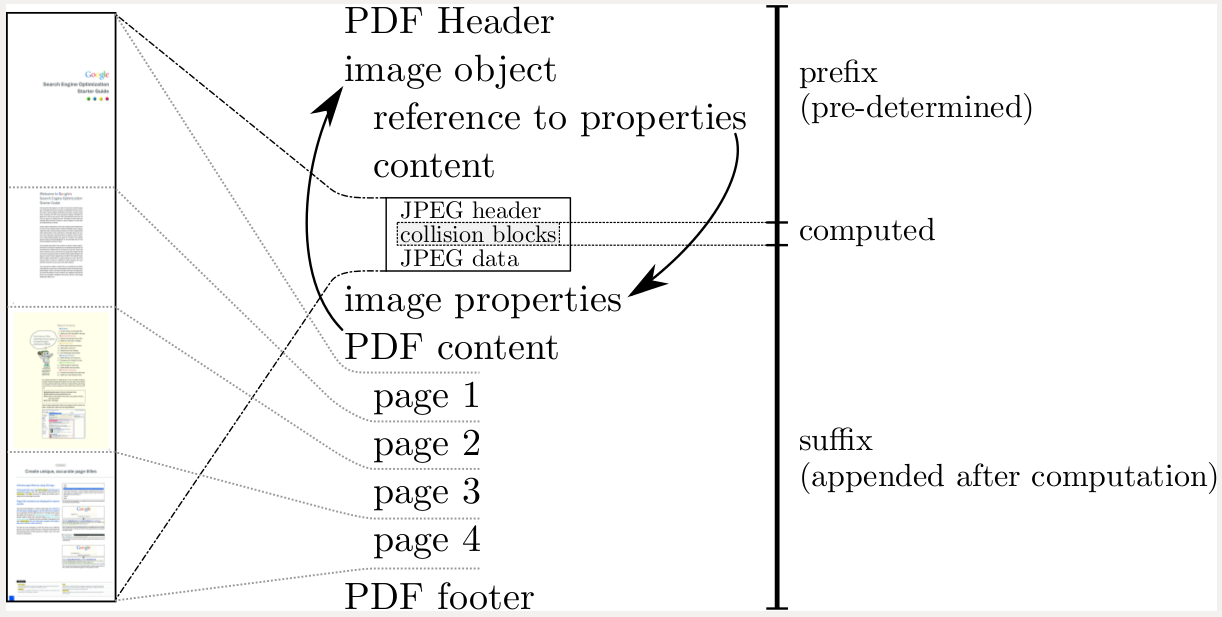
The visual description of the colliding files, at http://shattered.io/static/pdf_format.png, is not very helpful in understanding how they produced the PDFs, so I took apart the PDFs and worked it out.

Basically, each PDF contains a single large (421,385-byte) JPG image, followed by a few PDF commands to display the JPG. The collision lives entirely in the JPG data - the PDF format is merely incidental here. Extracting out the two images shows two JPG files with different contents (but different SHA-1 hashes since the necessary prefix is missing). Each PDF consists of a common prefix (which contains the PDF header, JPG stream descriptor and some JPG headers), and a common suffix (containing image data and PDF display commands).

The header of each JPG contains a comment field, aligned such that the 16-bit length value of the field lies in the collision zone. Thus, when the collision is generated, one of the PDFs will have a longer comment field than the other. After that, they concatenate two complete JPG image streams with different image content - File 1 sees the first image stream and File 2 sees the second image stream. This is achieved by using misalignment of the comment fields to cause the first image stream to appear as a comment in File 2 (more specifically, as a sequence of comments, in order to avoid overflowing the 16-bit comment length field). Since JPGs terminate at the end-of-file (FFD9) marker, the second image stream isn't even examined in File 1 (whereas that marker is just inside a comment in File 2).

tl;dr: the two "PDFs" are just wrappers around JPGs, which each contain two independent image streams, switched by way of a variable-length comment field.

Re: Announcing the first SHA-1 collision

#326
post #307

Earlier quoted context omitted.

It's almost certain that intelligence agencies could invest this effort to say, break SHA1 SSL certs. To the contrary, it is unlikely that they can do so. There is a world of difference between "come up with two things that hash to the same value" and "come up with something that hashes to a particular known value". It gets harder still if you're trying to add constraints about the format of your text (such as making…

> There is a world of difference between "come up with two things that hash to the same value" and "come up with something that hashes to a particular known value". Doesn't the PDF on their site pretty much prove they can do both of these - at least, in a way? They were able to change the color without impacting the contents of the PDF and get the same SHA1. They probably have a fair bit of garbage data to work with…

> Doesn't the PDF on their site pretty much prove they can do both of these - at least, in a way? They were able to change the color without impacting the contents of the PDF and get the same SHA1.

I think they prepared both PDFs and then tweaked with bits in both of them. This is much easier than tampering with only one PDF.

So I think it's still very hard to generated a CA cert where you can just copy the signature of an existing cert.

But maybe you can predict exactly what parts from your signing request and what timestamp and serial number and so on the CA will use, then you can maybe precompute a signing request that will result in a cert where you can replace some parts with other, evil, precomputed ones.

Re: Announcing the first SHA-1 collision

#327

Earlier quoted context omitted.

> The time needed for a homogeneous cluster to produce the collision would then have been of 114 K20-years, 95 K40-years or 71 K80-years If I'm reading that correctly, 852 (71 * 12) K80 cards gets that down to a month, which sounds well within the reach of NSA et al. Even getting it down to a day (71 * 12 * 30=25,560 cards) seems feasible. Assuming $10k per card ($5k launch price + doubled to account for supporting h…

Any serious effort I assume would use ASIC's.

I was interested if just using standard hardware was feasible due to the flexibility it provides (same hardware to, e.g., forge SHA-1 collisions, bruteforce other hash functions, or run speech-to-text/train ML models on a pretty much unbounded dataset), though I agree anything that is required frequently and/or quickly would probably be moved to specialised hardware.

Re: Announcing the first SHA-1 collision

#329
post #264

> How did you leverage the PDF format for this attack? > A picture is worth a thousand words, so here it is. > http://shattered.io/static/pdf_format.png This picture is meaningless to me. Can someone explain what's going on?

From the paper:

PDFs with the same MD5 hash have previously been constructed by Gebhardt et al. [12] by exploiting so-called Indexed Color Tables and Color Transformation functions. However, this method is not effective for many common PDF viewers that lack support for these functionalities. Our PDFs rely on distinct parsings of JPEG images, similar to Gebhardt et al.’s TIFF technique [12] and Albertini et al.’s JPEG technique [1]. Yet we improved upon these basic techniques using very low-level “wizard” JPEG features such that these work in all common PDF viewers, and even allow very large JPEGs that can be used to craft multi-page PDFs.

Some details of our work will be made public later only when sufficient time to implement additional security measures has passed. This includes our improved JPEG technique and the source-code for our attack and cryptanalytic tools.

Re: Announcing the first SHA-1 collision

#330
post #315

Earlier quoted context omitted.

> break SHA1 SSL certs. It's not possible to break existing SHA1 certificates because this attack is to generate collisions, not finding preimages.

You are thinking about this in a wrong way. It is in fact true that being able to generate collisions allows you to break SSL. What you do is this: generate two certificates with colliding hashes, one for google.com, the other for your own domain. Verisign will gladly sign the second one, since you own the domain, but since the hashes match, you can also use the same signature for the first one. Now you can impersona…

Moreover, how quickly we forget! An intelligence agency did in fact carry out such an attack on code signing certificates using an MD5 collision as part of the FLAME malware.
Post reply on HN