Earlier quoted context omitted.
Bitflips are not a RAM stability issue, they happen randomly due to radiation, but radiation is not random, especially in my area (I live not far from Chornobyl).
er.. you should probably move. Bitflips aren't the only things radiation does. Bitflips in DNA for example.
AMD Ryzen 7 1800X Benchmarked – Giving Intel’s $1000 Chips A Run For It
241–250 of 278 posts
Re: AMD Ryzen 7 1800X Benchmarked – Giving Intel’s $1000 Chips A Run For It
#242Earlier quoted context omitted.
The thing is, anyone with a 144 Hz monitor [1] knows from experience that what you're claiming here is complete bullshit. Then there's also the fact that 70 Hz causes demonstrably more nausea in VR users than 90 Hz or more. Beyond that, if you wanna act innocent and play a citation game, I can throw you a bone. I'll give you this [2], what do you give me in return? -- [1] This was already evident back in CRT days whe…
Really? Your first citation is youself[1] and the second one is a random website that's clearly not scientific or published. How about the NIH? https://www.ncbi.nlm.nih.gov/pmc/articles/PMC2826883/figure/... Gap detection thresholds for different age ranges. Notice that the average for vision is around 20ms, or 50fps. Yeah some people are lower but the large majority of people don't see any faster than 60fps [1] so i…
I could explain further, but I get the feeling that you've made up your mind and aren't willing to read much. If you change your mind, start with the link I gave earlier. [1]
In addition, this thing is pretty easily testable with home equipment. Get yourself a 144 Hz or faster monitor and construct the following program with OpenGL: two identical boxes moving side-by-side, one updating its position at the full 144 Hz and another at 60 Hz. [2] You'll see the difference yourself.
--
[1] http://www.100fps.com/how_many_frames_can_humans_see.htm
[2] There's a web app as well, but unfortunately browsers don't support frame rates higher than 60 Hz that well. My chrome is limited to 60 Hz even on 144 Hz for example. https://www.testufo.com/#test=framerates
Re: AMD Ryzen 7 1800X Benchmarked – Giving Intel’s $1000 Chips A Run For It
#243Earlier quoted context omitted.
Unless you have a 144p display then all of the high-end configs there will appear identical.
Do you mean 1440p or 144Hz? I'll assume 144Hz. First, that would be enough – gamers are flocking to those like crazy. Second, you have to really look at Multiplayer benchmarks here, not single player. In those Hyperthreading of the i7-7700K helps a lot when compared to the i5-7600K. If Ryzen can place a better model in between those two processor, that would be very nice.
I know people love their 144Hz screens, but if you're generating 170FPS then the remainder is utterly wasted. You're "bottlenecking" the monitor.
So at some point you're spending money on stuff you don't need, the extra frames are simply thrown away.
Re: AMD Ryzen 7 1800X Benchmarked – Giving Intel’s $1000 Chips A Run For It
#244More importantly for some, it's a 95W AMD part vs a 140W Intel part. If the power delta stays the same even for mainstream parts, does this mean AMD will become a good quiet option too? By quiet I mean "I can't hear it at night" not "I can't hear it over the music". Edit: Also, I think data centers these days are limited in density by power delivery and cooling. Even a 25W delta adds up when you're talking about thou…
If your goal is quiet and quiet alone, i would suggest a good cooler. A cooler master hyper 212 is really quiet. I thought data centers are going for ARM cpu's now, as shoveling data is not all that cpu intensive ?
I second this. I've been using the Hyper 212+ for 5 years and it's been great. The 212EVO looks just as good. Only drawback is the height (not an issue with larger cases).
Funny aside: I actually replaced the fan on my 212+ thinking the one it shipped with had failed. Turns out I'm an idiot and either didn't install the rubber dampeners correctly or the mounts came loose during shipping (can't remember which). The replacement's been solid for 5 years and although the original was relegated to spare (nothing wrong with it), I doubt I'll ever need it before I retire this build.
DEFINITELY better than the crummy cooler my Phenom II shipped with. That thing was noisy and ineffective. Next upgrade is definitely including the newer series 212 as well.
Re: AMD Ryzen 7 1800X Benchmarked – Giving Intel’s $1000 Chips A Run For It
#245Earlier quoted context omitted.
>newest Intel iGPU vs two-gen old AMD iGPU, barely keeping pace Yes, it's still true. That should've been plainly obvious.
Both are from 2015: https://ark.intel.com/products/88040/Intel-Core-i7-5775C-Pro... http://cpuboss.com/cpu/AMD-A10-7870K
Re: AMD Ryzen 7 1800X Benchmarked – Giving Intel’s $1000 Chips A Run For It
#246Earlier quoted context omitted.
As mentioned elsewhere, these chips only have a 128-bit SIMD unit (either for power or for space savings?) and so 256-bit SIMD executes half as fast as it would on Intel.
But if I read the picture properly, AMD appears to be 8 times(!) faster than anything else: http://cdn.wccftech.com/wp-content/uploads/2017/02/AMD-Ryzen... That seems to be untypically good, in the market where the new generations brought typically 10-20%. I still wouldn't say it's impossible, as, for example, Intel had (apparently until Sandy Bridge) much slower NaN handling than AMD, at least without SSE2. So maybe…
Re: AMD Ryzen 7 1800X Benchmarked – Giving Intel’s $1000 Chips A Run For It
#247Earlier quoted context omitted.
>Intel's response has always been the same. They cut their profit margins and start selling chips cheaper. They undercut AMD with volume and price and suddenly AMD is in the doghouse again struggling. AMD's best efforts can cut into Intel's profits, but Intel's response is to remove all profits from AMD until it's left behind. The last time Intel did that it was through illegal tactics - unlikely they'll get away wit…
Doing illegal is just optimization. Intel can undercut AMD lawfully if it wants. Instead of hidden rebates, Intel can openly cut prices.
Re: AMD Ryzen 7 1800X Benchmarked – Giving Intel’s $1000 Chips A Run For It
#248Earlier quoted context omitted.
Intel chips use a lower base clock frequency when they're running AVX code than when they're running non-AVX code for the very reasons you mention. In Intel's example[1] they talk about a base freqeuncy of 2.3 GHz without using AVX dropping to 1.9 with AVX[1]. That drop isn't much in frequency terms but you also have to figure in the voltage drop that the lower frequency allows you to cut power much more than you cut…
I agree with you but when I clicked your footnote source, oh god - the marketing wank. The problem with all of these benchmarks (starting with LAPACK in 1979, up until modern day benchmarks used in the TOP500 or the TPC which models a bank for RDBMS performance) is the synthetic nature of the tests and the unreasonable locality of what they end up testing. One of the bazillions of reasons why the base frequency can d…
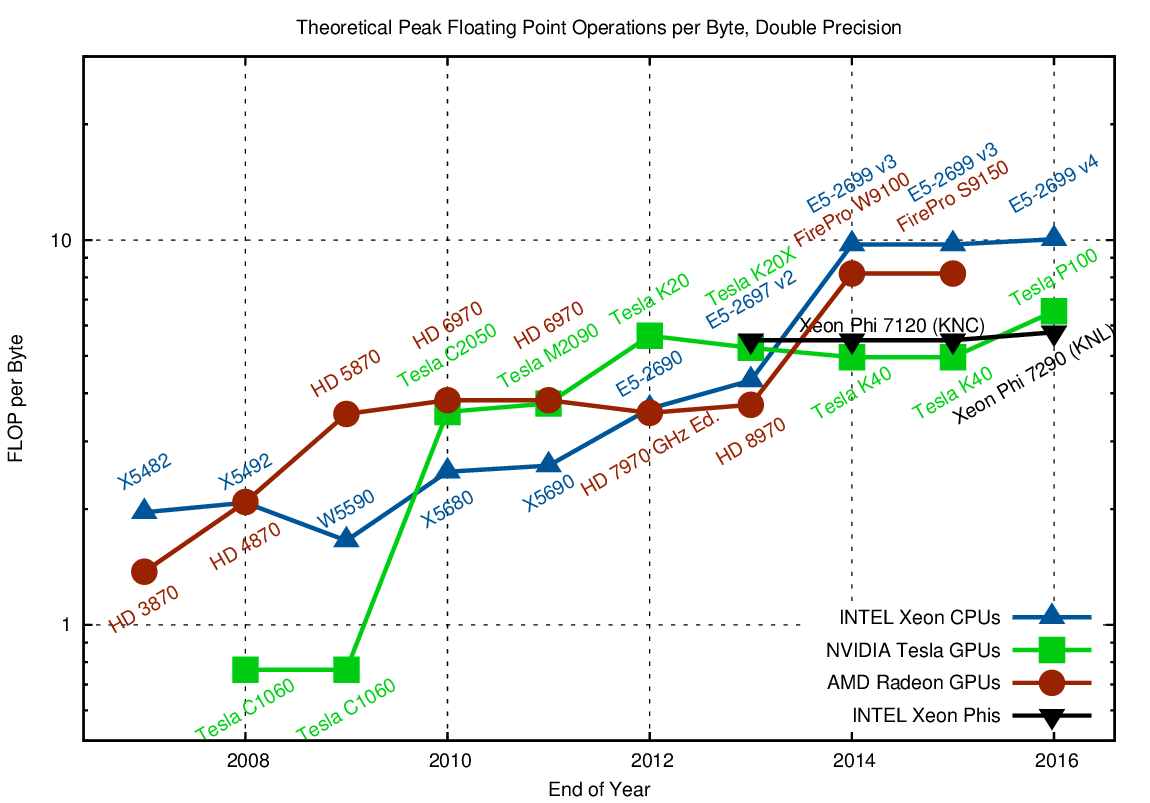
That's incorrect, DGEMM and most BLAS3 is way above most if not all processor uarch's aritmetic intensity threshold [1]. Broadwell CPUs are at 10 Flops/byte [1] while e.g. DGEMM is 32 Flops/byte [2], so that's definitely FLOP/instruction bound and not memory.
> Your processor can very easily anticipate from where in that sparse-matrix your next data fetch is going to be. It's the cost of that RAM fetch[1] going along that copper trace which is going to be where you're going to bottleneck on any heavy numerical computation.
You're mixing things up, it seems! LAPACK/BLAS is dense matrix, not sparse, so now you switched topics. Sparse matrix ops are generally >1 Flops/byte (see [2]), so that's indeed memory bound.
[1] https://www.karlrupp.net/wp-content/uploads/2013/06/flop-per... [2] http://www.siam.org/pdf/news/2090.pdf
Re: AMD Ryzen 7 1800X Benchmarked – Giving Intel’s $1000 Chips A Run For It
#249Earlier quoted context omitted.
At these TDPs, fully passive cooling is an option: http://www.silentpcreview.com/NoFan_CR-95C_Copper
It would be no longer fully passive, but I'm curious to see what the performance of that heatsink would be with a suitably-sized squirrel cage fan inserted into it. That is huge .
Surprisingly poor. A large conventional heatsink like the Noctua NH-D15 has far greater surface area. The densely packed fins of a conventional heatsink perform poorly if you're relying on convection, but they will dissipate a lot of heat with even modest airflow.
Re: AMD Ryzen 7 1800X Benchmarked – Giving Intel’s $1000 Chips A Run For It
#250More importantly for some, it's a 95W AMD part vs a 140W Intel part. If the power delta stays the same even for mainstream parts, does this mean AMD will become a good quiet option too? By quiet I mean "I can't hear it at night" not "I can't hear it over the music". Edit: Also, I think data centers these days are limited in density by power delivery and cooling. Even a 25W delta adds up when you're talking about thou…
All CPUs are silent when you water cool them. You can get a decent closed loop cooler for <$100 now.
A Noctua NH-D15 or a be quiet! Dark Rock Pro 3 will match or exceed the performance of a 240mm AIO, with considerably lower noise in a decent case.
There aren't a lot of applications where water cooling really makes sense. If you're cramming a very high performance rig into a tiny ITX case, you might be better off with an AIO. Competition-grade overclocking rigs will naturally benefit from a custom open-loop watercooling system. Otherwise, modern components just don't put out enough heat to stress a good air cooler.
The performance of water cooling can be deceptive, because of the relatively high thermal mass of the water in the loop. If you fire up Aida64 on an air cooler, the CPU temperature will climb fairly rapidly before levelling off. A water-cooled CPU will see a much more gradual increase in temperature, taking up to an hour to reach a maximum. Water coolers look really impressive if you only stress them for a short benchmark run, but they're far less impressive under sustained load.