Live data from Hacker News

How insects like bumblebees do so much with tiny brains

bbc.com

51–60 of 143 posts

Re: How insects like bumblebees do so much with tiny brains

#51

Earlier quoted context omitted.

Doesn't that imply that people who live in hotter climates have...how can I put this politely?...a disadvantage when it comes to the stability of their brains? I would assume that the brain has a certain amount of redundancy, but has this ever been researched: How hot can it get before people start getting noticeably "stupider"?

Our bodies can cool themselves decently well by sweating. I think that if the climate was affecting you to the point where your brain was getting cooked, the symptom would probably be less "slightly dumber" and more "seizures and organ failure". But I'm not a doctor or a scientist, so I could be completely wrong. Hopefully someone more informed will weigh in.

It'd make sense that there would be a mechanism for graceful degradation, no?
Re: How insects like bumblebees do so much with tiny brains

#52

"With just a few hundred or thousand neurons, you can easily recognise perhaps a hundred faces". It makes me think we are missing something when creating arificial neural networks which needs much more neurons to achieve only this specific task. Maybe artificial neurons are too simplified models compared to biological ones, maybe our training process could be much more efficient?

Probably a little bit of both, but definitely a huge amount of the former. Simplistic models of human intelligence being the result of neurons ignore huge amounts of human physiology, such as the fact that we have over 400 recognized types of neurons. Marvin Minsky has a lot of criticism of the overly fantastical fantasies of Neural Networks, and this is one of them.

Much of Minsky's criticisms came before current and modern implementations of neural networks, using extremely large datasets and large GPU processing. I'm not saying his criticisms are invalid - and certainly should not be tossed aside!

We are in the very early stages of another "AI Spring" - I have the inkling of an opinion that if we are to advanced further in the GAI direction, it will be by applying these same kinds of large-dataset tools toward other ML models of the past, much like we have done with neural networks - and also seeking to connect and unify these various parts into a whole (I don't think we should throw the baby out with the bathwater - I think all of our past ML systems have validity - it's more of where they fit in the overall scheme that may be lacking).

I do know that such approaches have been tried in the past, but I don't think as much consideration of using today's tools on yesterday's models has been approached as strongly, due to all the hype and money (and success!) being poured into neural networks today.

Re: How insects like bumblebees do so much with tiny brains

#53
Slightly off-topic but related. BEAM robots created by Mark Tilden who later founded WowWee might be of interest to readers.

From Wikipedia[0]: BEAM robotics (from Biology, Electronics, Aesthetics and Mechanics) is a style of robotics that primarily uses simple analogue circuits, such as comparators, instead of a microprocessor in order to produce an unusually simple design.

....

BEAM robots may use a set of the analog circuits, mimicking biological neurons, to facilitate the robot's response to its working environment.

[0]: https://en.wikipedia.org/wiki/BEAM_robotics

Re: How insects like bumblebees do so much with tiny brains

#54
post #47

Earlier quoted context omitted.

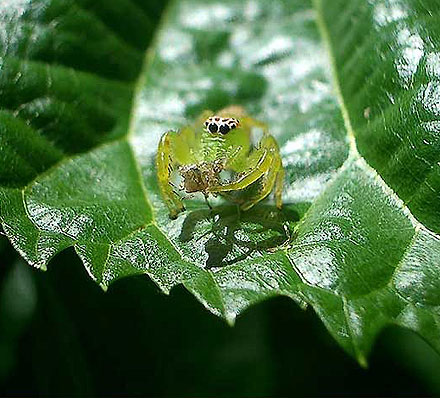
For people who don't believe that spiders can be cute: https://adlayasanimals.files.wordpress.com/2015/01/u2byv.jpg Also, I got interested and tried to find some documentation on Portia Labiata after reading Watts' book, and there's very, very little, but what he says appears to be true. They do have telescopic eyes with vibrating retinas. They do spend ages painstakingly scanning a scene before moving. They are absu…

If you're afraid of spiders, I would suggest not clicking on that link. I was hoping for cute, but that is just a very large closeup of a spider, and it definitely just hit the fear instinct.

That one is ugly. The jumping spiders have a neater look due to their colors. The really colorful ones with big eyes might not hit fear instinct so hard. Try this one I cherry-picked:

http://www.arachne.org.au/_dbase_upl/spi_mm.jpg

Re: How insects like bumblebees do so much with tiny brains

#55

Highly relevant is the Portia genus of spiders ([0], [1]) and apparently other related jumping spiders ([2]). One of my favorite excerpts from [1]: > Harland says Portia’s eyesight is the place to start. Jumping spiders already have excellent vision and Portia’s is ten times as good, making it sharper than most mammals. However being so small, there is a trade-off in that Portia can only focus its eyes on a tiny spot…

Their hunting strategies are awesome:

http://portiaspiders.weebly.com/hunting-strategies.html

Re: How insects like bumblebees do so much with tiny brains

#56
post #35
post #3

Earlier quoted context omitted.

Maybe something along the lines of "our brains would overheat" - there's a small temperature window in which proteins won't denature, it takes k T log 2 joules to erase one bit of information (Landauer's principle), and our brain uses around 20 Watts of power. Maybe tin foil hats make good heatsinks.. Interestingly enough there is some evidence that the Gibbs free energy of ketone metabolism is more thermodynamically…

Blood seems to be a pretty decent cooling agent. Our muscles can generate a lot more waste heat and we manage to get rid of it.

It's probably not so much the blood as a whole, but rather the water in it (in fact, I would expect the other parts in blood would make the water less efficient for heat carrying capacity - but they also may have other advantages to that end).

Re: How insects like bumblebees do so much with tiny brains

#57
post #3

Maybe the real question is 'why can we do so little with our giant brains?'

Maybe something along the lines of "our brains would overheat" - there's a small temperature window in which proteins won't denature, it takes k T log 2 joules to erase one bit of information (Landauer's principle), and our brain uses around 20 Watts of power. Maybe tin foil hats make good heatsinks.. Interestingly enough there is some evidence that the Gibbs free energy of ketone metabolism is more thermodynamically…

That hardly seems relevant. kT log 2 joules is something like 10^-7 times the energy of an electron. I seriously doubt that that is anything but negligible compared to the other operations brains are performing.

Re: How insects like bumblebees do so much with tiny brains

#58

Earlier quoted context omitted.

Yep! Watts' novels are how I first heard about Portia. I can't wait for the third in the trilogy. In general, I love a good novel with a bibliography.

For people who don't believe that spiders can be cute: https://adlayasanimals.files.wordpress.com/2015/01/u2byv.jpg Also, I got interested and tried to find some documentation on Portia Labiata after reading Watts' book, and there's very, very little, but what he says appears to be true. They do have telescopic eyes with vibrating retinas. They do spend ages painstakingly scanning a scene before moving. They are absu…

In English is it correct to say spiders are insects? In my native language (portuguese) it would be not accurate, as they are arachnida class, along with scorpions,mites and ticks.

Re: How insects like bumblebees do so much with tiny brains

#59

Earlier quoted context omitted.

Portia spiders are also referenced in Peter Watts' Echopraxia. (Some spoilers could be inferred from thinking about this too hard while reading the novel.)

Some spoilers could be inferred from thinking about this too hard while reading the novel Not.. if you don't say that...

Yeah, I guess it's a bit like saying "don't think about a pink elephant", but not saying that doesn't guarantee that they won't think of a pink elephant.

And I'd wager that people who would read about the Portia, and would read Blindsight and Echopraxia are the type to think long and hard about such topics anyway.

Re: How insects like bumblebees do so much with tiny brains

#60

Maybe the real question is 'why can we do so little with our giant brains?'

Read Blindsight by Peter Watts. Apart from being an incredible novel it gets into this question, and it's freely available from the author's site: http://www.rifters.com/real/Blindsight.htm Trying to avoid spoilers here, so ROT13 - Gur nyvraf rapbhagrerq va gur abiry ner abg pbafpvbhf, naq uhzna pbafpvbhfarff vf cerfragrq nf na ribyhgvbanel fvqr rssrpg / zvfgnxr juvpu erdhverf hf gb jnfgr uhtr nzbhagf bs cbjre guvaxv…

I really can't communicate how awesome Blindsight is. Have you read the sequel?
Post reply on HN