Live data from Hacker News

CMU's Libratus builds substantial lead in Brains vs. AI competition

cmu.edu

71–80 of 123 posts

Re: CMU's Libratus builds substantial lead in Brains vs. AI competition

#71
post #58

I believe we are witnessing the Cambrian explosion of intelligences. The techniques behind Libratus (abstraction algorithm and game theory [1]) appear to be qualitatively distinct from those behind AlphaGo (deep reinforcement learning and MCMC) and DeepBlue (search and heuristics). An ecology of Artificial Intelligences, unbounded by our evolutionary history and neural architecture, could evolve to suit each particul…

Chess, Go, Poker... All feel like variations on the same theme. While it's obvious there is innovation being done, I want to see something more challenging. Something with more dimensionality and integration of several types of input. How about a machine that can beat someone at Smash Bros, a game with varied characters, complex comboing mechanics, and a nontrivial computer vision task? Or--more difficult by a few or…

> what about a robot that can beat someone at tennis?

I think robotic and A.I. are not the same and shouldn't be compare. IMO, the only missing part in beating someone at tennis is having a robot that can compete with any athlete.
Re: CMU's Libratus builds substantial lead in Brains vs. AI competition

#72
post #53
post #5

Libratus biggest edge is probably grinding away at their blunders & tendencies (eg. Don never check raise bluffs in this spot, so I can safely value bet). It would be really interesting if they published the bots results vs. a mythical generic player. The difference would be a nice estimate as to how big an edge it derives from backtesting it's personalization strategies.

It doesn't use player tendencies, it plays closer to Nash equilibrium than the human players, AFAIK.

Yes it does. The Libratus bot uses a conterfactual regret minimization algorithm variant of the CMUs teams' own design to calculate endgame strategy. The inputs to that algorithm explicitly takes into account previous player behavior.

Re: CMU's Libratus builds substantial lead in Brains vs. AI competition

#73
post #64

Earlier quoted context omitted.

google brain^W deep mind is working on starcraft. on a related note, hopefully a benevolent gai emerges before human society implodes.

Google Deep Mind is working on Starcraft, not Google Brain (a different project)

excuse me, fixed. nb. quite confusing.

Re: CMU's Libratus builds substantial lead in Brains vs. AI competition

#74
post #58

I believe we are witnessing the Cambrian explosion of intelligences. The techniques behind Libratus (abstraction algorithm and game theory [1]) appear to be qualitatively distinct from those behind AlphaGo (deep reinforcement learning and MCMC) and DeepBlue (search and heuristics). An ecology of Artificial Intelligences, unbounded by our evolutionary history and neural architecture, could evolve to suit each particul…

Chess, Go, Poker... All feel like variations on the same theme. While it's obvious there is innovation being done, I want to see something more challenging. Something with more dimensionality and integration of several types of input. How about a machine that can beat someone at Smash Bros, a game with varied characters, complex comboing mechanics, and a nontrivial computer vision task? Or--more difficult by a few or…

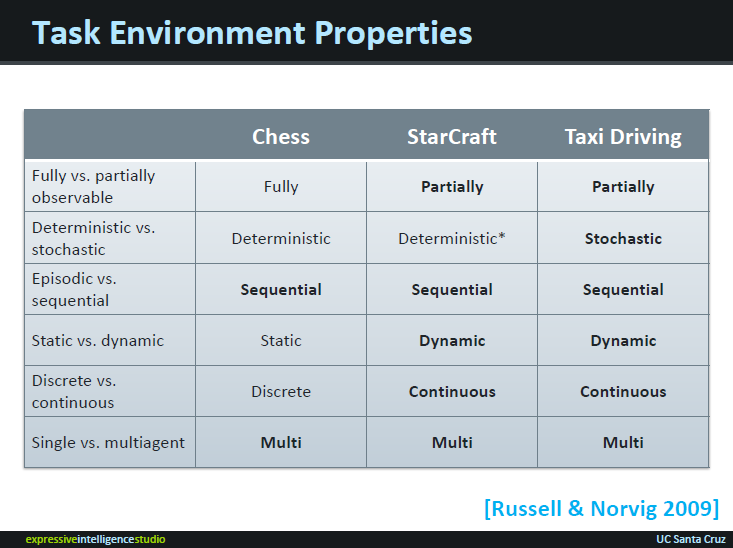
I think this table summarises the increase in complexity when comparing games to non trivial tasks http://alumni.soe.ucsc.edu/~bweber/gamasutra/Tasks.png

Re: CMU's Libratus builds substantial lead in Brains vs. AI competition

#75

Unless things have changed significantly from the previous version (Claudico), this is not really no limit hold'em, as the stack sizes are reset every hand.

How is that not no limit?

One of the distinctive traits of no limit tournament is that on any given hand a player can be knocked out the game with a big enough bet, which affects how players are likely to play (as might one player amassing a large chip lead ove another if neither player opts to go all in on early hands)

Of course it also makes games shorter and introduces a lot more variance, which isn't so good for assessing how well a computer plays.

Re: CMU's Libratus builds substantial lead in Brains vs. AI competition

#76
post #58

I believe we are witnessing the Cambrian explosion of intelligences. The techniques behind Libratus (abstraction algorithm and game theory [1]) appear to be qualitatively distinct from those behind AlphaGo (deep reinforcement learning and MCMC) and DeepBlue (search and heuristics). An ecology of Artificial Intelligences, unbounded by our evolutionary history and neural architecture, could evolve to suit each particul…

Chess, Go, Poker... All feel like variations on the same theme. While it's obvious there is innovation being done, I want to see something more challenging. Something with more dimensionality and integration of several types of input. How about a machine that can beat someone at Smash Bros, a game with varied characters, complex comboing mechanics, and a nontrivial computer vision task? Or--more difficult by a few or…

>Something with more dimensionality and integration of several types of input.

like using a few degrees of freedom and little strength to chop onions and some vegetable, crack eggs, whisking them, pour a bit of oil into a pan and lighting a stove, pour the omelette, flip it onto the plate, throw the eggshells in the trash unless it's too full (and take the trash out if it is) and wash the chopping board and pan with a sponge (adding a little dish soap) and not too much water, then rinse them thoroughly but without too much water. Which poses no challenge to most adult humans who take just a bit of time to learn (if you never learned to make an omelette and you're an average adult, by Wednesday you can make a perfect omelette every time.) Even though objectively humans have very weak hands, see things very, very slowly compared with machines, and cannot do any single mechanical action as reliably and predictably as robots.

computers might be able to find and count all the primes between one and a million before I can count the ones up to ten[1], but they can't even scrub my bathtub with a sponge given a whole afternoon to do it - not without a lot of specialized robotics anyway.

[1] https://www.quora.com/How-long-does-the-fastest-algorithm-ta...

Re: CMU's Libratus builds substantial lead in Brains vs. AI competition

#77
post #41

It's important to note that last time, the poker players beat CMU's AI by around 500k chips as well and they had the gall to declare it a "statistical tie". Yet if they win by chip they will claim to have "won".

http://motherboard.vice.com/read/a-poker-playing-supercomput... Lost by $732,713, with $170 million bet... pretty close. But you're right, a victory by a chip will be declared a win

That's both an unfair slight to the ethics of the researchers involved, as well as inaccurate. They've published in advance their criteria for declaring a victory vs a tie: http://www.cardplayer.com/poker-news/21215-poker-bot-doubles...

which is: "If after 120,000 hands either Libratus or the humans are one standard deviation above break-even, they will have won the competition with “statistical significance.”"

(I'm a professor at CMU, but I have nothing to do with this research or competition.)

Re: CMU's Libratus builds substantial lead in Brains vs. AI competition

#78
post #57

I believe we are witnessing the Cambrian explosion of intelligences. The techniques behind Libratus (abstraction algorithm and game theory [1]) appear to be qualitatively distinct from those behind AlphaGo (deep reinforcement learning and MCMC) and DeepBlue (search and heuristics). An ecology of Artificial Intelligences, unbounded by our evolutionary history and neural architecture, could evolve to suit each particul…

> Promises and perils abound. what's the peril? I can only see promise ahead, if AI's progress continue unimpeded.

Collapse of the current economic and political system as increased consumption can no longer compete with increased efficiencies.

For once. But back when we were thinking about the perils of the internet we didn't correctly anticipate homogenization of media consumption and filter bubbles. People rather thought that it would be the other way around, everyone would have access to high quality information and enjoy diverse (long tail) media content. So we're likely to be wrong about the precise perils here, too.

Re: CMU's Libratus builds substantial lead in Brains vs. AI competition

#79
post #62

Earlier quoted context omitted.

Indeed, from 2015: http://kotaku.com/overpowered-bot-puts-top-smash-bros-player...

This is not really a good example. That bot is massively cheating and if you played against him a few times you would find very simple patterns that always beat him. (I don't even think the base AI can actually see your location in the air very well, and it has no air DI itself so it really could not win for long.)

This one is a better example - https://github.com/vladfi1/phillip. It does not have such perfect reactions and can be trained on a tensorflow model that you can build in a few hours/days by playing against it. Although it plays weird, it plays a lot more like a human than the other bot. And yes, it is very very good - it can pretty easily beat top 50 players.

Re: CMU's Libratus builds substantial lead in Brains vs. AI competition

#80

I played poker part time heads up (one against one) previously and the amount of study and analyses players have to do is huge to only get to a reasonable level. This challenge is very unfair to players so I wouldn't say it won, players have a massive disadvantage, every professional player has tracking software and a database to analyse every decisions that has been made. This is of course extremely important becaus…

>o the bot adjusts it's play based on their human opponents but humans cannot do the same and are left with a guessing game

Do we know if it actually does it? I imagine it's much simpler to build a bot that plays a balanced profitable strategy rather than one that tries to build a model of their opponent and exploit it.

Post reply on HN