Live data from Hacker News

Economists versus the Economy

project-syndicate.org

61–70 of 115 posts

Re: Economists versus the Economy

#61
post #43

> Economists claim to make precise what is vague, and are convinced that economics is superior to all other disciplines, because the objectivity of money enables it to measure historical forces exactly, rather than approximately. Economist here. Maybe some economists make this very bold, presumptive claim. But I'll be honest, money very rarely enters into the paradigm; rather resource allocation and maximizing utilit…

>resource allocation and maximizing utility are the common approach. Utility maximisation has always struck me as a horrible way to do modelling. In most cases your results must depend heavily on the form of utility function you choose. And you always have to make a choice since utility functions are unobservable.

> And you always have to make a choice since utility functions are unobservable.

If the utility function isn't provided to you directly, then you should infer the functional form from the data with a reasonable prior, and use sampling techniques to show the uncertainty in your answer due to uncertainty in the utility function.

There's nothing wrong with utility functions as a model sense they are exactly dual to any 'reasonable' choice function, meaning the space they model is the same. If you find them mathematically inconvenient, then you can use choice functions directly, but raw choice functions are usually not very helpful for modeling or predicting anything at all.
Re: Economists versus the Economy

#62
post #58

>Policymakers don’t know what to do. They press the usual (and unusual) levers and nothing happens. That's not really true if they're refusing to push the Keynesian levers for ideological reasons.

That's not really true if they're refusing to push the Keynesian levers for ideological reasons. snort Everyone's a Keynesian when it's time to spend but Keynes also said to pay down your debts on the upswing of the cycle, and guess what everyone didn't do?

...But that doesn't make them wrong. That just makes society spineless when it's time to start the unglamorous work paying back.

Re: Economists versus the Economy

#63

Paul Krugman's brief rebuttal may be relevant: http://krugman.blogs.nytimes.com/2016/12/24/dont-blame-macro...

>But his prime examples of economics malfeasance are, well, terrible: >Policymakers don’t know what to do. They press the usual (and unusual) levers and nothing happens. Quantitative easing was supposed to bring inflation “back to target.” It didn’t. Fiscal contraction was supposed to restore confidence. It didn’t. >“Supposed to” according to whom? Not basic macroeconomics! >Look, we had a more or less standard model…

> Whoops

According to the data, not really. Short-term mortgage rates increased steadily for the next several years; long-term rates also ticked up, but not by as much.

He basically refinanced his home exactly at the bottom [1].

[1] http://www.bankrate.com/finance/mortgage-rates-history-0112....

Re: Economists versus the Economy

#64
post #43

> Economists claim to make precise what is vague, and are convinced that economics is superior to all other disciplines, because the objectivity of money enables it to measure historical forces exactly, rather than approximately. Economist here. Maybe some economists make this very bold, presumptive claim. But I'll be honest, money very rarely enters into the paradigm; rather resource allocation and maximizing utilit…

>resource allocation and maximizing utility are the common approach. Utility maximisation has always struck me as a horrible way to do modelling. In most cases your results must depend heavily on the form of utility function you choose. And you always have to make a choice since utility functions are unobservable.

I guess the follow up question to this is: what superior alternative do you propose we use for evaluating competing government policies?

Re: Economists versus the Economy

#65
post #64

Earlier quoted context omitted.

>resource allocation and maximizing utility are the common approach. Utility maximisation has always struck me as a horrible way to do modelling. In most cases your results must depend heavily on the form of utility function you choose. And you always have to make a choice since utility functions are unobservable.

I guess the follow up question to this is: what superior alternative do you propose we use for evaluating competing government policies?

The fact there is no alternative doesn't mean we should use something that we know barely works. This is exactly the problem with economism

Re: Economists versus the Economy

#66
post #65
post #64

Earlier quoted context omitted.

I guess the follow up question to this is: what superior alternative do you propose we use for evaluating competing government policies?

The fact there is no alternative doesn't mean we should use something that we know barely works. This is exactly the problem with economism

That all sounds very clever and all, but there's still a rather important question being left unanswered here: on what basis should a government make decisions? Coin flips? Gut feelings? The phase of the moon?

Let's say you're the King of the United States. One of your noblemen comes in to your palace and says 'Your majesty, I suggest we eliminate corporate taxation and replace the lost revenue with a tax on consumption.' What happens next?

Re: Economists versus the Economy

#67
post #8

I'm not sure if this article brings up anything new but it fans my crisis of epistemology all the same. I've always been a good "the academics know what they're talking about" believer, but lately I've started having doubts. I went to MIT and many of my good friends and peers went onto PhDs in the hard sciences (Princeton/CERN, Harvard CfA, CalTech chemistry) so I've always been impressed, almost reverential, towards…

All models are wrong, some models are useful. And what is useful is subjective.

The Newtonian model works brilliantly at human-scale resolution. But if you are a quark, it is totally unconvincing. So the quarken-creatures' understanding of physics would have developed totally differently.

Similarly, SM/GR seems basically fine at solar-system resolution. But at an intergalactic scale it's completely unworkable – "regular" matter is only 5% of the universe! You are not going to get very far through the galaxy on that.

In reality, even "hard" science is very squishy. It's closely tied to the sort of creatures doing it, and different creatures would have done it differently. "Our" physics can answer a lot of questions – unless you want to leave the galaxy or learn about 95% of the stuff in the universe in which case we have no idea. But that doesn't matter (yet) because what we've got is good enough for a bunch more planetary expeditions.

Similarly, economics has solved some problems and not solved others. The difference is, lots of the "unsolved" problems seem quite urgent. Dark energy might be useful someday, but minimum wage theory would be useful right now.

But that has nothing whatsoever to do with science, or with correctness (all models are incorrect). It has more to do with our goals as a society, and how closely our discoveries map onto problems we think are urgent. A quarken society would have completely different set of priorities than we do, and the way they think about "sturdiness" would be entirely different as a result.

Re: Economists versus the Economy

#68

Earlier quoted context omitted.

>But his prime examples of economics malfeasance are, well, terrible: >Policymakers don’t know what to do. They press the usual (and unusual) levers and nothing happens. Quantitative easing was supposed to bring inflation “back to target.” It didn’t. Fiscal contraction was supposed to restore confidence. It didn’t. >“Supposed to” according to whom? Not basic macroeconomics! >Look, we had a more or less standard model…

> Whoops According to the data, not really. Short-term mortgage rates increased steadily for the next several years; long-term rates also ticked up, but not by as much. He basically refinanced his home exactly at the bottom [1]. [1] http://www.bankrate.com/finance/mortgage-rates-history-0112....

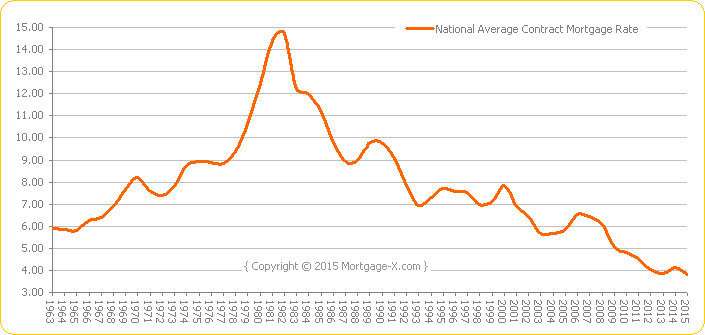
I think we need to change the scales and put it in context:

http://mortgage-x.com/images/graph/fhfb_contract_rate.gif

According to the data, yes really.

Re: Economists versus the Economy

#69

Earlier quoted context omitted.

> Whoops According to the data, not really. Short-term mortgage rates increased steadily for the next several years; long-term rates also ticked up, but not by as much. He basically refinanced his home exactly at the bottom [1]. [1] http://www.bankrate.com/finance/mortgage-rates-history-0112....

I think we need to change the scales and put it in context: http://mortgage-x.com/images/graph/fhfb_contract_rate.gif According to the data, yes really.

Your graph shows the same as the one from smallnamespace: 2003 was a good year to refinance because rates were at a bottom.

Re: Economists versus the Economy

#70
post #69

Earlier quoted context omitted.

I think we need to change the scales and put it in context: http://mortgage-x.com/images/graph/fhfb_contract_rate.gif According to the data, yes really.

Your graph shows the same as the one from smallnamespace: 2003 was a good year to refinance because rates were at a bottom.

Krugman's bet - in his own words and using ISLM - was that interest rates would skyrocket because of deficit spending on the Iraq war in 2003. He paid extra to make this bet.

Where on that graph did rates skyrocket exactly?

Post reply on HN