Sure. For instance, I had a buddy that was sure Bernie would win the NY democratic primary since Bernie had such huge rallies and people were excited. I trusted the polls. We both made small bets on PredictIt - I even bet Clinton would win by at least a 15 point margin, since that's where the polls were. I won, and he now trusts poll aggregates more.
I find the treatment of psychology on HN to be perplexing. On one hand, there have been attacks on psychology as a field [1] due to legitimate concerns related to replication. On the other hand, blog posts such as this come up every few days that take the same results for granted and frame them in everyday terms. I wonder, are there different groups of HN readers with different attitudes towards psychology? Or does t…
On replication, this same criticism has recently been directed at physics, chemistry and biology, among others. [1] Psychology, with view to its practical (non-research) use has not helped me, but at least three people I know say they benefitted from cognitive behavioural therapy. Perhaps in the future, medicine and science will subordinate it to the same role of philosophy to better explain human behaviour and think…
Historically you have the roles reversed in that medicine and science are both subordinates of philosophy. But admittedly due to the predominance of analytic philosophy, particularly in modern western philosophy, it has become much more of what you describe. This is really more a failing of modern philosophy than a condemnation of the field as a whole. There were/are/will-be many philosophers that don't ascribe to its limitations.
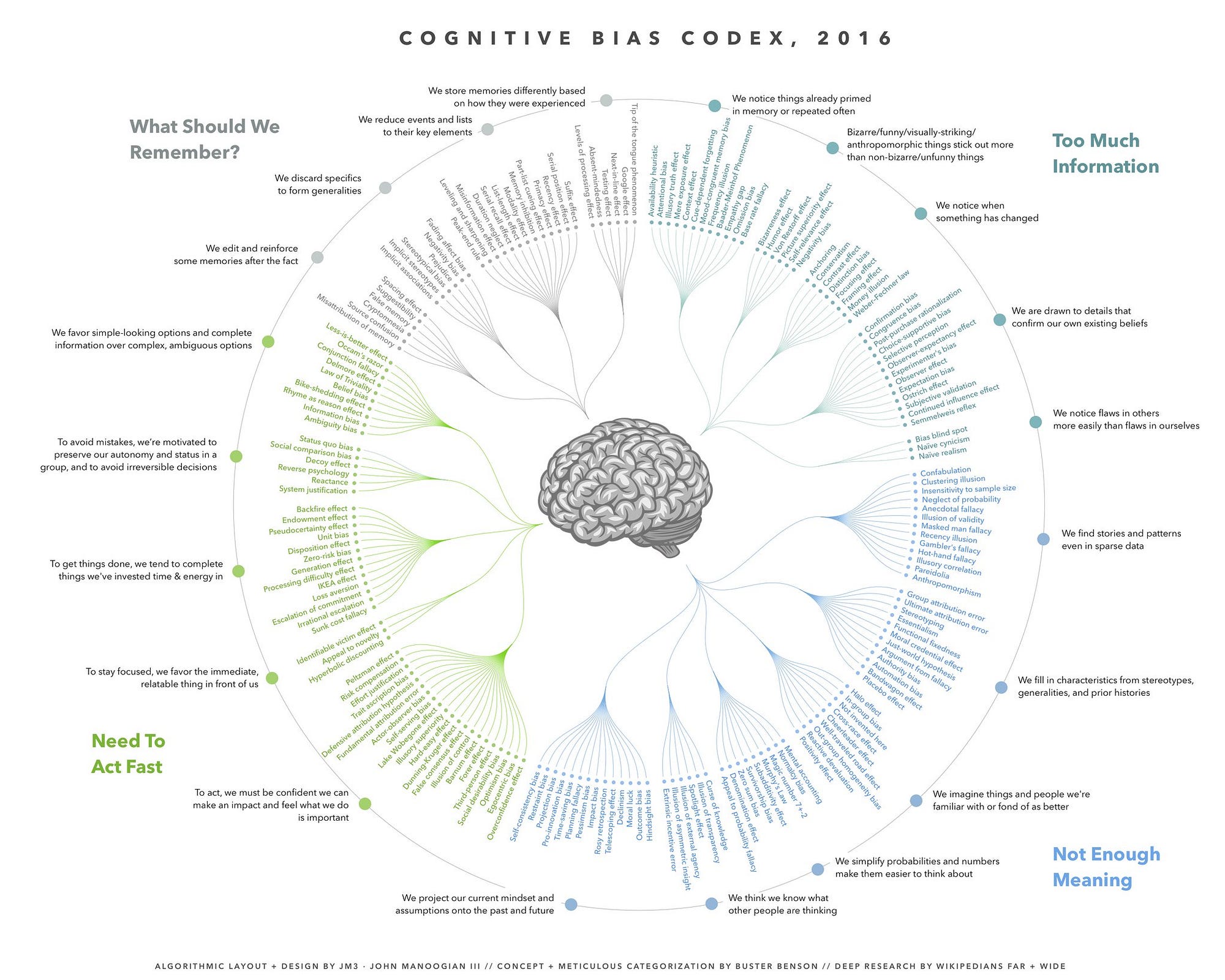
This is excellent. It could be improved by adding a very short summary of each bias. This would help the reader to drill-down to a specific bias of interest.
If a one-sentence tooltip for each bias were added to the codex graphic fielded on a webpage, and each bias was linked to its own page, that would make the graphic more sensible and accessible. And if each quartile of the codex had a color coded mouse target, you could popup a menu of just that cluster of biases sorted into whatever spectrum makes the most sense.
Rendering the graph as an SVG with embedded links might work.
I'm fascinated by the graph Manoogian created. Does anyone know what specific tools were used to create it, or which could be used to create similar ontologies?
In politics, I find gambling is the best way to resolve disputes among friends stemming from cognitive bias. Put a bit of money on various results and someone will be right and someone will be wrong.
Prediction markets work ... up to the point that skewing the message of the prediction market itself is an incentive and a party has sufficient resources to do that.
Information is used both to understand and to influence. It's a three-edged sword.
I find the treatment of psychology on HN to be perplexing. On one hand, there have been attacks on psychology as a field [1] due to legitimate concerns related to replication. On the other hand, blog posts such as this come up every few days that take the same results for granted and frame them in everyday terms. I wonder, are there different groups of HN readers with different attitudes towards psychology? Or does t…
I actually get the impression that most of the articles that are "liked" by HN are somewhat grass roots. Take this one. It is a "hacker" that is spending time to try to improve biases held. It is somewhat ironic, to me, that I am basically accusing us of having an anti-intellectual bend. However, it is not unique to psychology. There is a similar slant against "academic" computer science.
There is a difference between anti-intellectual and anti-academic.
I would agree. For me, the most important thing to know is that there are biases that could be impacting me and to always leave room for a) a competing viewpoint can be sincerely held and possibly correct over the viewpoint I am convinced of, and b) to always ask myself if there is a self interested reason I want the belief I hold to be true. Many biases cannot be overcome even with knowing about them... but acceptin…
but accepting that it's possible I'm wrong and that the crazy guy on the other side is both sincere in his competing belief and possibly correct, allows me to evolve and learn and ultimately get along with more people. As often as not you're both right but simply have different or conflicting priorities
Very True. I would add that conflicting priorities and/or conflicting preconceptions. In other words, conflicting priorities reflects bias in general, but cognitive bias could be independent of self interest priorities and simply be about a different preconceived perception, frame or foundation.
As someone who is probably guilty of ignoring most psychology articles due to doubts about psychology research, I think this article is an interesting step forward for popular psychology. This categorization of biases is something I can use both for myself and when I try to help others. This article is unlikely to lead to debates about research methods and statistics because it's very high level and presents few opin…
> This article is unlikely to lead to debates about research methods and statistics because it's very high level and presents few opinions. Huh? The article is entirely opinion. Every single thing that's in bold text is a testable hypothesis presented as pure fact. Even the selection of "problems" is pure and problematic conjecture (are these actually the most important problems? Are these actually problems at all? W…
I can see your viewpoint. I see the article as a suggested categorization of a complex subject, where that suggested categorization is an opinion of what's useful. You're right, that's an opinion. I've read many textbooks that were also opinion in the same sense.