Earlier quoted context omitted.
The Waipio Valley road, as I understand it, is mostly paved but extremely steep and narrow/twisty. So the 4x4 requirement is probably more about being able to control speed without burning up brakes and dealing with often wet conditions. However, in the general case throughout most of the US West, "4WD roads" do indeed tend to be as much about having high clearance as about having 4WD per se. It's also just a way of…
And in particular, the Hawaiian rental car counters will tell you when you rent which roads your car is not allowed to go on.
4WD vs. AWD. What's the Difference?
131–140 of 209 posts
Re: 4WD vs. AWD. What's the Difference?
#132Re: 4WD vs. AWD. What's the Difference?
#133In real life, in most situations, ground clearance, good tires, traction control and ABS make more difference than driving all four wheels, most of the time. Personally, I'm more concerned with stopping than starting, and that's where ABS and good tires matter and what kind of transmission you have doesn't. This is a sales pitch video, but it is interesting to illustrate the differences in AWD approaches, with differ…
Something I've learned is that snow tires make a big difference during the winter, and I've read that they make a bigger difference than AWD.
Re: 4WD vs. AWD. What's the Difference?
#134Re: 4WD vs. AWD. What's the Difference?
#135In real life, in most situations, ground clearance, good tires, traction control and ABS make more difference than driving all four wheels, most of the time. Personally, I'm more concerned with stopping than starting, and that's where ABS and good tires matter and what kind of transmission you have doesn't. This is a sales pitch video, but it is interesting to illustrate the differences in AWD approaches, with differ…
Something I've learned is that snow tires make a big difference during the winter, and I've read that they make a bigger difference than AWD.
And, even more important, you have to keep a level head when you see that there's snow on the road and not try to do anything crazy, like making sudden left or right wheel movements. Also try to keep a safe distance from the vehicle in front of you, and, before you venture on a trip outside of the city, just check the weather forecasts: if there's a "red code" storm announced you'd better postpone your journey, only a tank can get you out from something like this: https://www.youtube.com/watch?v=Frf2lV77fl0
Re: 4WD vs. AWD. What's the Difference?
#136There are lots of variations on this theme. There are off-road differentials which limit the speed difference between the output shafts to a fixed maximum ratio, usually in the 2:1 to 4:1 range. It's possible to do some or all of this in software. Tesla has an ordinary open differential but will apply the brake on an overspeeding wheel. Tesla's all wheel drive system has a separate motor for the front and rear wheels…
"It's possible to do some or all of this in software. Tesla has an ordinary open differential but will apply the brake on an overspeeding wheel. Tesla's all wheel drive system has a separate motor for the front and rear wheels. Power distribution between the two during acceleration is mostly equal, but once speed stabilizes, the rear powertrain takes most of the load. Off-road slip handling doesn't seem to be well do…
If you're driving in a straight line, with good traction on all wheels, will a single larger motor be more efficient than two smaller ones on each wheel? For many people, I think that's 99% of their driving, so it makes sense to optimize. Especially on electric vehicles, where increasing battery capacity is much harder than just adding an extra gas can.
Maybe in that case the complexity of AWD/4WD/Traction control makes sense in that case.
Re: 4WD vs. AWD. What's the Difference?
#137Earlier quoted context omitted.
Generally a sign saying you need 4wd in the US really means you need a lot of ground clearance. Your car probably would have high-centered, that is stuck resting on the middle of the car with the tires in the air. The annoyed ranger was probably just tired of pulling stuck tourists out.
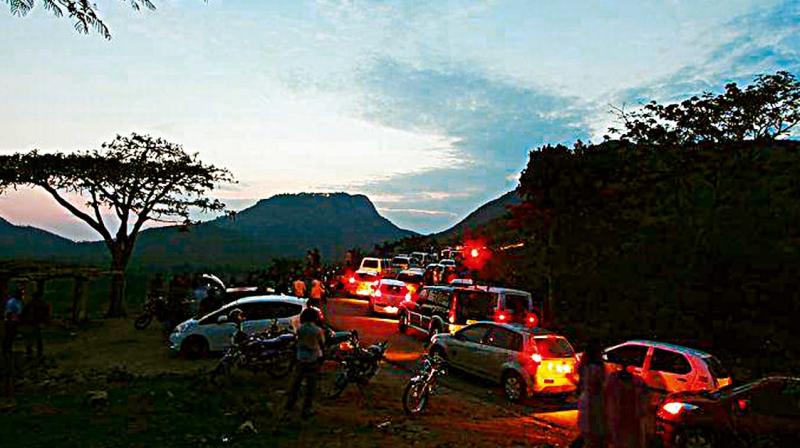
Normally I would 2nd this, but it does not apply on this particular 4x4 road. It really sucks when opposing traffic appears as it's barely wide enough for 1 vehicle in most parts: The road gains 800 vertical feet (243.84 m) in 0.6 miles (0.9 km) at a 25% average grade, with steeper grades in sections. This is a paved public road but it is open only to 4 wheel drive vehicles. It is the steepest road of its length in t…
The video posted in another comment doesn't look that bad.
I am not sure about the grade, but one of the Bangalore's weekend gateway has some steep sections(a low average grade but some sections are steep).
https://www.youtube.com/watch?v=C0_MyaPzM88
That footage is from a rally but every weekend, fwd cars with 800/1000cc engines and a peak torque of about 70 Nm do it just fine. Most of the cars have 2-5 occupants decreasing the already low torque/kg, and almost the whole climb is done in a bumper to bumper traffic(no momentum for the climb).
https://dc-cdn.s3-ap-southeast-1.amazonaws.com/dc-Cover-nj6b...
Re: 4WD vs. AWD. What's the Difference?
#138Earlier quoted context omitted.
And in the next paragraph "To counteract this [sending of power to the wheel of least resistance] , the better AWD cars are fitted with a center differential that contains a clutch or viscous drive unit. This splits torque front-to-rear, directing it away from the spinning wheel. " So, a well engineered AWD system actually sends power away from the slipping wheel(s) and towards the wheels with traction, which makes m…
Well, not quite; the viscous drive unit really just ensures that every path has some resistance floor, and thus that not all torque goes to one wheel. At one point I remember there was a workaround mentioned by the Hummer engineers (I believe) to apply the brake simultaneously with the gas if you ran into the "one wheel spinning in the air" problem. This is a simply a manual application of the same physical solution…
Hummers have torsen diffs, which have a pair of worm gears where a conventional open diff would have single star gear. As a result, the torsen diff sends some fixed multiple (changes with model) of the torque used by the easier to spin side, to the harder to spin side.
Of course if one wheel is spinning in air, the easy side uses effectively 0 torque, and 0 times anything is still 0, hence the brakes.
Applying the brakes increases the torque requirement of all wheels by a fixed amount, but the hard to spin wheels get More than that amount of extra torque.
Re: 4WD vs. AWD. What's the Difference?
#139Here are the key takeaways for me: "Thanks to that differential between your axles, an AWD car will send your engine’s power down the path of least resistance—the wheel with the least grip. Where a two-wheel drive car can only choose between two wheels, an AWD system looks for that least resistance across all four wheels." "4WD works by locking the front and rear axles together, splitting torque 50:50 between them. T…
This isn't always true either. 4WD can mean that you send equal amounts of power to each axle, but at that point there are things that can change the amount of power going to each wheel within the center differential casing. If you have a limited slip differential (why some 4WD vehicles can drive perfectly fine on pavement) it'll basically send a 50/50 split (lock the axles together when going straight) but allow the…
Re: 4WD vs. AWD. What's the Difference?
#140Earlier quoted context omitted.
This isn't always true either. 4WD can mean that you send equal amounts of power to each axle, but at that point there are things that can change the amount of power going to each wheel within the center differential casing. If you have a limited slip differential (why some 4WD vehicles can drive perfectly fine on pavement) it'll basically send a 50/50 split (lock the axles together when going straight) but allow the…
Very hard to read because you bunched everything into one huge paragraph but if I read it right then you are absolutely correct.